Why You May Need a 2024 1040 Form in 2026
If you didn’t file your individual income tax return for 2024, you can still use a 2024 1040 form to file in 2026. It’ll come with penalties, but it’s better to file late than not at all. You can stop interest from accumulating, avoid additional penalties, and protect your access to future benefits like loans and credit applications that may ask for proof of tax compliance.
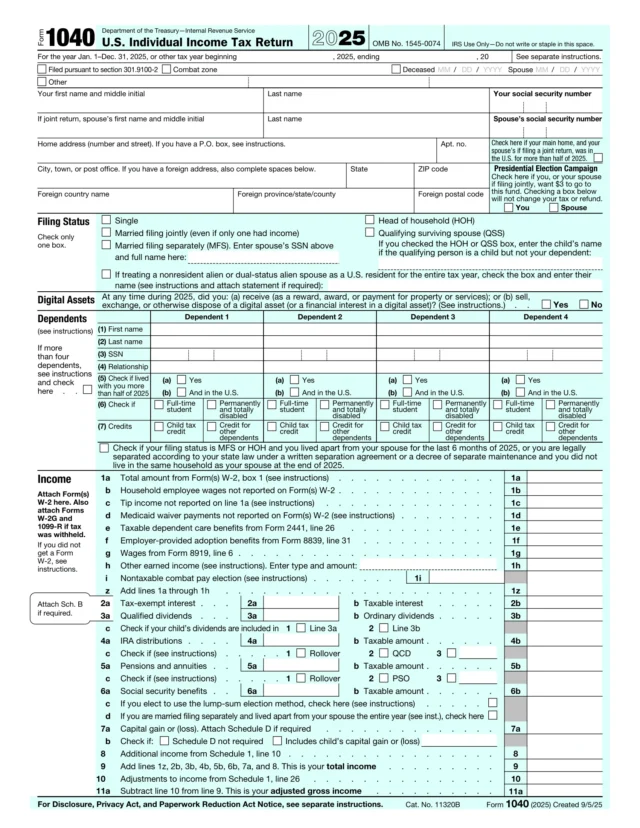
The IRS requires you to use the tax form that was created for the year you’re filing for. If you need to file for the 2025 tax year, you must use the 2025 1040 form.
Consider some possible reasons you may need to use a 2024 1040 form in 2026:
1. You Didn’t File Your 2024 Tax Return When It Was Due
The deadline for submitting a 2024 tax return was Tuesday, April 15, 2025. If you successfully obtained a six-month extension by completing Form 4868, your return was due on Wednesday, October 15, 2025.
Filing a late return may result in penalties and interest on an unpaid tax liability. However, you can use Form 1040 for 2024 to manage your responsibilities.
2. You Need to File for a Deceased Taxpayer with a Delayed Return
You may need to prepare a final tax return for someone who passed away in 2024. You can file their return if you’re a surviving spouse or appointed representative. You’ll use the 2024 form to close their 2024 taxes, settle any tax debts, or request a refund if one is due.
3. You Need to Catch Up on 2024 Back Taxes
If you owe taxes for 2024, file your return as soon as possible. If you earned income from a job, self-employment, investments, or other sources in 2024, you likely need to file and pay what you owe using the 2024 Form 1040.
Filing late doesn’t erase the taxes owed, but it’s an important first step to get back on track. Even if you can’t pay everything now, it’s better to file to avoid more penalties. You might qualify for a payment plan to pay off what you owe.
4. You Need to Claim a 2024 Refund
There’s a silver lining to filing a late return—you may find out that the IRS owes you money. The only way to know is by preparing your 2024 return. You can claim a refund for the 2024 tax year by the later of three years from the date you filed your tax return or two years from the date you paid the tax.
How to Fill Out Your 2024 1040 Form in 2026
Completing a late tax return isn’t too different from the normal process. You’ll provide the same details you would for any other year: earnings, deductions, and personal information.
Follow these steps to fill out your 2024 1040 form and then submit it to the IRS.
Step 1 – Obtain Your Tax Transcript and Other Documents
Filing late can make it tricky to know what income to report. A tax transcript from the IRS, which you can request using Form 4506-T, lists income sources, like wages and dividends, tied to your taxpayer identification number (TIN). It’s a good starting point, especially if you lost information returns or never received them.
A tax transcript does not replace your individual income tax return. You must still file Form 1040 for 2024 if you have not already done so.
Step 2 – Collect Personal Information
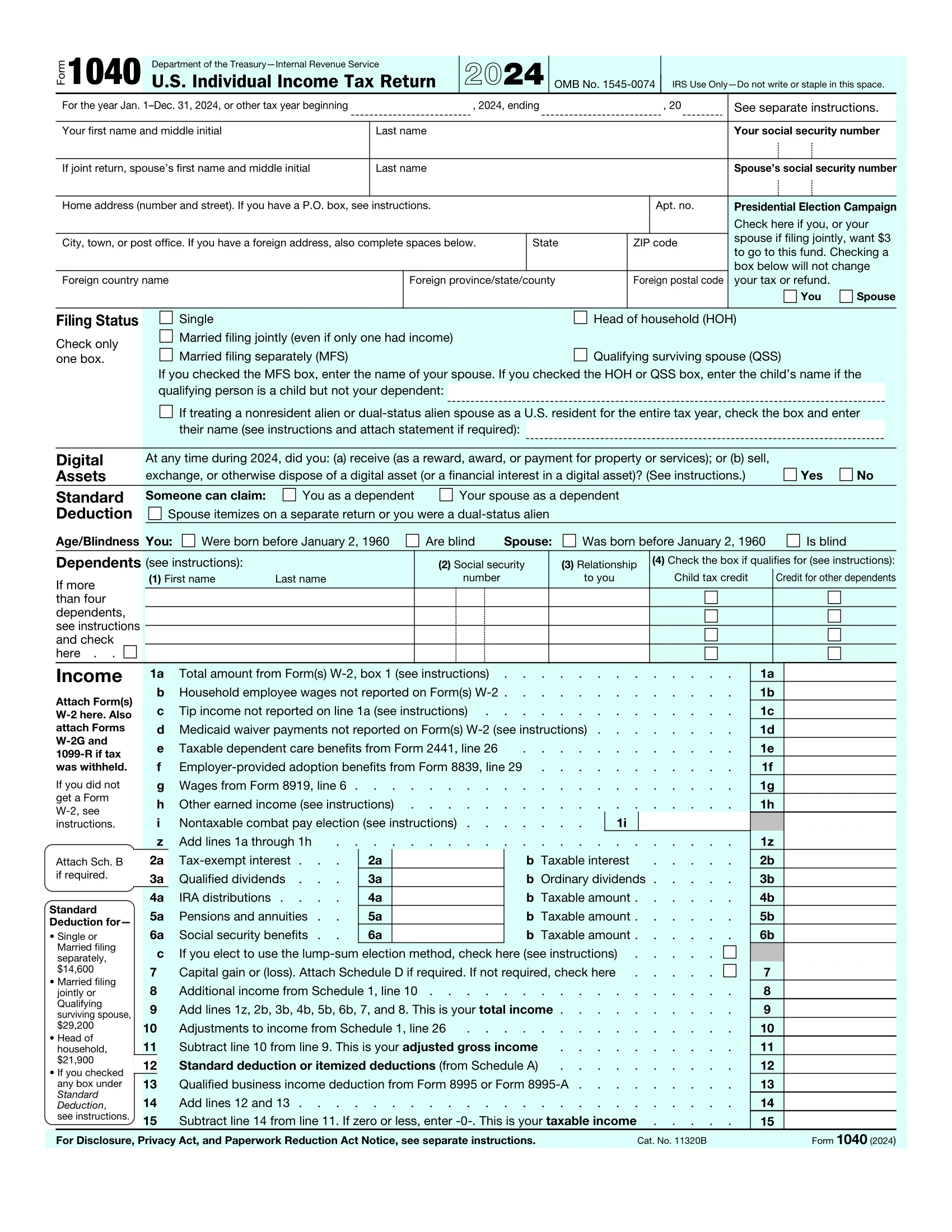
The 2024 1040 form includes an area for your name, address, TIN, and filing status. You’ll also share the details of any dependents you’re claiming and their Social Security numbers. Have this information readily available so you can include it on your form.
Step 3 – Gather Income Documents
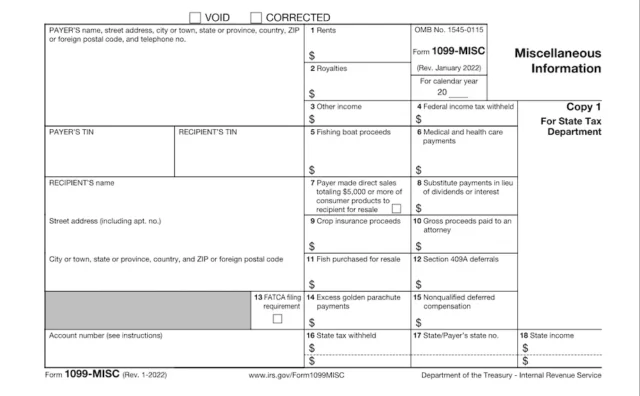
If you earned any income from a job or other source in 2024, you must gather any income reporting documents you received to include their numbers on your 2024 1040 form. You may not receive an information return if your earnings don’t meet the form’s thresholds. For example, making less than $600 from one source won’t prompt a business to send you a 2024 1099-MISC form or a 1099-NEC form. But you still need to report the income for tax purposes.
If you think you might have income from an unreported source, check your 2024 monthly bank statements to confirm.
Step 4 – Fill Out Your 2024 1040 Form
If you’re wondering how to fill out your 2024 1040 form, the instructions are similar to previous years. Complete each line with your information.
Be aware of the 2024 tax law changes that will affect how you complete your individual income tax return. The IRS provides a complete summary of the 2024 tax law changes, but you can study an overview below:
- Additional child tax credit: $1,700 per qualifying child.
- Standard deduction amounts: $14,600 (Single or Married filing separately); $29,200 (Married filing jointly or Qualifying surviving spouse); and $21,900 (Head of household).
- Digital assets received as ordinary income: Ordinary income from digital assets that is not otherwise reported must be entered on Schedule 1 (Form 1040), line 8v.
- Seven tax brackets: For the 2024 tax year, the IRS maintained the seven tax rates but adjusted the income brackets for inflation.
- IRA contribution limit: $7,000 ($8,000 for individuals age 50 or older).
You must use the requirements for the 2024 tax year when completing your 2024 1040 form. By doing so, you can ensure correct tax calculations and avoid processing delays from the IRS.
Step 5 – File Your Return With the IRS
If you usually prepare your taxes using an online platform, you might be able to e-file. However, some platforms don’t allow late e-filing after October of the year the taxes are due, so you may need to file a paper return by mailing it in.
You can refer to the 2024 Form 1040 instructions to see where to mail your 2024 tax return. Here’s a summary of where to mail your Form 1040 depending on where you live and whether you’re enclosing payment.
| If You Live In | Use This Address If You're Requesting a Refund or Otherwise Not Including Payment | Use This Address If You're Including Payment |
|---|---|---|
| Alabama, Georgia, North Carolina, South Carolina, Tennessee | Department of the Treasury Internal Revenue Service Austin, TX 73301-0002 | Internal Revenue Service P.O. Box 1214 Charlotte, NC 28201-1214 |
| Alaska, California, Colorado, Hawaii, Idaho, Kansas, Michigan, Montana, Nebraska, Nevada, North Dakota, Ohio, Oregon, South Dakota, Utah, Washington, Wyoming | Department of the Treasury Internal Revenue Service Ogden, UT 84201-0002 | Internal Revenue Service P.O. Box 802501 Cincinnati, OH 45280-2501 |
| Arizona, New Mexico | Department of the Treasury Internal Revenue Service Austin, TX 73301-0002 | Internal Revenue Service P.O. Box 802501 Cincinnati, OH 45280-2501 |
| Arkansas, Oklahoma | Department of the Treasury Internal Revenue Service Austin, TX 73301-0002 | Internal Revenue Service P.O. Box 931000 Louisville, KY 40293-1000 |
| Connecticut, Delaware, District of Columbia, Illinois, Indiana, Iowa, Kentucky, Maine, Maryland, Massachusetts, Minnesota, Missouri, New Hampshire, New Jersey, New York, Rhode Island, Vermont, Virginia, West Virginia, Wisconsin | Department of the Treasury Internal Revenue Service Kansas City, MO 64999-0002 | Internal Revenue Service P.O. Box 931000 Louisville, KY 40293-1000 |
| Florida, Louisiana, Mississippi, Texas | Department of the Treasury Internal Revenue Service Austin, TX 73301-0002 | Internal Revenue Service P.O. Box 1214 Charlotte, NC 28201-1214 |
| Pennsylvania | Department of the Treasury Internal Revenue Service Kansas City, MO 64999-0002 | Internal Revenue Service P.O. Box 802501 Cincinnati, OH 45280-2501 |
| A foreign country, US territory*, or use an APO or FPO address, or file Form 2555 or 4563, or are a dual-status alien *If you live in American Samoa, Puerto Rico, Guam, the US Virgin Islands, or the Northern Mariana Islands, see Pub. 570. | Department of the Treasury Internal Revenue Service Austin, TX 73301-0215 | Internal Revenue Service P.O. Box 1303 Charlotte, NC 28201-1303 |
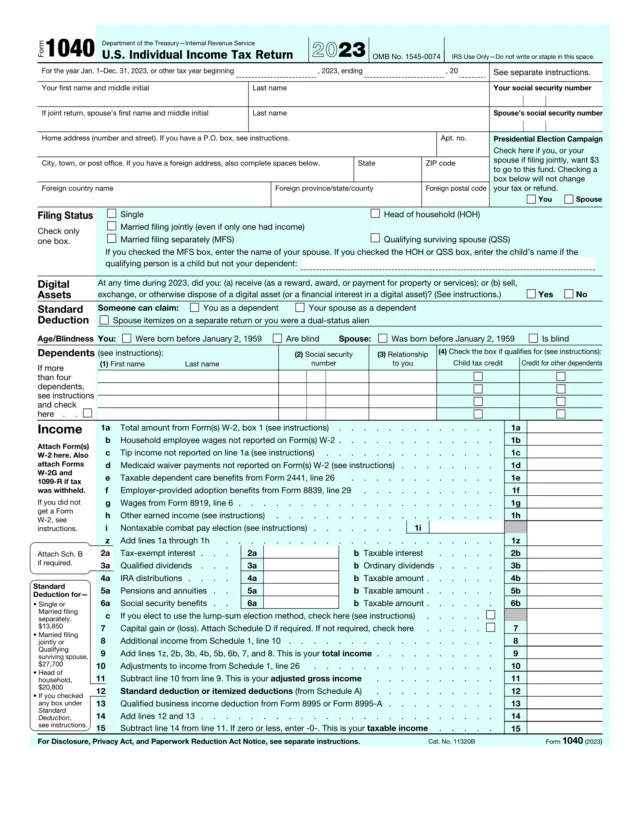
Fillable 1040 Form for 2024
Below, you can view an example of the 2024 1040 form. Then, fill it out using Legal Templates’s PDF editor and download it in PDF format.
Penalties for Filing Your 2024 Form 1040 Late
Filing your tax return, even after the deadline, is an important step to get back on track with the IRS and limit additional costs. The IRS may assess penalties, but understanding them helps you make informed decisions:
- Failure to file penalty: For a 2024 Form 1040 filed more than 60 days late, the penalty starts at $510 or 100% of the unpaid tax, whichever is less. Filing as soon as possible reduces this penalty.
- Failure to pay penalty: If you owe taxes, the IRS charges 0.5% of the unpaid balance per month, up to 25%. Even paying a partial amount shows good faith and can lower penalties.
Interest also accrues on unpaid taxes, but filing promptly and paying as much as you can minimizes additional charges and proves your effort to comply.
How to Reduce Penalties for Filing Late
Fines can add up, but you can always request penalty relief. If you have a solid payment history with the IRS and a good reason for delaying your return, ask for a reprieve. They may be willing to look past your late filing, which can save you money.
Explore some specific ways to reduce penalties for late filing:
- Payment plan: Request an installment agreement with the IRS via Form 9465.
- Penalty abatement for reasonable cause: You may be able to lower or eliminate penalties and interest if you have a valid reason for filing or paying late, such as a health condition or natural disaster.
- First-time penalty abatement: You may qualify for a one-time penalty waiver if you have no history of late filing or payments.
- Offer in compromise: The IRS may let you settle your tax debt for less than what you owe if you prove that paying the full amount would hurt you financially.