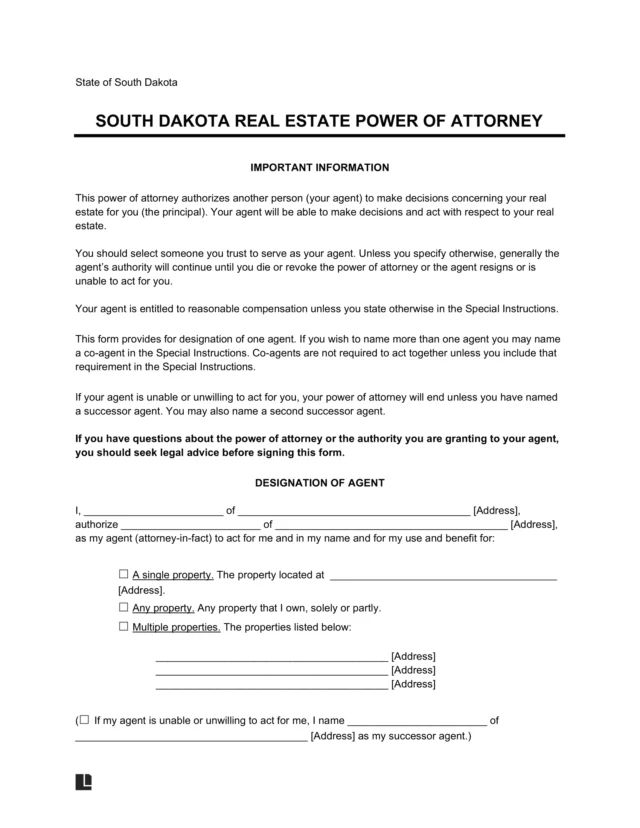
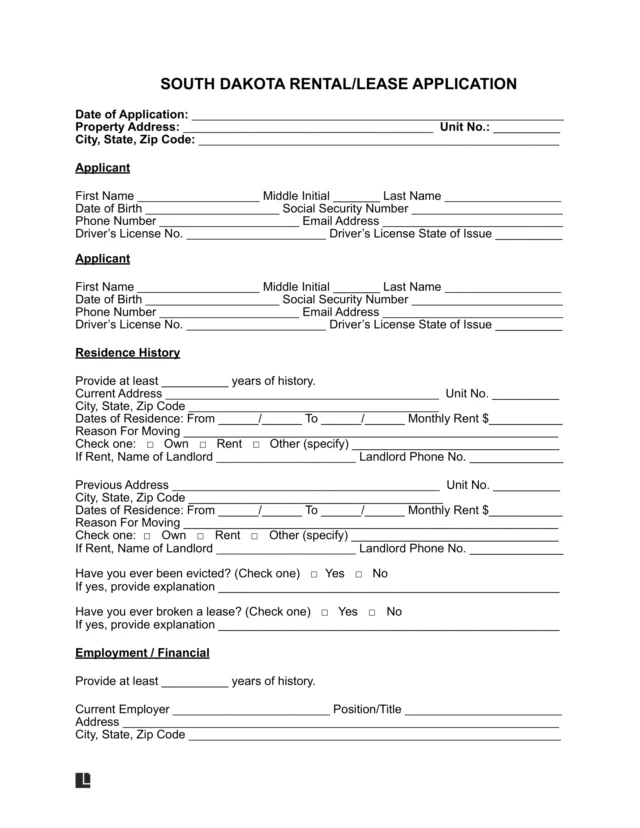
What Is a South Dakota Lease Agreement?
A South Dakota lease agreement is a legal document that a landlord and tenant sign to establish the terms of renting property. Within this contract, the parties provide their identifying information and the address of the rented property. They also record terms and conditions, such as rent payment details, pet and smoking rules, and disclosures about the property.
When a landlord and tenant write and enter a South Dakota rental agreement, they can protect their rights and clarify expectations with the other party. If disputes arise, they’ll have the contract to reference to settle them.
South Dakota Landlord-Tenant Laws Overview
State law in South Dakota governs several aspects of leases. If a provision doesn’t abide by state law, it won’t be enforceable. Below, you will find a table summarizing the key laws pertaining to South Dakota lease agreements.
| Topic | Rule | Law |
|---|---|---|
| Security Deposit Maximum | One month's rent | SD Codified Laws § 43-32-6.1 |
| Security Deposit Storage | Not required | n/a |
| Security Deposit Interest | Not required | n/a |
| Security Deposit Return | Two weeks after the tenant moving out | SD Codified Laws § 43-32-24 |
| Rent Control | None | SD Codified Laws § 6-1-13 |
| Late Fee Maximum | None | n/a |
| Grace Period | None | n/a |
| Landlord Entry | None, but 24 hours' notice is recommended | SD Codified Laws § 43-32-32 |
| Lease Termination | One month's notice (two months' notice for tenants who are in active military service) | SD Codified Laws § 43-8-8 |
Types of South Dakota Lease Agreements
Depending on your property type and the length of time you want to lease for, you’ll need a certain type of South Dakota lease agreement. Explore our templates below to find the one that’s right for your situation.
South Dakota Standard Lease Agreement
Establishes a guided tenancy between both landlord and tenant.
South Dakota Month-to-Month Rental Agreement
Lets tenants occupy a landlord's property on a monthly basis.
South Dakota Commercial Lease Agreement
Creates a contract for renting spaces for commercial use.
South Dakota Room Rental Agreement
Details individual responsibilities, shared expenses, and living arrangement between tenants of a shared space.
South Dakota Sublease Agreement
Allows the subtenant to rent all or a portion of the leased property for a predetermined period.
South Dakota Rent-to-Own Lease Agreement
Enables occupants to rent with an eventual ownership plan.
Security Deposit Regulations in South Dakota
A landlord may collect up to one month’s rent from a tenant as a security deposit (SD Codified Laws § 43-32-6.1). However, a landlord can ask for a larger amount if both parties agree to it and there are special conditions that make the property harder to maintain.
State law does not require South Dakota landlords to store the security deposit in a separate bank account, so they can commingle it with other funds. They also do not have to pay interest on deposits to tenants or provide them with receipts.
When it comes time to return the security deposit, South Dakota law has some requirements. Once the lease ends, the landlord has two weeks to return the deposit to the tenant (SD Codified Laws § 43-32-24). If the tenant requests an itemized statement of any deposit withheld, the landlord must provide it within 45 days after the lease ends.
South Dakota Rent Payment Rules
In South Dakota, rent is due at the end of each month unless the lease lists another requirement (SD Codified Laws § 43-32-12).
No statewide laws exist limiting the amount a landlord can set for rent, and cities and counties cannot impose their own caps (SD Codified Laws § 6-1-13). A landlord can make a written amendment to a lease and increase the month-to-month rent, provided they give the tenant 30 days’ notice (SD Codified Laws § 43-32-13).
Landlords can charge however much they’d like as a penalty for tenants paying rent late, but the amount must be included in the lease. Furthermore, there is no grace period for late rent payments. As soon as rent is late, the landlord can issue a 3-day notice to quit for non-payment of rent.
If the tenant notifies a landlord of a repair and waits a reasonable period after the landlord fails to address the issue, the tenant can repair the problem and discount the repair from the rent (SD Codified Laws § 43-32-9). If the repairs cost more than one month’s rent, the tenant can withhold the rent payment and deposit the amount into a separate bank account.
Landlord Entry Regulations in South Dakota
A landlord must provide reasonable notice, which is presumably 24 hours, to a tenant before entering the rental property. No notice is necessary if it’s impractical to do so or if there’s an emergency (SD Codified Laws § 43-32-32).
Tenants can change the locks on a rental unit without the landlord’s permission unless the South Dakota residential lease agreement says otherwise. Landlords may not change the locks as part of a self-help eviction (SD Codified Laws § 43-32-6).
South Dakota Landlord and Tenant Property Repair Responsibilities
The landlord must keep the property fit for human habitation unless the tenant engages in malicious behavior that results in disrepair (SD Codified Laws § 43-32-8).
The tenant shall preserve the premises and other leased property in good condition. They must repair all damage caused by their malicious conduct (SD Codified Laws § 43-32-10).
South Dakota doesn’t define the period during which a landlord can consider the property abandoned. However, if the tenant uses the property in a manner contrary to the lease’s terms, the landlord can issue an immediate notice to quit for non-compliance (SD Codified Laws § 43-32-18).
Required Lease Disclosures in South Dakota
Landlords should be aware of two disclosures they must make in a South Dakota residential lease agreement, one required by federal law and one required by state law:
- Lead-Based Paint Disclosure. If the property they’re leasing was built before 1978, a landlord must inform a tenant that it may contain lead-based paint (42 US Code § 4852d).
- Methamphetamine Production Disclosure. If the property they’re leasing was once used for methamphetamine production, the landlord must disclose this fact (SD Codified Laws § 43-32-30).
Terminating a Lease in South Dakota
A landlord can end a month-to-month tenancy by serving a one-month notice (SD Codified Laws § 43-8-8). If the tenant is on active military service, the landlord must provide a two-month notice.
If the tenant leaves any property worth less than $500 on the property, the landlord can consider it abandoned after ten days and dispose of it (SD Codified Laws § 43-32-25). If the tenant leaves any property worth more than $500 on the premises, the landlord should store it for 30 days. They can dispose of it after the 30-day period (SD Codified Laws § 43-32-26).
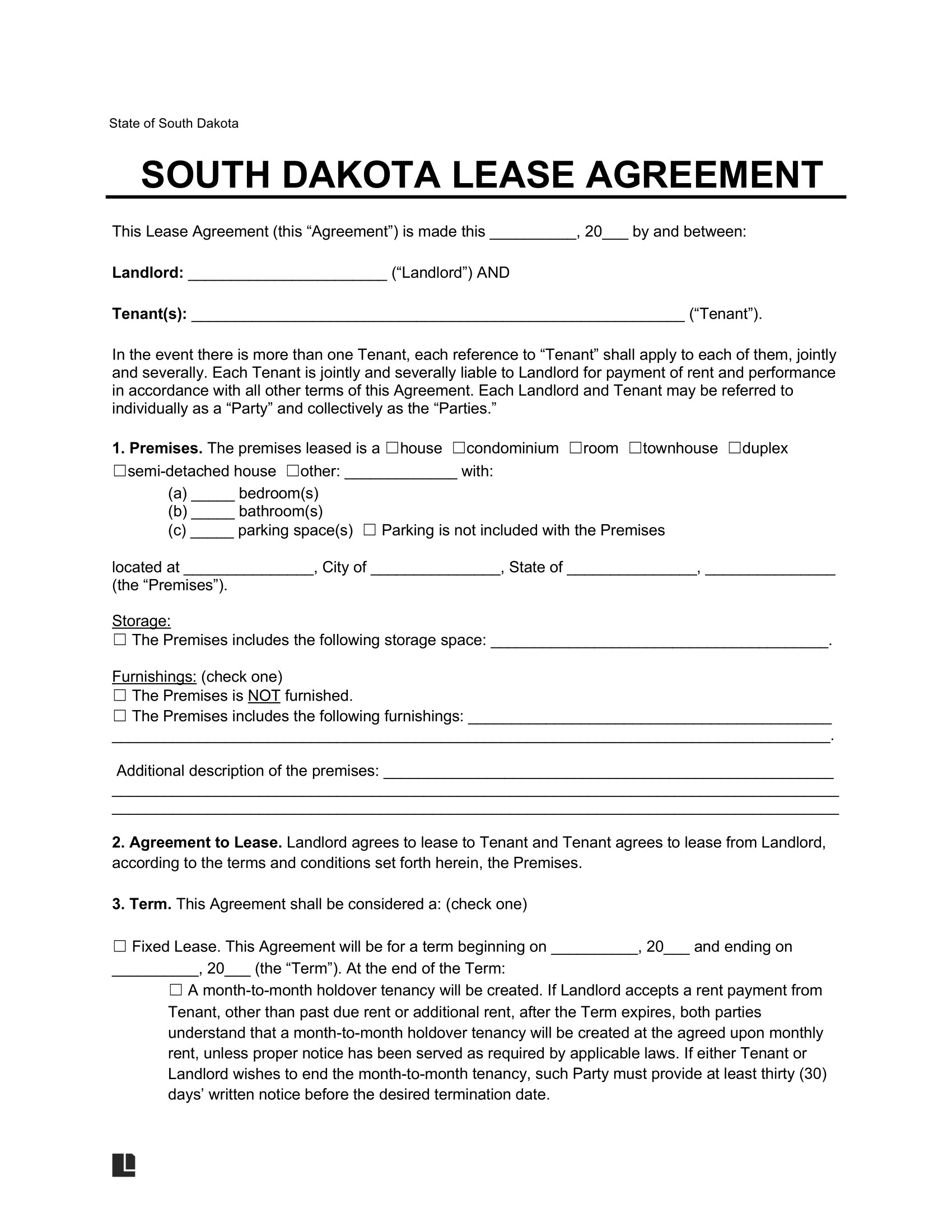
South Dakota Lease Agreement Sample
Here’s a free sample of our South Dakota residential lease agreement template to understand its requirements. Write your own using our guided form, then download it as a PDF or Word document and store it in your records.