







What Is a Codicil to a Will?
A codicil to a will is an official amendment to a last will and testament, which outlines how your personal property will be managed upon your death. A codicil allows minor updates to an existing will without the expense and time of writing a new one.
In many cases, you don’t need to hire an estate attorney. Write a legally binding codicil yourself using Legal Templates’ codicil form template.
Codicil vs. New Will: When to Use Each
If you need to make minor changes to your will, writing a codicil is best. You can use a codicil to name a new estate executor or add or remove beneficiaries. A codicil also lets you correct trivial errors in your existing will or name new legal guardians for minor children.
Sometimes, writing a new will is more appropriate than amending the existing one. A significant life event, such as remarriage, divorce, the birth or adoption of a child, or a major redistribution of assets, may call for the creation of a new will. If a codicil can’t adequately address the scope of your changes, consider writing a new will.
| Reason for Change | Codicil or New Will? | Explanation |
|---|---|---|
| Updating beneficiary details | Codicil | A codicil can address changes to names or percentages. |
| Changing the executor | Codicil | This is a common codicil use case. |
| Fixing errors or clarifying terms | Codicil | A codicil is suitable for small corrections. |
| Changing legal guardians for current minor children | Codicil | A codicil is acceptable if no other major changes are needed. |
| Adjusting asset distribution | Depends | A codicil can account for minor changes, but a will can handle a major restructuring. |
| Adding newly acquired assets | Depends | A codicil can address small additions, but a new will is appropriate if the assets will significantly change your estate. |
| Naming a guardian for a new minor child | New Will | This often indicates a major life change; a new will is safer. |
| Removing outdated legal language | New Will | This is best handled with a full rewrite to ensure clarity and consistency. |
| Ensuring the will reflects your current wishes | New Will | Broad updates are better managed in a new will. |
| Divorce or remarriage affecting minor children | New Will | Major legal and family changes typically require a new will. |
How to Write a Codicil to a Will
You can write your own legally binding codicil, but it must follow your state’s laws, which can vary. To ensure compliance, use a state-specific template like those offered by Legal Templates.
Generally, codicils must be signed and witnessed in the same manner as the original will to be valid. Simply choose your state from the dropdown to start customizing your form and learn how to update a will without a lawyer below.
1. Review Your Current Will
Acquire a copy of your will, ensuring it’s the most updated version available. Read over it to ensure it reflects your current wishes. Identify what changes need to be made, if any.
For example, suppose the executor of your original will is now deceased. In this case, you will want to name a new executor to handle your estate. Or, suppose your sister and brother-in-law were the legal guardians of your minor children, but the pair has since divorced. You may decide that you want to remove your sister’s former spouse from the original will.
2. Provide Testator and Will Information
Provide information about yourself as the testator or author of the will. Give your address and specify your gender to identify yourself clearly. Then, give the date of the original will and the date you’re writing the codicil. Specify if there were any prior codicils to create a clear record and prevent any contradictions.
3. Draft the Codicil
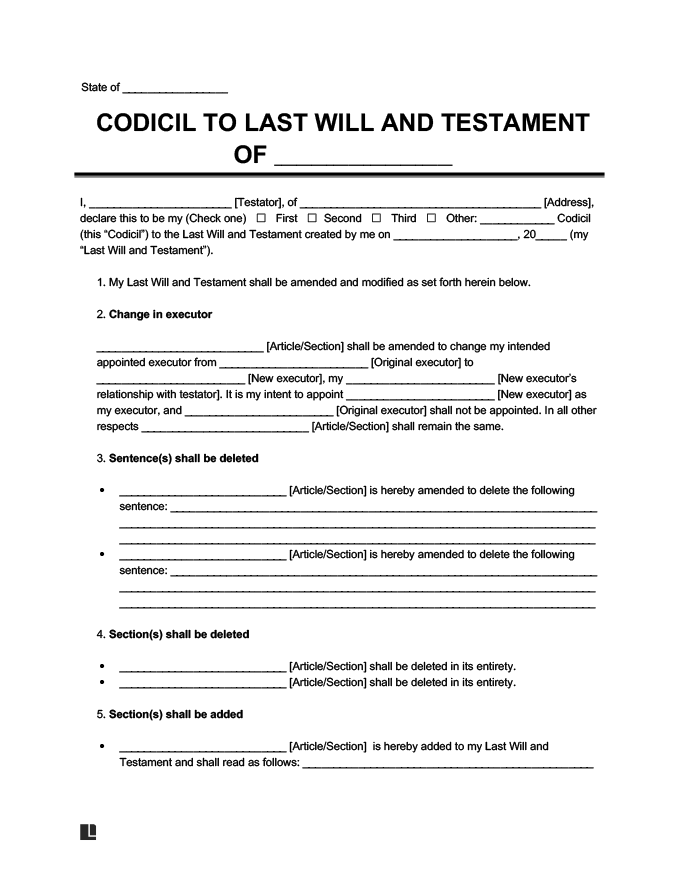
Once you give context about which last will the codicil will apply to, you can begin drafting your amendment. Legal Templates’ questionnaire guides you through each change you need to make. We offer options for the following changes:
- changing the executor
- deleting a section
- adding a section
- modifying a section
- inserting additional provisions
You can make several codicils if necessary, depending on your situation. Make your changes precise and straightforward. Vague or poorly worded codicils can trigger legal disputes or delay probate. You may even risk having the original will enforced instead of your updated wishes, so be as clear as possible.
Can I Make a Handwritten Codicil?
Don’t make handwritten changes to your will unless you’re sure your state allows them. Some states don’t recognize handwritten wills or amendments, and they can lead to legal disputes.
4. Sign With Witnesses
Once you draft your codicil, ensure to sign the new changes into effect while meeting witness requirements. Codicil signing requirements are the same as last will signing requirements.
Most states require at least two disinterested witnesses to be present while you sign your codicil as the testator, but you should confirm the requirements in your jurisdiction. While notarization may not be necessary, it can increase its validity.
Notarization will be necessary if you get a self-proving affidavit for the codicils. A self-proving affidavit helps streamline the probate process by allowing the court to accept the codicil without needing the witnesses to testify in person.
5. Store the Codicil With Your Original Will
Attach the codicil to your most recent will so your executor can easily follow your updates. If the codicil isn’t present, the court may follow the instructions in the old will and not be aware of the amendment. Store both your will and any codicils in a secure location.
Ensure your executor knows where to find these documents, whether in a fireproof home safe or with your attorney. Don’t store the codicil separately, which can lead to confusion or disputes.