What Is a Washington, DC Notary Acknowledgment?
A Washington, DC notary acknowledgment is a certificate attached to a legal contract or agreement. It verifies the identity of the person signing the original legal document. A notary public completes it to confirm that the document’s signer entered into the agreement of their own free will.
For a District of Columbia notary acknowledgment to be complete, the signer must personally appear before the notary public (DC Code § 1-1231.05). The notary public must also verify the signer’s identity through personal knowledge or satisfactory evidence (DC Code § 1-1231.04). Satisfactory evidence can include a current government-issued ID card or an affirmation from a credible witness (DC Code § 1-1231.06).
Documents That Typically Require Notarization in Washington, DC
If a document is set to go on public record or requires a higher level of security, it may need to be notarized. Some examples of documents that require notarization under Washington, DC law include the following:
- Durable power of attorney
- Non-durable power of attorney
- Limited power of attorney
- Real estate power of attorney
- Minor power of attorney
- Power of attorney revocation
- Warranty deed
- Quitclaim deed
- Living trust
Some personal and business documents may be usable without notarization. However, you may still consider having them notarized to add a layer of protection. Here are some examples of legal documents to get notarized in Washington, DC:
What to Include in a District of Columbia Notary Acknowledgment Form
When writing a District of Columbia notary acknowledgment form, you should include the jurisdiction in which the notarial act is performed. It should not be listed as the surrounding states of Maryland or Virginia, as Washington, DC is its own jurisdiction. In addition to the venue of acknowledgment, here are some other key elements to include on your form (DC Code § 1-1231.14):
- The notary public’s title (“Notary Public”)
- The date of the notarial act
- The signer’s name
- The notary public’s signature (in the same manner as on file with the Mayor)
- The expiration date of the notary’s commission
Your Washington, DC notary acknowledgment form must have a seal that’s photographically reproducible (DC Code § 1-1231.16). It must be placed near the notary’s signature and include the following details:
- The words “District of Columbia”
- The notary’s commissioned name
- The expiration date of their commission
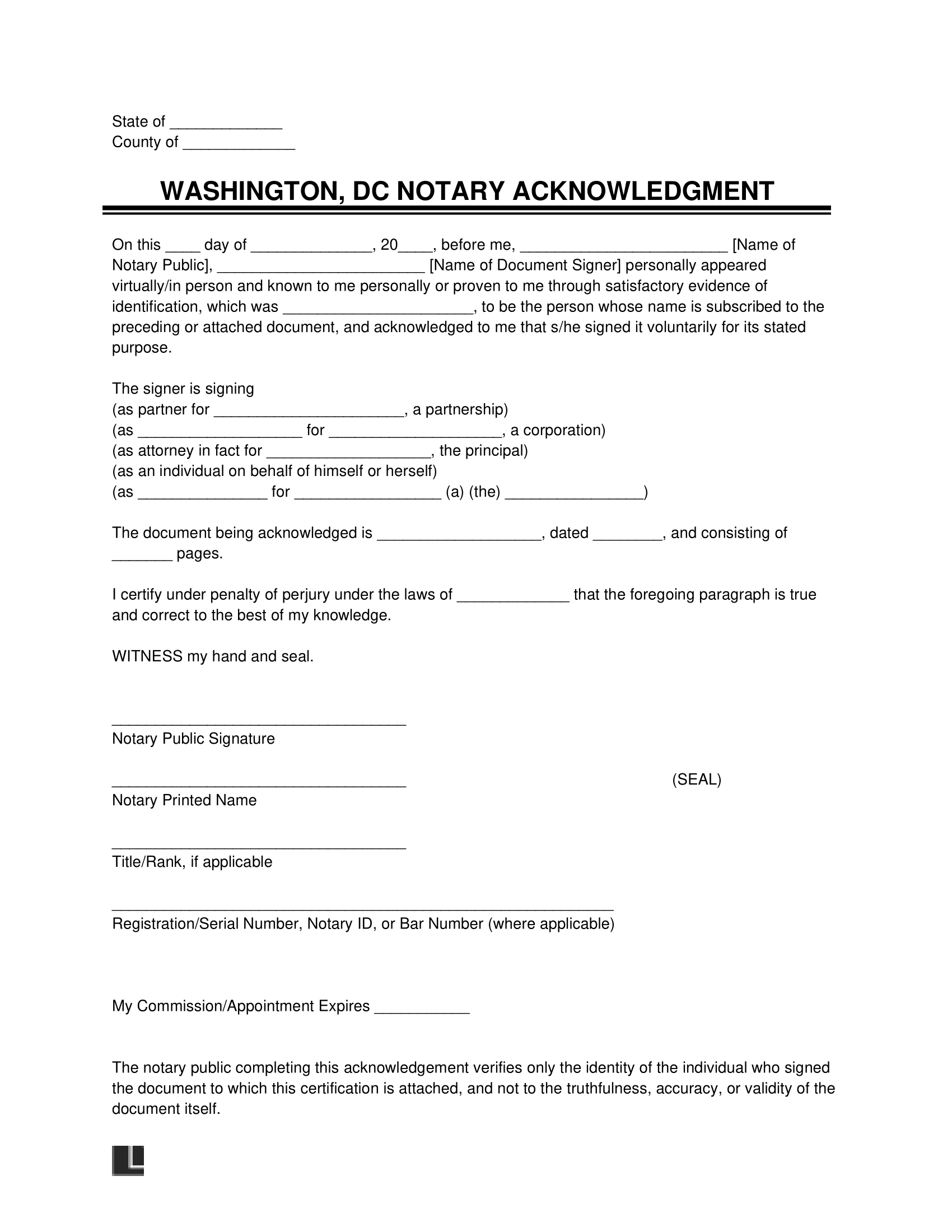
Sample Washington, DC Notary Acknowledgment
View an example of our Washington, DC notary acknowledgment form to see how you can customize it. Add the signer’s name, the document being notarized, the number of pages, and other key information. Fill out the preliminary details using Legal Templates’s form. Then download it in PDF or Word, which you can print and take to a notary public.
Is Remote Online Notarization Legal in Washington, DC?
Yes, remote online notarization (RON) became legal in Washington, DC when Bill 24-457 went into effect on September 21, 2022. Currently, RON in the District of Columbia is governed by DC Code 1-1231.13a. Signers can use communication technology to appear before a notary public, provided the remote notarial act follows these rules:
- The notary public confirms the signer’s identity through personal knowledge, an oath from a credible witness, or at least two different types of identity proofing.
- The notary public creates an audio-visual recording of the remote notarial act.
- The notary public retains a copy of the recording for at least 10 years.
- The Washington, DC notary acknowledgment form clearly states that the remote notarial act uses communication technology.
- The notary must be physically present in DC.
- The signer can be anywhere in the world, but the legal document being signed must relate to a matter or property subject to US jurisdiction.
- The notary public notifies the Mayor that they will perform a remote notarial act and identifies the technology they intend to use prior to performing their initial notary act.
RON can be used for most business and general contracts in DC. However, it is not for use with wills, trusts, codicils, or powers of attorney. In-person notarization is required for these documents because of the heightened importance for the notary public to understand the signer’s capacity.