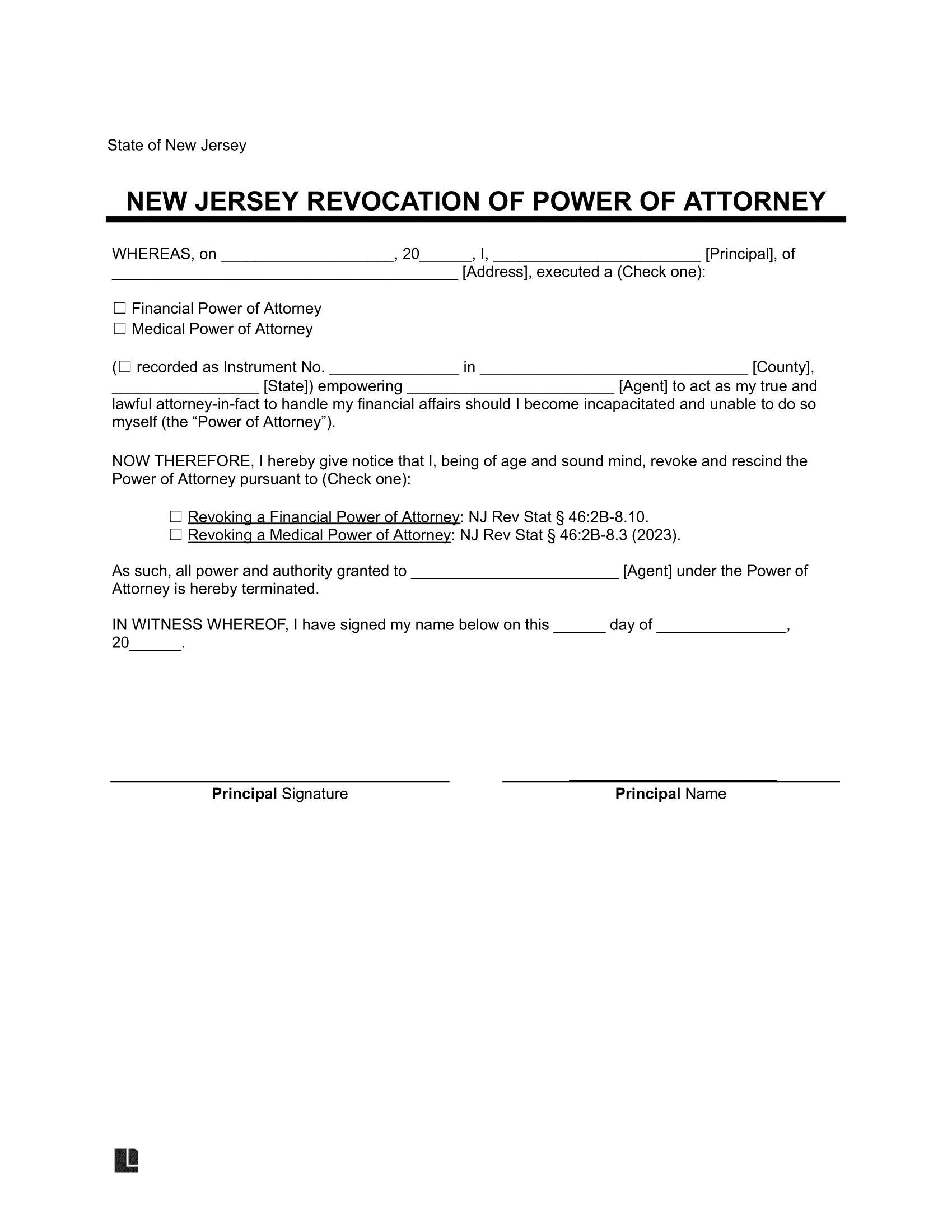
A New Jersey power of attorney revocation form is a document allowing an individual to cancel an appointed agent’s authority previously granted through a power of attorney. It is crucial to distribute copies of this revocation to the agent and any other parties relying on the original power of attorney.
If parties are unaware of the revocation, they may not be held liable for actions taken under the assumption that the power of attorney was still valid. Therefore, it is essential to ensure that all relevant individuals and entities are properly informed about the revocation.
Legal Considerations
Statute – New Jersey Revised Statutes – Revised Durable Power of Attorney Act (§ 46-2B-8.1 – 46-2B-19).
Termination – § 46-2B-8.10.
Signing Requirements – One witness and a Notary Public (§ 46-2B-8.10 and § 46-14-2.1).
Revocation and Termination
In New Jersey, a Power of Attorney (POA) can be revoked if the principal either destroys all official copies, signs a formal revocation document, or sends a written cancellation notice to the agent. Creating a new POA does not automatically invalidate an existing one unless it explicitly states so (46:2b-8.10).
To revoke a Power of Attorney (POA) in before its expiration date using a revocation form, follow these steps:
- Draft a Revocation Notice: Create a written document that includes the principal’s name, the agent’s name, and the date the original POA was executed. The principal must sign and date this notice.
- Deliver the Notice to the Agent: Ensure the revocation notice reaches the agent, either in person or through certified mail with a return receipt requested to confirm delivery.
- Notify Third Parties: Inform any third parties, such as banks or financial institutions, that may have been dealing with the agent under the authority of the POA.
- File with County Recorder (if necessary): For certain types of POA, like a durable POA, record the revocation at the local county recorder’s office where the original POA was filed.
- Legal Restrictions: Note that if the principal is mentally incapacitated, they cannot legally revoke the POA. In such cases, a court may need to intervene.
- Consult an Attorney: It is recommended to seek advice from an experienced attorney to ensure the revocation process complies with New Jersey law.
Fees
- Notary Fees: Notarization is required in New Jersey for POA revocation, with fees ranging from $2.50 to $15.00 per signature.
- Legal Fees: Consulting an attorney is advisable for complex POA issues, with legal fees varying by complexity and attorney experience—typically $100 to $500 for flat fees or hourly rates.
- Recording Fees: If the original POA was recorded, the revocation must also be recorded at the same office, with fees typically ranging from $30 to $50 in New Jersey
Related Forms
Medical Power of Attorney
Signing Requirements: Two witnesses or a notary public. (§ 26:2H-56).
Durable Power of Attorney
Signing Requirements: Notary public (§ 46:2B-8.9).
Vehicle Power of Attorney
Signing Requirements: Notary public.
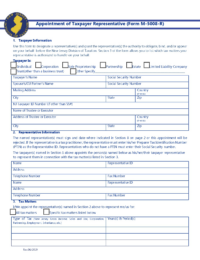
New Jersey Tax Power of Attorney | Form M-5008-R
Signing Requirements: Principal and their representative.
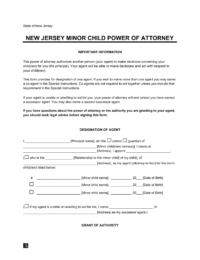
Minor (Child) Power of Attorney
Signing Requirements: Two witnesses.