What Is a Washington, DC Quitclaim Deed?
A Washington, DC, quitclaim deed is a legal document used to transfer a person’s ownership interest in real estate. It passes whatever interest the grantor currently has in the property, but does not guarantee that the title is free of defects.
Because it does not include title guarantees, quitclaim deeds are usually used when the parties involved already trust each other. For example, they are common when transferring property between family members, dividing property after a divorce, or adding or removing someone from a deed.
Under DC Code § 42 – 401, a quitclaim deed takes effect between the parties once it is signed, acknowledged, and delivered. Recording the deed is not required for the transfer to be valid, but it helps protect the new owner if another buyer or creditor later claims an interest in the property.
Quitclaim deeds transfer ownership without guarantees about the title. Other types of deeds may offer stronger protections for buyers, depending on the situation.
Washington, DC Quitclaim Deed Requirements
A quitclaim deed in Washington, DC, needs to meet several basic requirements. These steps help the Recorder of Deeds confirm the transfer and add it to the public record.
1. Sign and Notarize the Deed
The person transferring the property (the grantor) needs to sign the deed and acknowledge it before a notary or another authorized official before it can be recorded (DC Code § 42 – 407). Washington, DC, also accepts notarizations completed outside the District.
2. Include Property Details and Proper Formatting
The deed needs to include enough information to clearly identify the property being transferred. The Recorder of Deeds also requires documents to follow certain formatting rules. For example, deeds need to be submitted on 8½ × 11 or 8½ × 14 paper, and double-sided pages are allowed.
3. Submit Tax Forms and Pay Any Taxes
When recording a deed, you usually need to submit required tax forms and pay any applicable transfer or recordation taxes. The Recorder of Deeds may reject the filing if the required forms are missing or if property-related taxes have not been paid.
Most deeds recorded in Washington, DC, require Office of Tax and Revenue forms, such as ROD-1 or ROD-2. The correct form depends on the type of transfer and whether a tax exemption applies.
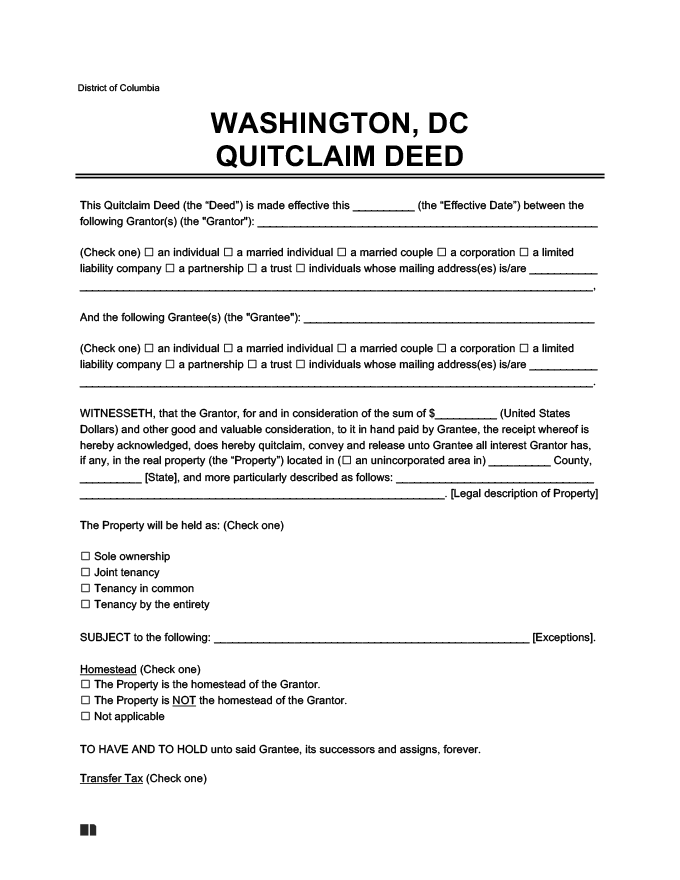
Washington, DC, Quitclaim Deed Sample
View a sample Washington, DC, quitclaim deed to see how the document looks. Then customize your own and download it in Word or PDF.
How to Record a Quitclaim Deed in Washington, DC
To record a quitclaim deed in Washington, DC, submit the signed deed to the DC Office of the Recorder of Deeds. Recording adds the transfer to the public property record and helps protect the new owner’s interest in the property. You can record a deed electronically, in person, or by mail. If you file in person or send the deed by mail, use the following address:
DC Office of the Recorder of Deeds
1101 4th Street, SW, Suite 500W
Washington, DC 20024
Recording hours for deeds are typically 9:00 AM to 3:00 PM. The office accepts cash, check, money order, or credit card for in-person filings. Mailed filings generally require a check or money order payable to the DC Treasurer. After recording, the original document is usually returned by mail within 4-6 weeks.
How Much Does It Cost to File a Quitclaim Deed in Washington, DC?
Recording a quitclaim deed in Washington, DC, usually costs about $30, according to the DC Office of Tax and Revenue (OTR). However, you may need to pay additional taxes depending on the property’s value. Washington, DC, charges two property transfer taxes when a deed is recorded: a recordation tax and a transfer tax. Both use the same rates:
- 1.1% for residential transfers under $400,000
- 1.45% for transfers of $400,000 or more
Recordation taxes fall under DC Code Title 42, Chapter 11, while transfer taxes are covered by DC Code Title 47, Chapter 9.
If a deed lists only nominal consideration (such as $1), the District may calculate transfer and recordation taxes based on the property’s fair market value instead.