What Is an Illinois Quitclaim Deed?
An Illinois quitclaim deed is a written form that transfers property ownership rights to another individual. This type of deed is often used in divorces, family transfers, or the creation of new deeds. You can also use a quitclaim form to correct or change title information. The quitclaim terms also include no warranty or guarantee for a clean title.
Use Legal Templates’s free Illinois quitclaim deed form to record the change in property ownership. Our document includes state-compliant terms for a valid transfer.
What to Include in an Illinois Quitclaim Deed
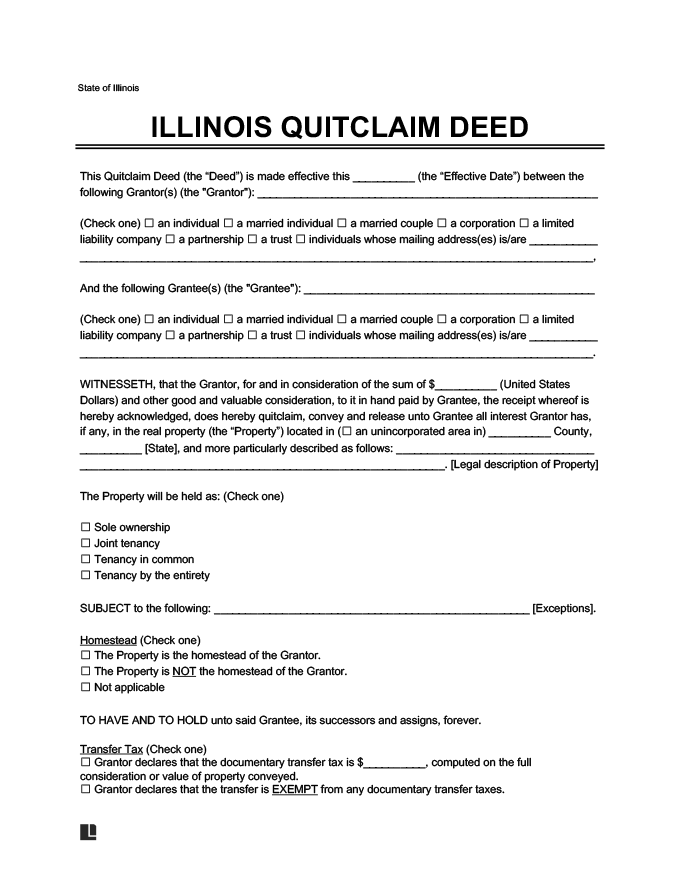
Your Illinois quitclaim deed must include the proper information and language to ensure a valid property transfer. Each element of your form works to record and establish the terms and details of the deed.
- Parties involved: Name the grantor, grantee, and document preparer, and include the address of each individual. Ensure that the parties are clearly identified.
- Property description: Provide a legal description of the transferred property. Include the property location, county, boundaries, and type of survey used.
- Statement of quitclaim: In the terms of your deed, note the quitclaim nature of the agreement to distinguish it from a warranty deed. Provide an explicit statement to “convey and quit claim” and avoid any mention of a grant, bargain, or sale.
- Statement of consideration: Include a statement of a payment made in exchange for the property. This is not usually the actual price, but often includes a nominal amount to show that a transaction has occurred.
- Signatures and notarization: Under 765 ILCS 5/20, an Illinois quitclaim deed requires the grantor’s signature and a notary acknowledgment.
Sample Illinois Quitclaim Deed
Legal Templates’s free Illinois quitclaim deed offers customizable terms for an effective property transfer that works for you. Use our downloadable form available in PDF or Word format.
How Much Does an Illinois Quitclaim Deed Cost?
The overall cost of a quitclaim deed in Illinois depends on the county, property value, and applicable taxes. Both state and local fees and taxes apply and vary depending on your specific situation. Consider the following factors to determine the cost of your property transfer and documentation.
Filing Fees
You must file your Illinois quitclaim deed with the County Recorder of Deeds for the property location. This ensures a valid, legally documented transfer of ownership. Each county assesses its own filing fees. For example, Cook County charges a fee of $107, while filing in DuPage County costs only $86.
Gift Taxes
While Illinois has no state gift tax, the IRS imposes a federal gift tax. This tax applies to any remaining property value that exceeds the gifting limit of $19,000, or $38,000 for married couples, for the 2025 tax year. Fill out Form 709 to pay gift taxes if the consideration paid for the property does not equal the overall property value.
Transfer Taxes
Illinois requires a real estate transfer declaration when recording a deed. These taxes are determined and filed via the Illinois Form PTAX-203. Under 35 ILCS 200, the state transfer tax is $.50 per $500 of value. 35 ILCS 200/31-45 also lists the applicable transfer tax exemptions.
Capital Gains Taxes
The IRS also charges a federal capital gains tax if the property is sold for significantly more than the original purchase price, with some exceptions if the property was the grantor’s primary residence for a certain number of years prior to the sale. In addition, Illinois has a capital gains tax, which is assessed and filed with the ordinary income tax at a flat rate of 4.95%. Include the profit from the property transfer as part of your annual gains to pay the corresponding taxes.