

What Is an Affidavit of Domestic Partnership?
An affidavit of domestic partnership is a sworn statement that confirms two people are in a committed relationship. Employers and insurance companies often require it when someone wants to add a partner to workplace or health benefits.
The affidavit acts as proof of the relationship for private purposes, like employee benefits or insurance coverage. In many cases, you don’t need to register your partnership with the state. You can simply confirm that you meet the required criteria.
You may also see the term declaration of domestic partnership. That usually means officially registering your relationship with a state or local program. An affidavit is different. It can support a registered partnership, but it can also be used on its own.
What Qualifies as a Domestic Partnership?
There isn’t one standard definition of a domestic partnership. Requirements can vary based on state law, local rules, or the organization requesting the form.
In most cases, a domestic partnership means two unmarried adults who live together in a committed relationship. They usually share a home and support each other financially. To confirm the relationship, most affidavits ask partners to verify a few basic details. You’ll often need to confirm that you:
- Are at least 18 years old
- Are not closely related in a way that would prevent marriage
- Are not married or in another domestic partnership
- Live together in the same household
- Share financial responsibilities, like bills or living expenses
Some states or programs may add extra rules. For example, Maine requires partners to live together for at least 12 months before registering a domestic partnership.
Domestic partnerships started as a way for unmarried couples, especially same-sex couples, to gain legal recognition before same-sex marriage was legal nationwide. After same-sex marriage became legal in 2015, many states kept domestic partnerships as another option or as a way for employers to offer partner benefits.
Which States Recognize Domestic Partnerships?
Domestic partnership laws vary across the United States. Some states recognize them under state law. Others offer similar options, like civil unions. Some states don’t recognize them at all.
Because of that, legal rights can vary depending on where you live. In some states, registered domestic partners have rights similar to married spouses. For example, Nevada gives registered domestic partners the same rights and responsibilities as spouses under state law. In other states, recognition is more limited or tied to specific programs.
The table below shows how states recognize domestic partnerships or similar relationships, based on data from the National Conference of State Legislatures (NCSL).
| How the state recognizes relationships | States | When an affidavit may be needed |
|---|---|---|
| Statewide domestic partnership registration available | California, District of Columbia, Maine, Nevada, Oregon, Washington, Wisconsin | Used to confirm a relationship when applying for employer benefits, health insurance, housing, or similar programs |
| State offers a similar legal status instead (civil unions or equivalent) | Colorado, Hawaii, Illinois, New Jersey, Vermont (civil unions); Hawaii (reciprocal beneficiaries) | May be used when partners need to prove their relationship but are not registering a domestic partnership |
| No statewide domestic partnership system | Alabama, Alaska, Arizona, Arkansas, Connecticut, Delaware, Florida, Georgia, Idaho, Indiana, Iowa, Kansas, Kentucky, Louisiana, Maryland, Massachusetts, Michigan, Minnesota, Mississippi, Missouri, Montana, Nebraska, New Hampshire, New Mexico, New York, North Carolina, North Dakota, Ohio, Oklahoma, Pennsylvania, Rhode Island, South Carolina, South Dakota, Tennessee, Texas, Utah, Virginia, West Virginia, Wyoming | Often used because the state does not provide a domestic partnership registry |
Some states use civil unions instead of domestic partnerships. A civil union certificate can prove your relationship. Still, employers, insurers, or landlords may ask for a domestic partnership affidavit when you apply for benefits.
When Do You Need an Affidavit of Domestic Partnership?
Even if your state recognizes domestic partnerships, many organizations still ask for proof. An affidavit gives them written confirmation of your relationship.
You may need one when you:
- Add a partner to life, dental, or health insurance
- Apply for partner benefits through an employer
- Don’t have a marriage certificate or registered partnership
- Complete forms during open enrollment
- Update benefits after moving in together
- Confirm your partner for hospital visits, next-of-kin records, or certain medical decisions
Depending on the program, partners may qualify for:
- Health, dental, or life insurance
- Family or bereavement leave
- Retirement or survivor benefits
- Hospital visits or limited medical decisions
- Housing protections (in some areas)
An affidavit doesn’t give you these rights. It simply helps the organization confirm your relationship so they can decide if you qualify.
An affidavit of domestic partnership doesn’t give you full legal rights. Many couples pair it with other documents to handle legal, medical, or financial decisions, such as:
What to Include in an Affidavit of Domestic Partnership
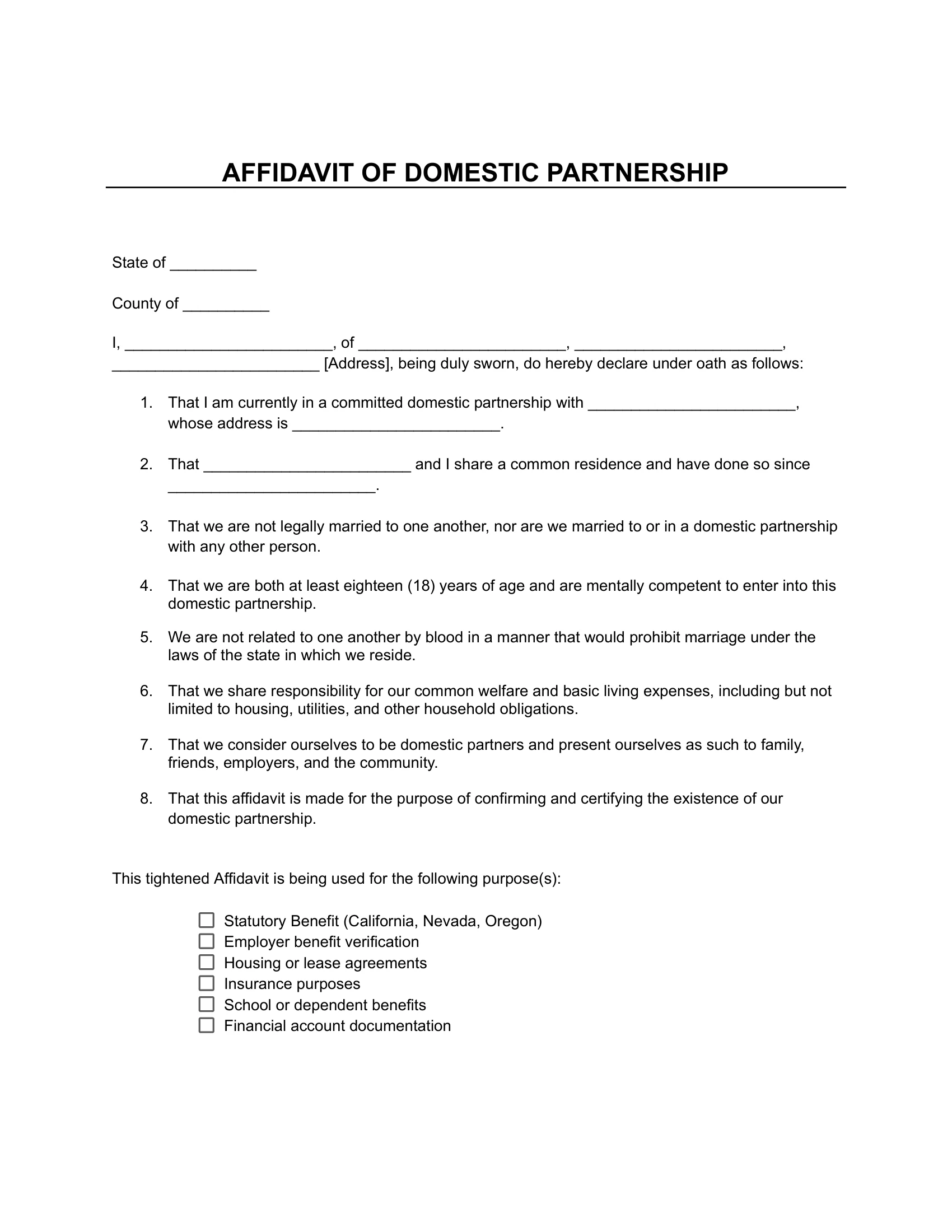
An affidavit includes basic details about both partners and statements confirming your relationship. Most forms ask for the:
- Full legal name of each partner
- Shared address to confirm you live together
- The purpose of the affidavit (like applying for benefits)
- State and county where you sign the document
- Date of signing
- Notary section, if required
You’ll also need to confirm a few key statements, such as:
- Both partners are 18 or older and mentally capable
- You are not closely related
- Neither partner is married nor in another partnership
- You share financial responsibilities
- You consider yourselves domestic partners
- You present your relationship to others (friends, family, etc.)
Organizations use this information to review benefit requests. For example, an employer may check that you live together and meet eligibility rules before adding a partner to a health plan. Missing or incorrect details can delay approval.
Many employers or insurers require both partners to sign the affidavit. Some also ask for a witness or notarization. If notarization is required, you’ll need a valid photo ID when signing. Always check the exact requirements before submitting your form.
Sample Affidavit of Domestic Partnership
Review a sample affidavit before filling out your own with Legal Templates’s guided form. Then customize and download your document in Word or PDF format.