What Is an Unpaid Wages Demand Letter?
An unpaid wages demand letter is a formal, written request for payment of any withheld wages. This letter is often used when money is owed after leaving a job or completing a freelance or contract project. Unpaid wages or wage theft may also occur when a current employer provides less than minimum wage, withholds tips, or fails to pay for overtime hours. A documented request provides evidence of communications for future legal disputes.
Your state labor office can help you understand your rights to payment under the Fair Labor Standards Act.
How to Write a Demand Letter for Unpaid Wages
Writing an unpaid wages demand letter can help document and resolve owed payments. An effective letter must include information about the parties, payments, and communications involved. Create a valid and helpful demand letter with the following steps.
1. Identify the Parties Involved
Clearly record the names and addresses of the payee sending the letter and the payor who owes them wages. Ensure that each section is addressed to the correct party and note whether they are individuals or business entities.
2. Outline the Unpaid Wages
Include a detailed description of the unpaid wages you intend to collect. Provide the start and end dates of the owed wages period. This may include the dates listed on a termination, severance, or freelance contract, or the dates of an unpaid pay period. Also include a statement of the exact amount owed and a due date for the employer to provide your funds. This section can also include a notice of any intended legal actions if the recipient fails to pay.
3. Sign Your Letter
Once your letter has the necessary details, sign and date it, and send it to the intended party. Noting the date helps document the notice period and helps the recipient determine the timeline for repayment.
4. Send Via Certified Mail
Send your letter through certified mail to obtain a receipt and confirmation of personal delivery. The extra documentation enhances validity and serves as proof in the event of legal disputes over unpaid wages.
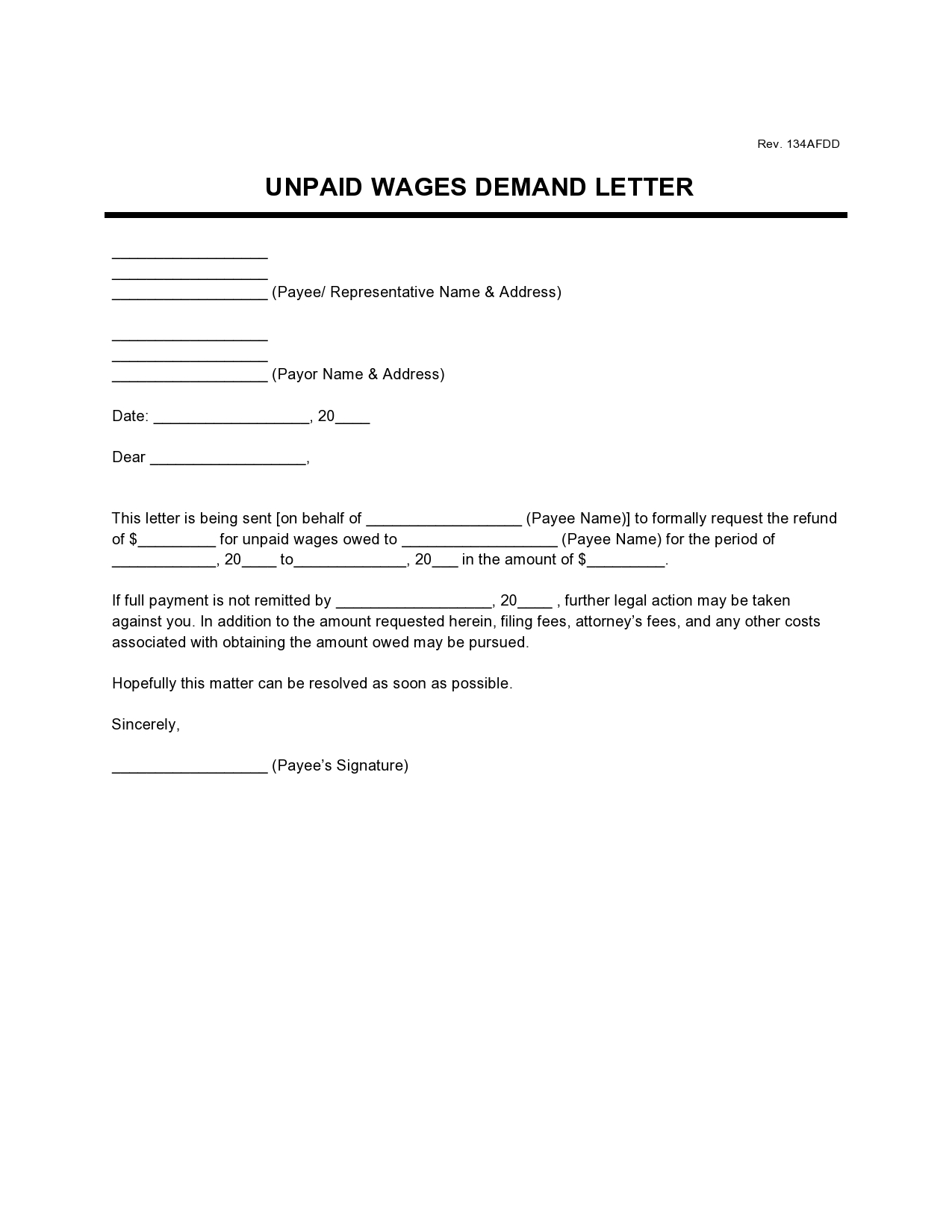
Sample Unpaid Wages Demand Letter
Legal Templates’s free unpaid wages demand letter allows you to request owed payments from an employer. Use our letter template, available in PDF and Word formats, to ask for your wages.
Final Paycheck and Unpaid Wage Laws By State
Most states have specific legal requirements for when an employer must provide a final paycheck. These laws specify the timeline for providing any unpaid wages when an employee is fired or quits. Alabama, Florida, Georgia, and Mississippi are the only states without laws governing final paychecks. View the table below for an overview of each state’s legal guidelines to help inform your unpaid wages demand letter.
State Law When Employee Is Fired When Employee Quits
Alaska Within three business days Within three business days or the next regular payday, whichever is sooner
Arizona Within seven business days or the next payday, whichever is sooner By next payday
Arkansas By next payday By next payday
California
Additional laws: 201.3, 227.3Immediately 72 hours or immediately if employee gives at least 72 hours notice
Colorado Immediately By next payday
Connecticut By the next business day By next payday
Delaware By next payday, or 3 days after last day worked, whichever is later By next payday, or 3 days after last day worked, whichever is later
Hawaii Immediately By next payday or immediately if employee gives one pay period’s notice.
Idaho
(Additional Law)By next payday or within 10 days, whichever is sooner; within 48 hours if employee requests earlier payment By next payday or within 10 days, whichever is sooner; within 48 hours if employee requests earlier payment
Illinois By next payday, or immediately if possible By next payday, or immediately if possible
Indiana
(Additional Law)By next payday By next payday
Kansas By next payday By next payday
Kentucky By next payday or within 14 days, whichever is later By next payday or within 14 days, whichever is later
Louisiana By next payday or within 15 days, whichever is later By next payday or within 15 days, whichever is later
Maine By next payday or within 14 days of demand, whichever is sooner By next payday or within 14 days of demand, whichever is sooner
Maryland By next payday By next payday
Massachusetts Immediately By next payday
Michigan
(Additional Law)Immediately As soon as amount is calculated
Minnesota (Additional Law) Immediately, within 24 hours of demand By next payday, unless payday is less than 5 days after last day; in which case, by the following payday or within 20 days, whichever is earlier
Missouri Immediately Immediately
Montana Immediately or in accordance with written policy By next payday or within 15 days, whichever is sooner
Nebraska By next payday or within 14 days, whichever is sooner By next payday or within 14 days, whichever is sooner
Nevada
(Additional Law)Immediately By next payday or within seven days, whichever is sooner
New Hampshire Within 72 hours, or by next payday if employee was laid off By next payday, or within 72 hours if employee gives one pay period of notice
New Jersey By next payday By next payday
New Mexico
(Additional Law)Within five days By next payday
New York By next payday By next payday
North Carolina By next payday By next payday
North Dakota By next payday By next payday
Ohio By next payday, or within 15 days, whichever is first By next payday, or within 15 days, whichever is first
Oklahoma By next payday. or within 14 days, whichever is later By next payday, or within 14 days, whichever is later
Oregon By end of business day Immediately if given 48 hours notice; if no notice, within five days or by next payday, whichever is sooner
Pennsylvania By next payday By next payday
Rhode Island By next payday; if laid off due to merger, relocation, or liquidation, within 24 hours By next payday
South Carolina Within 48 hours or by next payday, no more than 30 days Within 48 hours or by next payday, no more than 30 days
South Dakota
(Additional Law)By next payday or whenever employee returns employer’s property By next payday or whenever employee returns employer's property
Tennessee By next payday or within 21 days, whichever is later By next payday or within 21 days, whichever is later
Texas Within six days By next payday
Utah Within 24 hours By next payday
Vermont Within 72 hours By next payday
Virginia By next payday By next payday
Washington By end of pay period By end of pay period
West Virginia By next payday By next payday
Wisconsin Next payday or within one month, whichever is sooner; if laid off due to merger, relocation, or liquidation, within 24 hours By next payday
Wyoming By next payday By next payday
Next Steps After Sending a Demand Letter for Unpaid Wages
If your demand letter goes unanswered, the next step is to contact your state’s labor office. They may be able to contact your employer on your behalf and demand payment. If your state doesn’t have a state-level Department of Labor or you want to escalate the issue to a federal department, you can contact the Wage and Hour Division to reach your employer.
If your employer still doesn’t comply, the next step is to file a complaint and go to court. In your complaint, you will state when the wages went unpaid, the amount you are owed, and the steps you took to collect payment. You may attach a copy of your due wages demand letter, the certified mail receipt as proof that the letter was sent, and communications with state and federal labor departments.
After you file a complaint, your employer will receive a summons notifying them that a case has been brought against them. Once a complaint is filed, you must prepare to attend a court hearing. This means that you may have to pay a lawyer’s fees for representation. You must also gather all the documentation and evidence to show your case to the judge.