What Is an Interior Design Retainer Agreement?
An interior design retainer agreement is a contract that allows an interior designer to charge a recurring fee for ongoing design services. Instead of a one-time project fee, the retainer keeps the designer involved.
Under this contract, the designer may act as a consultant during new construction or remodeling projects. Alternatively, they can provide full interior design services for a building, room, or other space in a home or business.
As the work takes shape, the designer handles tasks such as space planning, sourcing furniture and finishes, making revisions, and coordinating with vendors. Design projects tend to change along the way, so this setup makes it easier to manage changes without having to update the agreement every time.
The retainer fee secures your time for ongoing interior design work. It typically covers sourcing, selections, revisions, and coordination. Many fall in the 10-20% range of the total project budget, with higher fees for full-service or multi-room projects.
When Should You Use an Interior Design Retainer?
Use an interior design retainer when your work is ongoing and likely to shift as the project moves forward. It works best in situations like:
- Designing multiple rooms or a full home. Larger projects come with more moving parts, so a retainer helps you stay involved without resetting terms.
- The scope may expand over time. Clients may add rooms, request new services, or make changes, and a retainer lets you handle that without renegotiating.
- You’re providing ongoing services. Tasks like sourcing, revisions, and vendor coordination continue throughout the project.
- The project is delivered in phases. From initial design through procurement and final installation, a retainer keeps you involved at each stage.
- The timeline isn’t fully defined upfront. When timing is flexible, a retainer helps you stay engaged without locking into a fixed schedule.
An interior design retainer agreement helps you protect your time and keep sourcing, revisions, and installs on schedule, without constant back-and-forth. Legal Templates helps you set clear terms for scope changes, monthly fees, and the handling of ongoing work.
If the work is fixed with clear deliverables and a defined end date, a standard interior design contract may be a better fit.
What to Include in an Interior Design Retainer Agreement
Interior design retainer work can change as the project takes shape. Set clear terms early so scope, timelines, and payments stay easy to manage. Include details like:
- Who the client is: List the homeowner, property owner, or business client, along with the full address for the client or project.
- Who you are: Include your name or studio name and business address.
- What you’re responsible for: Outline services like space planning, mood boards, furniture and finishes selection, sourcing, site visits, vendor coordination, and revisions.
- How the project is broken down: Optionally attach a scope by room, area, or phase, such as the living room, kitchen, or full home.
- How you charge: Set a flat monthly retainer or a rate based on ongoing hours.
- When you get paid: Clarify when invoices go out and when payment is due.
- How the retainer is used: State whether it gets topped up as hours or revisions are used.
- What happens to unused funds: Explain if any unused retainer is refundable.
- How expenses are handled: Note whether sourcing, travel, or vendor costs are included or billed separately.
- When work starts: Confirm if work begins on signing or on a specific date.
- When it ends: Define if the agreement runs until the project wraps, for a set timeframe, or is ongoing.
- How issues are handled: Outline dispute resolution, such as mediation, arbitration, or court.
- Which laws apply: Specify the governing state law.
- When the agreement takes effect: State the official effective date.
- Sign-off: Include both your signature and the client’s to confirm the terms.
When these details are clear, you don’t have to stop and reset terms every time something changes. You can keep sourcing, revising, and coordinating without pausing to check the scope or billing terms.
Set clear limits for your retainer, including design hours, revisions, site visits, and sourcing. Explain what happens when the retainer runs out, such as extra hourly fees or a top-up. Keep design work separate from purchases like furniture, finishes, shipping, and vendor costs.
Sample Interior Design Retainer Agreement
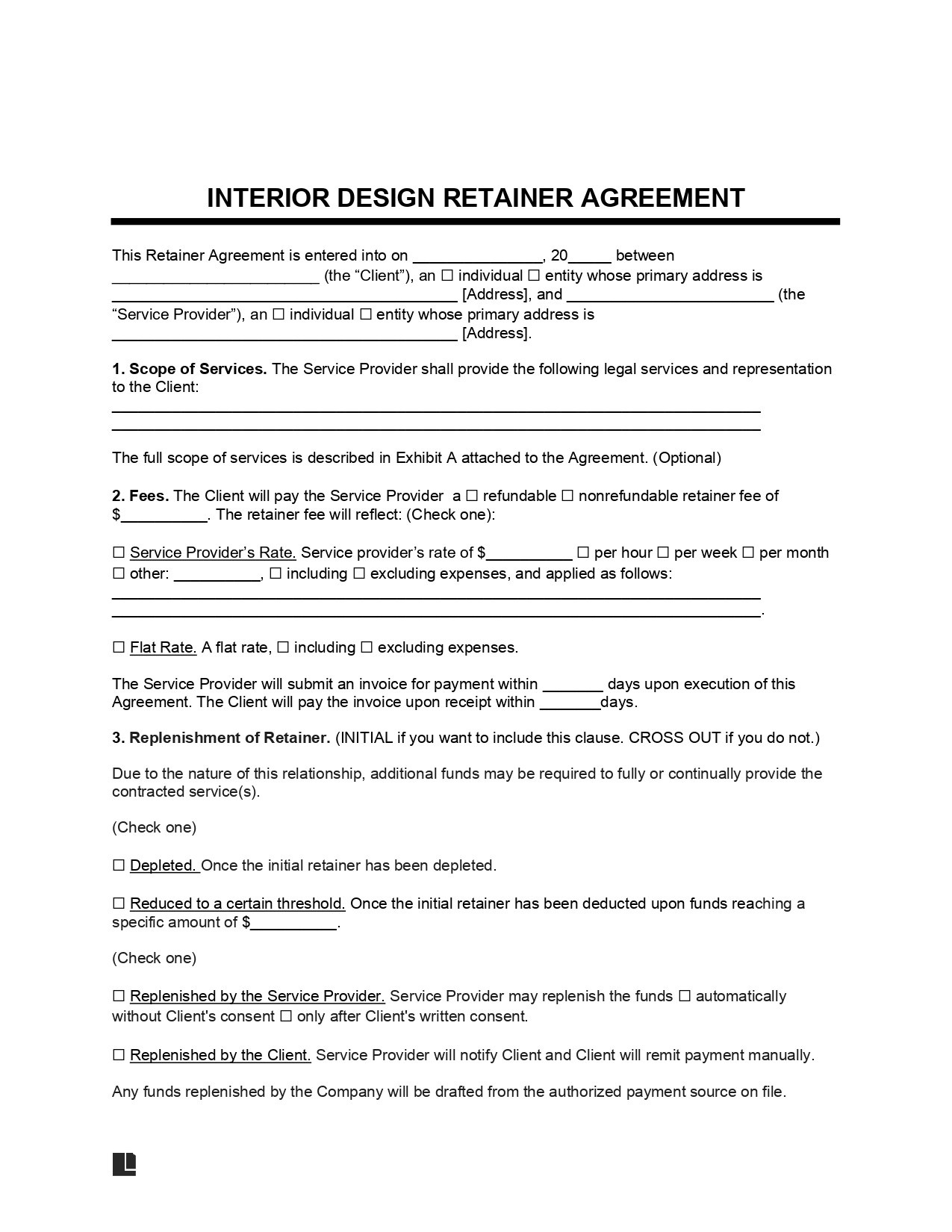
View our sample to understand how ongoing design work, timelines, and payments are set up. Build your version and download it in Word or PDF format.