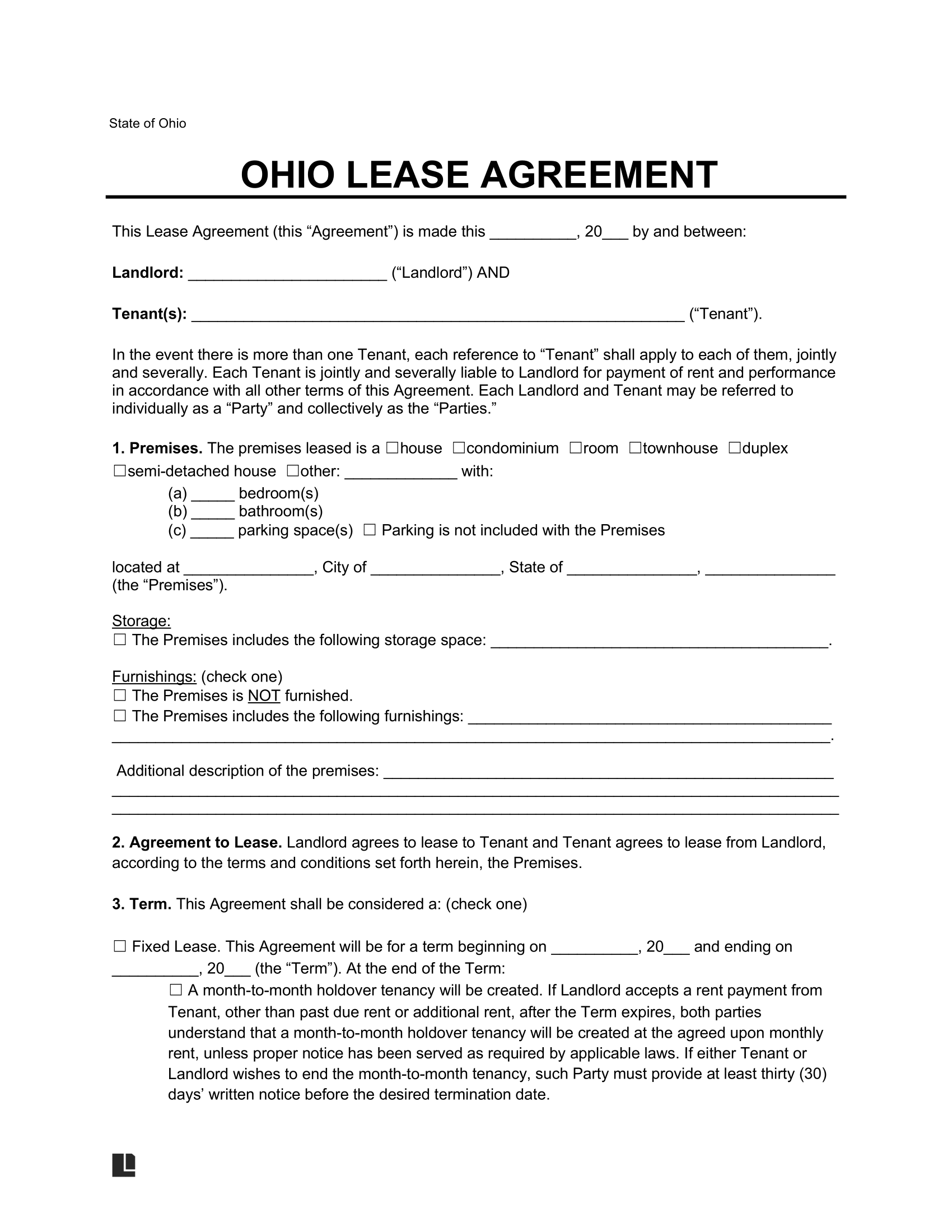
What Is an Ohio Lease Agreement?
An Ohio lease agreement is a contract that a landlord uses to rent out their property under certain conditions to a tenant. It includes details like the rent duration, rent payment, and the landlord’s and tenant’s duties. Both parties rely on this contract for protection in case a dispute arises.
Do Ohio Leases Need to Be Notarized?
OH Rev Code § 5301.01, known as Ohio’s Statute of Conveyances, requires any lease longer than three years to be notarized. OH Rev Code § 5301.08 specifically exempts leases under three years from this requirement.
Even if a lease is less than three years old, it can still help to get it notarized. A notarized Ohio lease is easier to prove in court if the parties disagree on certain terms.
Does an Ohio Lease Need to Be Recorded?
Ohio leases that are at least three years old must be recorded with the county recorder and notarized. However, OH Rev Code § 5301.251 allows for the recording of a memorandum of the lease instead of the full lease.
Ohio Landlord-Tenant Laws Overview
Ohio lease agreements must abide by certain laws to be valid. Here’s an overview of some of the key regulations.
| Topic | Rule | Law |
|---|---|---|
| Notarization Required? | Yes (if the lease is longer than three years) | OH Rev Code § 5301.01 |
| Recording Required? | Yes (if the lease is longer than three years) | OH Rev Code § 5301.251 |
| Security Deposit Maximum | None | n/a |
| Security Deposit Interest | Must accrue 5% (if the deposit is greater than $50) | OH Rev Code § 5321.16 |
| Security Deposit Return | Within 30 days | OH Rev Code § 5321.16 |
| Late Fees | None | n/a |
| Grace Period | None | n/a |
| Landlord Right of Entry | Reasonable notice (can be assumed to be 24 hours) | OH Rev Code § 5321.04 |
Types of Ohio Lease Agreements
Choosing the right type of Ohio lease agreement helps ensure you outline your desired terms clearly. Explore the different Ohio lease agreement forms that Legal Templates offers:
Ohio Standard Lease Agreement
Creates a tenancy for a designated property
Ohio Room Rental Agreement
A documented understanding between a property owner and a renter, outlining the renter's rights and duties for a room.
Ohio Commercial Lease Agreement
A formal agreement where a landlord leases property for commercial activities to a tenant.
Ohio Rent-to-Own Lease Agreement
An arrangement where renters pay towards eventual homeownership.
Ohio Month-to-Month Rental Agreement
Reinstates itself monthly without a fixed expiration date.
Ohio Sublease Agreement
An ancillary leasing contract, enabling the prime tenant to sublet the property, while preserving responsibilities to the original property owner.
Ohio Security Deposit Requirements
Ohio landlords may charge a security deposit to protect against property damage and unpaid rent. While Ohio law doesn’t define a maximum amount a landlord can charge, landlords must follow other regulations.
For example, if the tenant lives at the property for more than six months, their security deposit (if it’s greater than $50) must accrue 5% interest. The landlord must pay this interest annually to the tenant (OH Rev Code § 5321.16).
When a lease ends, a landlord has 30 days to return the tenant’s security deposit (OH Rev Code § 5321.16). The landlord can withhold some of it for unpaid rent or damages due to the tenant’s non-compliance. Any deductions must be itemized. If the tenant doesn’t give the landlord a forwarding address to send the deposit to, the tenant is not entitled to damages or attorneys’ fees.
Rent Payment Regulations in Ohio
Rent is typically due on the first of each month or the date specified in the Ohio residential lease agreement. State law doesn’t require a grace period or maximum late fee, so rent is due on the stated date. Landlords must issue a three-day notice to quit or pay before starting the eviction process (OH Rev Code § 1923.04).
If a landlord fails to meet their duties or if a property is non-compliant with codes, tenants can send a written notice detailing the issue. If the landlord does not fix it within 30 days (or a reasonable time), tenants may pay rent to the municipal court clerk and request that the rent be applied to fix the condition (OH Rev Code § 5321.07).
Landlord Right of Entry in Ohio
A landlord must provide a tenant with reasonable notice before entering a property. Reasonable notice is assumed to be at least 24 hours, except in the case of an emergency, unless evidence indicates otherwise (OH Rev Code § 5321.04).
Property Maintenance Responsibilities in Ohio
Landlords must ensure rental units are habitable by maintaining health and safety standards and promptly addressing repair requests (OH Rev Code § 5321.04). Tenants must do their part to maintain the unit and keep it clean. Some of their obligations include maintaining appliances and disposing of trash properly (OH Rev Code § 5321.05).
Required Lease Disclosures in Ohio
- Disclosure of lead-based hazards. Federal law mandates all landlords to disclose if the property they’re renting was built before 1978 due to the risk of lead poisoning from lead-based paint (42 US Code § 4852d).
- Property owner. All Ohio lease agreements must contain the property owner’s name and address (OH Rev Code § 5321.18).
Terminating a Lease in Ohio
A landlord can terminate an Ohio residential lease agreement by issuing 30 days’ written notice (OH Rev Code § 5321.17(B)). The 30-day requirement only applies to month-to-month leases.
Sample Lease Agreement for Ohio
View a free Ohio lease agreement template to learn what elements you must include. Create your own using our guided form, then download it in PDF or Word format.