What Is an Ohio Notary Acknowledgment?
An Ohio notary acknowledgment confirms that a signer appeared before a notary public authorized to take acknowledgments. This form adds validity to a legal document and prevents fraud, as it verifies these facts:
- The signer proved their identity to the notary public (using the methods under OH Rev Code § 147.50).
- The signer confirmed that they willingly signed a legal document without coercion or duress.
- The signer personally appeared before the notary public.
- The signer declared that their signature is their own.
It’s the signer’s responsibility to ensure the document’s contents are true. A notary public does not verify the truthfulness of the legal document; they only verify the signer’s intent.
While a signer can sign their legal document before a notary public, they don’t need to. They can sign it beforehand as long as they declare their signature as their own once they’re in front of a notary public.
Documents That Typically Require Notarization in Ohio
If you want certain documents to be legally enforceable or recorded with your county, you may need to get them notarized. Here are some examples of documents that typically require an Ohio notary acknowledgment statement to go along with them:
- Durable power of attorney
- Non-durable power of attorney
- Limited power of attorney
- Real estate power of attorney
- Minor power of attorney
- Power of attorney revocation
- Warranty deed
- Quitclaim deed
- Living trust
Other documents may not have strict legal requirements for notarization, but you can still consider getting them notarized. Notarizing the following documents can help you prove their authenticity if their legitimacy is ever questioned:
Does an Ohio Notary Have to Acknowledge a Signature on an Affidavit?
An Ohio notary must acknowledge a signature on an affidavit, but they must administer an oath to the signer using a jurat. A jurat verifies the legal document’s truthfulness, distinguishing it from a notary acknowledgment.
Under OH Rev Code § 147.542, a notary public can only explain the differences between a jurat and a notary acknowledgment to a signer. They may not advise them on which one to use (unless they are an attorney).
What to Include in an Ohio Notary Acknowledgment Form
According to OH Rev Code § 147.542 and OH Rev Code § 147.55, an Ohio notarial certificate must contain the following elements:
-
The state and county venue where the notarization is occurring
-
The Ohio notary acknowledgment wording, “Acknowledged before me”
-
The date when the notarization is performed
-
The notary’s signature
-
The notary’s printed name (below their signature)
-
The notary’s seal and commission expiration date
-
A sentence stating that the notarization was performed remotely (if applicable)
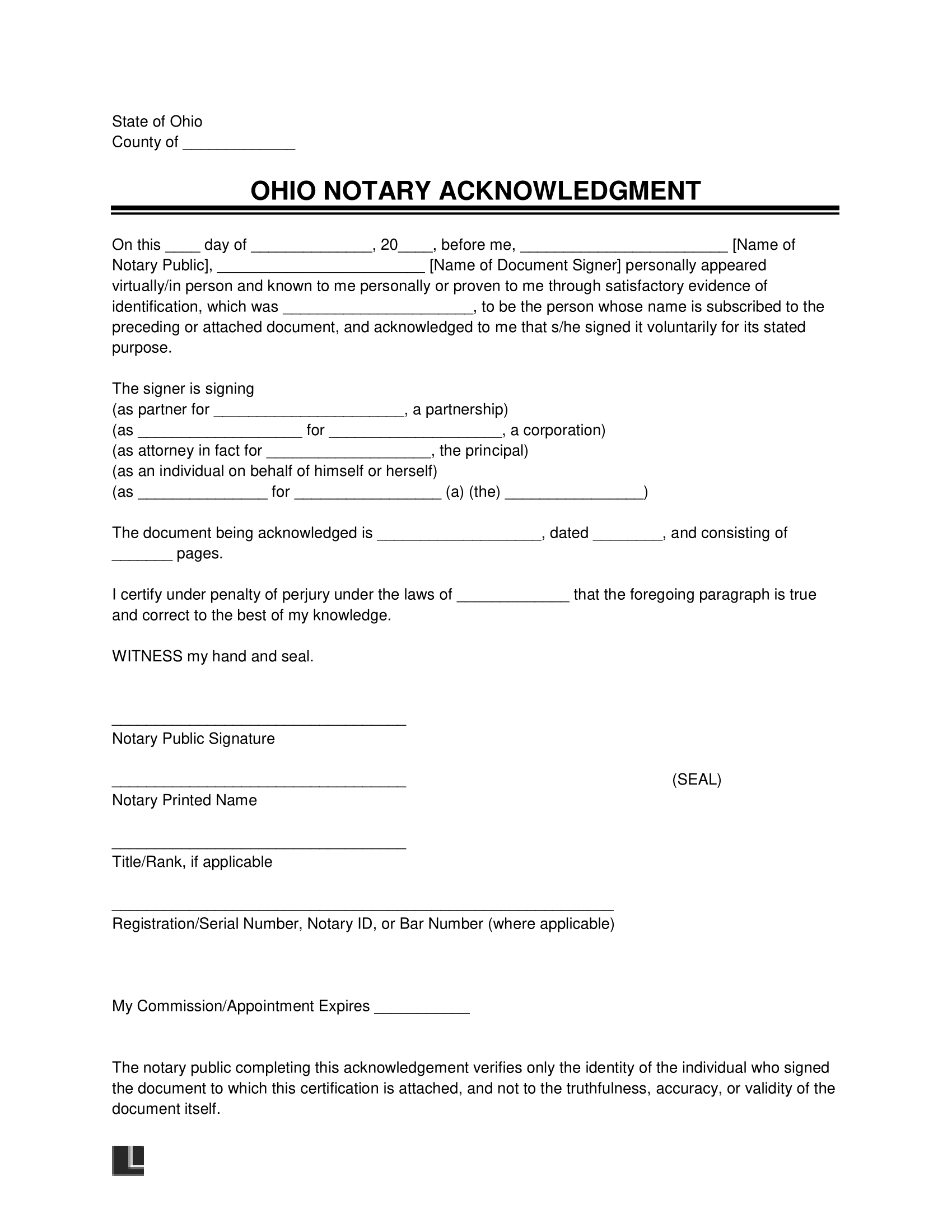
Ohio Notary Acknowledgment Sample
View our Ohio notary acknowledgment template to understand how to structure your notarial certificate. When you’re ready, you can customize your form using our guided questionnaire.
Then, download an Ohio notary acknowledgment in PDF or Word and print out a copy to present to a notary public, along with your signed legal document. They will follow state procedures for notarization and ensure the document is legally notarized.
Is Remote Online Notarization Legal in Ohio?
Yes, remote online notarization (RON) is legal in Ohio. It became legal under the Ohio Notary Modernization Act, which came into effect in September 2019. This framework is codified under OH Rev Code §§ 147.60 through 147.66.
In order to legally perform RON, a notary public must:
- Hold an active, standard Ohio Notary Public commission.
- Complete an additional, state-approved RON education course and pass a specific exam.
- Submit a formal application to the Ohio Secretary of State and pay a $20 authorization fee.
- Select and register the state-compliant technology vendor platforms they intend to use.
The notary public must be physically located in Ohio during the remote notarization session. The signer can be located anywhere, as long as the notary verifies their identity following the requirements under OH Rev Code § 147.64.
To comply with OH Rev Code § 147.65, every Ohio RON session must be recorded using secure electronic technology that captures audio and video. The authorized online notary must keep a copy of the recording for at least 10 years from the date of the notarial act.