



What Is a Cohabitation Agreement?
A cohabitation agreement defines the living arrangements of two unmarried people. It’s helpful for couples who choose not to marry but share finances and other responsibilities.
A living-together contract outlines how partners will manage their assets and expenses. It also explains what happens if they separate or if one partner dies. If one party stops abiding by the contract, the non-breaching party can take legal action to enforce it.
Unmarried people living together don’t enjoy marriage-like protections without a contract. They must write a cohabitation agreement to seek such protections. This document is helpful for:
- Domestic partners who don’t have a legally recognized union
- Common-law partners without an official marriage license
Without this contract, unmarried partners receive limited legal protection. This may lead to disputes over property, shared debts, and support upon a breakup.
When to Use a Cohabitation Agreement
A cohabitation agreement is ideal for any unmarried couple living together. Ideally, they will write it before they move in together.
It provides some legal protection without binding couples to state domestic relations laws. With this contract in place, couples can protect each other from their individual debt, define financial duties, and protect ownership of individual assets. Explore some situations when it’s useful:
- When buying property together
- When one partner contributes more financially
- When one partner has substantial assets or debts
- When there are children involved
How to Write a Cohabitation Agreement
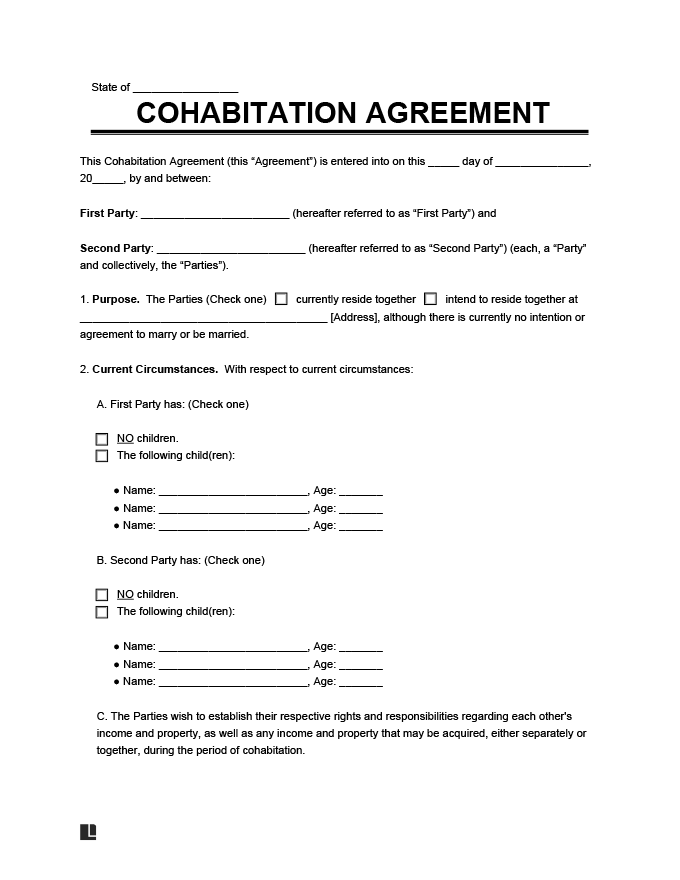
A well-written cohabitation agreement creates clarity and establishes expectations for unmarried partners. Learn what to include in a cohabitation agreement below.
1. Parties’ Information
Record the names of both partners. Designate them as the “first party” and the “second party.” Clarify whether you both already live together.
2. Children’s Details
Indicate whether either party has any children from previous relationships. If so, provide the names and ages of each child. Unless the parties obtain a court order of adoption, Legal Templates’s form assumes each partner is only responsible for their own children.
3. Separate & Shared Property
A property agreement for unmarried couples should define any property the first or second party wants to keep separate. This property can include real property, household items, and personal effects.
If you and your partner own any real or personal property together that you want to specify as shared property, you can indicate this in the contract. Note how shared property will be divided if the relationship ends.
Identifying Separate & Shared Property
Using our guided form, you can list each property item or include an exhibit that defines each item.
4. Separate & Shared Debts
Note whether each party has existing debt or obligations. Like with property, you can list each debt in the contract or attach a separate exhibit. Ensure you clarify whether each party is solely responsible for their individual debt.
At some point, one party may decide to pay the other’s debt. If this happens, you’ll want to know ahead of time whether this act is a gift. You can specify this arrangement in your contract.
If the relationship ends, it’s a good idea to establish how shared debt will be divided. Assign a percentage to each party, clarifying how much of the shared debt they’ll be responsible for.
5. Household Expenses
Include how much each party will contribute to household expenses, assigning a percentage to each party. State whether the parties will pay for household expenses from a joint account.
6. Additional Provisions
Depending on your relationship, you may include other provisions in your common-law agreement. For example, you can outline palimony payments. Palimony is similar to alimony, but it refers to support payments from one unmarried partner to the other if their relationship ends. Not all states legally recognize palimony payments, so you should ensure that this type of agreement is valid before you enter into it.
You may also reference some of your estate planning intentions. You can specify whether your unmarried partner will:
- Be the beneficiary in your last will or retirement accounts
- Inherit your share of the property that you co-own
- Be able to act under a power of attorney
- Make end-of-life decisions
- Manage funeral plans
7. Waiver of Rights
When you write a common-law agreement, you establish your own rules for navigating the relationship. Ensure that both parties waive their rights to claim any rights granted by your state’s cohabitation laws.
8. Termination Procedures
Clarify termination procedures, such as whether the agreement will end:
- Upon either party’s death
- When the parties stop living together
- When either party breaches the contract
- When one party sends a written notice to the other
You can indicate that it will end upon one or more of these conditions. Also, state the number of days that the parties will have after termination to arrange their assets.
9. Governing Law & Date
Specify which state’s laws will govern your living-together agreement. Add a date to the agreement and declare when the agreement will go into effect. Once you finalize these details, you and your partner can add your signatures and seek notary acknowledgment.