



What Is the Purpose of a Postnup?
A postnuptial agreement helps couples clarify financial responsibilities and protect their assets after getting married. It offers a second chance to define economic terms, especially for those who didn’t sign a prenuptial agreement. A postnup can reduce future conflict by setting clear expectations and ease the divorce process, should it ever become necessary.
Couples typically create a postnup when their life circumstances change. Some common reasons include:
- Having children or one spouse becoming a stay-at-home parent
- Buying property or starting a new business
- Taking on new debt or receiving an inheritance
- Changing jobs or seeing a significant shift in income
A postnup helps both spouses feel more secure when financial or personal dynamics shift. It ensures transparency, promotes honest conversations, and provides a clear plan in case the marriage ends.
A postnup doesn’t mean you’re planning to separate—it means you’re planning responsibly.
When Do You Need a Postnup?
Spouses typically create a postnup when their circumstances change during the marriage. For example, if a couple decides to have children, one parent might stay home to care for them. In this case, the stay-at-home parent could become financially vulnerable without a postnup. A postnup can help protect both spouses by outlining financial support or asset division in case the marriage ends.
Some other life changes during a marriage that a postnup can help navigate include:
- buying property
- starting a business
- changing jobs and earning a different amount of income
- taking on debt
- receiving an inheritance
In these situations, a postnup helps by clearly stating how money and property will be divided before problems arise. This planning can lower conflict if a divorce occurs and ensure that financial matters are handled as agreed. Creating a postnup lets couples protect their finances and avoid extra stress if their marriage ends.
Do I Need a Lawyer to Write a Postnup?
While you can draft the agreement yourself, you may consider getting a lawyer to review it to ensure it’s fully compliant with the law. A postnup is a complex legal document with strict requirements, but a lawyer can ensure your postnup is enforceable and accurately reflects your and your spouse’s preferences.
In some states, like California, Florida, Texas, and New York, courts strongly recommend that each spouse have independent legal counsel when creating a postnup. This helps ensure that both parties fully understand the terms and that the agreement is considered fair and voluntary, which are key factors in whether a court will enforce it.
Are Postnuptial Agreements Enforceable?
Postnuptial agreements can be enforceable, but courts review them closely. For a postnup to hold up legally, it must be fair, voluntary, and created with complete financial transparency. If any part of the agreement seems one-sided or was signed under pressure, a judge may reject it.
Some states are stricter than others. In community property states like California and Texas, postnups face extra scrutiny. These states expect both parties to have equal bargaining power and full disclosure. That’s why working with a lawyer is often recommended, especially in high-asset or high-conflict cases.
In general, to be enforceable, a postnup should:
- Be written (not verbal)
- Be signed by both spouses voluntarily
- Include full financial disclosures from each party
- Contain fair and reasonable terms for both sides
- Comply with your state’s laws and public policy
Postnup vs. Prenup
Both prenuptial and postnuptial agreements help couples make financial decisions and set expectations in case their relationship ends. The biggest difference? Timing. A prenup is signed before the wedding. A postnup is signed after you’re already legally married.
Here’s how they compare:
| Feature | Prenup | Postnup |
|---|---|---|
| When it's created | Before marriage | After marriage |
| Legal standing | Generally more enforceable | Enforceable but may face more scrutiny |
| Requires full disclosure? | Yes | Yes |
| Covers same topics? | Yes—property, debt, spousal support | Yes—same topics, minus child matters |
| Legal counsel recommended? | Strongly recommended | Often strongly recommended |
While both documents serve similar purposes, courts may be more skeptical of postnups, especially if there’s an imbalance of power or assets. Independent legal counsel and full financial transparency can make either agreement stronger and more enforceable.
Postnuptial Agreement vs. Divorce Agreement
A postnup is a document created by couples during their marriage. It details changes in circumstances, helps couples clarify their financial arrangements, and provides financial protection during the marriage and potentially afterward.
On the other hand, a divorce agreement is part of the final divorce decree that officially ends the marriage. It covers all the important issues, like how the couple will divide their debts, assets, spousal support, and other matters, once the divorce is complete.
These documents differ in four major ways:
- Timing: A couple creates a postnup while married, but they create a divorce agreement when they plan to get divorced.
- Purpose: A postnup sets financial protections during the marriage, while a divorce agreement finalizes the division of assets and other matters once the couple is divorcing.
- Enforceability: A divorce agreement is legally binding once approved by the court, while a postnup is enforceable but may need court approval.
- Provisions: A divorce agreement includes more provisions, such as child support and custody arrangements, that are not allowed in a postnup.
If you’re considering divorce, you may want to create a separation agreement instead of a postnup. A separation agreement can address similar topics—like property division and financial support—but is designed for couples who are actively separating or planning to divorce.
What to Include in a Postnup
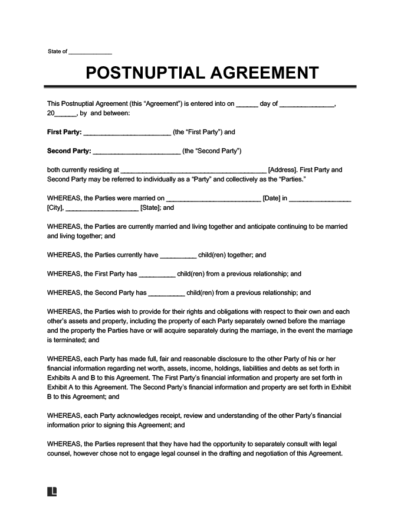
Now that you and your spouse have shared the basic information, you can start working on the main parts of your postnup. This is where you decide how to handle your money, property, and debts during your marriage and if it ever ends.
- Property Ownership: Specify the treatment of property owned before marriage and property acquired after marriage.
- Division of Marital Property: Decide how to divide marital property if the marriage ends.
- Business Ownership: Clarify the division of businesses owned before marriage and businesses acquired during the marriage.
- Debts: Specify the treatment of debt owed before the marriage and debt acquired during the marriage.
- Division of Marital Debt: Decide how to divide debts if the marriage ends.
- Taxes: State whether you and your spouse will file your tax returns jointly or separately.
- Housing Arrangements: Declare the division of the marital home if you separate from your spouse.
- Pets: Describe provisions for pets acquired during the marriage, such as which party will take ownership or have visitation rights if the marriage ends.
- Spousal Support: Decide whether the parties will waive spousal support or if one will be responsible for paying it.
- Disability: Clarify if one party will support the other if the other becomes disabled.
- Death: Explain what happens to the marital property and the deceased person’s property if one spouse passes away.