What Is an Alabama Notary Acknowledgment?
An Alabama notary acknowledgment is a formal statement that a notary public has identified a signer and confirmed they signed a document of their own free will. To complete this form, the signer must personally appear before the notary public (AL Code § 36-20-73.1).
Before confirming the signer’s signature, the notary must verify the signer’s identity. They can do so either by personal knowledge of the signer or by viewing a government-issued ID with a photograph.
The signer may sign their legal document before getting a notary acknowledgment. However, if they sign it before going in front of the notary, they must verbally declare that the signature is their own. Alternatively, the signer can sign the document in the notary’s presence.
An Alabama notary acknowledgment prevents fraud by ensuring that the signer signs their own name and no one else’s. In general, a notary may not perform a notary acknowledgment form for an incomplete legal document. This prevents the signer from adding new terms after the acknowledgment is complete.
What to Include in an Alabama Notary Acknowledgment
An Alabama notary acknowledgment requires the following elements (AL Code § 35-4-29):
- The state (Alabama) and county
- The name of the notary
- The signature and seal of the notary (following the requirements under AL Code § 36-20-72)
- The expiration date of the notary’s commission
- The date of the acknowledgment
- The signer’s name
- Verbiage that confirms the notary is identifying the signer and witnessing their intent to execute the document
State law recognizes notary acknowledgments made in various capacities. For example, a notary public may notarize acknowledgments made for individuals, corporations, and others in a representative capacity.
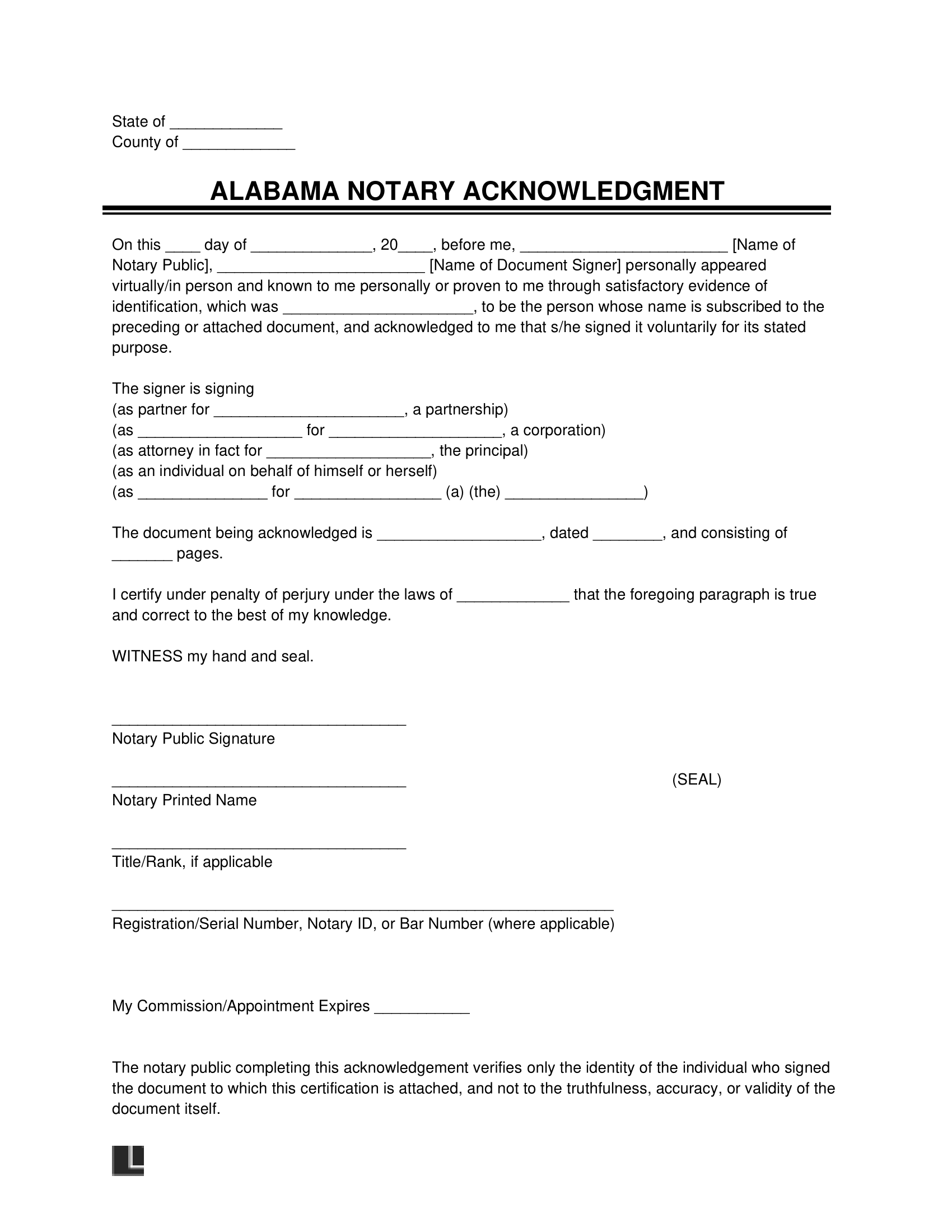
Sample Alabama Notary Acknowledgment
View our Alabama notary acknowledgment form to understand how to complete yours. Our guided form makes it easy to enter your custom details, including the signer’s name and the entity or individual they’re signing on behalf of (if applicable).
Write your form today using Legal Templates’s guided questionnaire, then download it in PDF or Word. Our printable document will be ready for you to take to a notary public, who can complete the official notarization process.
Is Remote Ink-Signed Notarization Legal in Alabama?
Yes, remote ink-signed notarization was permanently authorized in Alabama with the passage of Senate Bill 275 on July 1, 2021. This bill, which is codified in AL Code § 36-20-73.1, implements the following requirements for remote notarization:
- The signer must sign their name on physical paper with wet ink. Digital signatures are not allowed.
- The notary public must be physically located in the state. The signer can be located anywhere.
- The notarization session must occur using recorded two-way audio-video communication technology.
- The notary must retain a recording of the session for at least seven years.
If you prefer a fully digital process, you can use out-of-state notaries. Alabama law recognizes documents that have been properly notarized online by a notary commissioned in another state that has true remote online notarization (RON) laws.
Documents That Typically Require Notarization in Alabama
When you have certain documents notarized, you can ensure they are properly recorded and legally recognized. View some legal documents that typically require notary acknowledgment in Alabama:
- Durable power of attorney
- Non-durable power of attorney
- Limited power of attorney
- Real estate power of attorney
- Minor power of attorney
- Power of attorney revocation
- Warranty deed
- Quitclaim deed
- Living trust
Some personal and financial documents don’t strictly require notarization, but you can still get a signature authenticated to prevent disputes over the document’s legitimacy. Consider notarization for documents such as: