What Is a California Notary Acknowledgment?
A California notary acknowledgment validates the authenticity of signatures on legal papers. A notary public completes it to ensure the voluntary signing of a document, such as a property deed or power of attorney. The notary public also checks the signer’s identity to prevent fraud.
Notaries public should request satisfactory evidence to confirm a signer is who they claim to be. Satisfactory evidence can include any of the following:
- A paper ID issued within the last five years; it must contain a serial number, photograph, description, and signature
- Confirmation from one credible witness who the notary knows personally
- Confirmation from two credible witnesses (they don’t have to know the notary, but they must show their own valid IDs)
When appearing before a notary public for a California notary acknowledgment, a signer can sign their name in the notary’s presence or present a pre-signed document. If they present a pre-signed document, they must attest that it’s their signature on it.
How to Fill Out a California Notary Acknowledgment
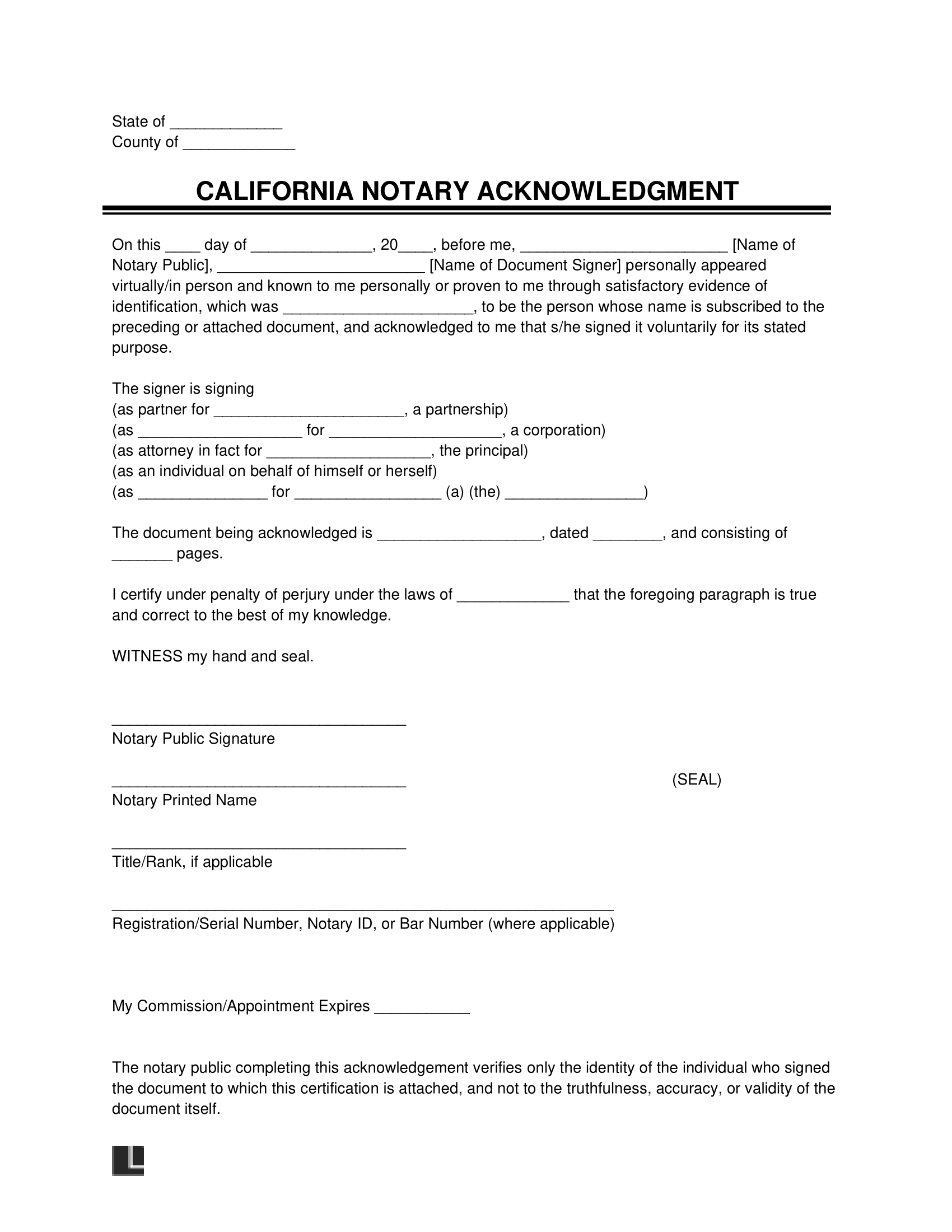
When filling out a California notary acknowledgment, the notary public must include the following elements:
- Venue where the acknowledgment takes place (usually the county)
- The date of acknowledgment
- The name of the document signer
- The date when the notary’s commission expires
- The notary’s signature
- The notary’s official seal
Unlike other states, a notary acknowledgment in California does not need to specify the capacity of the signer. For example, it doesn’t need to say whether the signer is signing as an individual, on behalf of a corporation, or in another representative capacity. It only needs to verify their identity.
CA Civ Code § 1189 requires a specific disclaimer to appear at the top of a California notary acknowledgment. It must state that the notary public is only verifying the signer’s identity, not the truthfulness, validity, or accuracy of the document itself.
California Notary Acknowledgment Sample
View an example of our California notary acknowledgment form to get an idea of the key elements. Then, create your own using our guided questionnaire and download a printable notary form for California in PDF or Word format.
Is Online Notarization Legal in California?
While California has passed legislation to allow remote online notarization (RON), the state is currently in a transitional “phased” rollout. Learn about the nuances involved to ensure legal documents are properly executed and accepted:
- Under SB 696, California legally recognizes and accepts documents notarized online by commissioned notaries in other states. This is the primary way Californians currently access online services.
- Although the law is on the books, California-commissioned notaries cannot yet perform online notarizations. They must wait for the Secretary of State to complete the necessary technology infrastructure, which is expected to be fully operational by 2030.
- Online notarizations performed by out-of-state platforms are valid for most California legal agreements. However, they must meet the statutory requirements of the notary’s home state.
Documents That Typically Require Notarization in California
A state of California notary acknowledgment helps signers meet execution requirements for the following documents:
- Durable power of attorney
- Non-durable power of attorney
- Limited power of attorney
- Real estate power of attorney
- Minor power of attorney
- Power of attorney revocation
- Self-proving affidavit
- Warranty deed
- Quitclaim deed
- Living trust
Some legal documents may not explicitly require notarization. However, that doesn’t mean you should forgo it completely. Consider notarization for these documents to increase their legal validity: