What Is a Massachusetts Notary Acknowledgment?
A Massachusetts notary acknowledgment is a form that verifies a signer’s signature on a legal document. The signer goes before a notary public with a legal document that needs their signature as the principal. The signer either signs it in front of the notary or signs it beforehand and acknowledges the signature as their own.
A notary public signs and stamps a Massachusetts notary acknowledgment to confirm that the signer appeared before them. They also verify that the signer is who they claim to be and that they signed the document of their own free will.
When a legal document has a signed Massachusetts notary block, requesting organizations can be more confident that it has been properly executed.
A Massachusetts notary acknowledgment does not confirm that the document’s contents are accurate. Instead, it only confirms that the signer signed the document for its stated purpose.
Documents That Typically Require Notarization in Massachusetts
Massachusetts law sometimes requires documents to be notarized. Otherwise, they won’t be legally enforceable in courts. Here are some documents that typically require notarization:
- Durable power of attorney
- Non-durable power of attorney
- Limited power of attorney
- Real estate power of attorney
- Minor power of attorney
- Power of attorney revocation
- Warranty deed
- Quitclaim deed
- Living trust
Some documents are more informal or otherwise don’t require recording. However, this doesn’t mean they can’t benefit from notarization. Here are some documents that you should consider getting notarized to increase requesting organizations’ confidence in them:
Legal Requirements for a Massachusetts Notary Acknowledgment
A Massachusetts notary acknowledgment is a helpful form that enhances the credibility of a legal document. However, you must follow certain guidelines when completing yours. Keep these points in mind to ensure compliance:
-
Contents of the acknowledgment: Your Massachusetts notary block must contain the following elements (per MA Gen L ch 222 § 15):
- The notary’s name
- The notary’s signature and seal
- The signer’s name
- The date of the notarization
- The commission expiration date
- The method used to prove the signer’s identity
-
Evidence of the signer: A notary must confirm the signer’s identity with one of the following pieces of evidence (per MA Gen L ch 222 § 1):
- A photographic ID issued by the US government
- An oath from a credible witness who is personally known to the notary public and who personally knows the signer
- The notary public’s personal knowledge of the principal’s identity
- Representative capacity: The MA notary acknowledgment must state the capacity in which the signer is signing, especially if they are signing on behalf of a trust, corporation, or partnership.
- Seal requirements: The notary public’s seal must be in black ink and placed near the signature, but not obscure any text in the acknowledgment. It must also contain the words “notary public” and “Commonwealth of Massachusetts,” the notary’s name, and an expiration date of the commission (MA Gen L ch 222 § 8).
Is Remote Online Notarization Legal in Massachusetts?
Yes. Remote online notarization (RON) was permanently authorized by MA House Bill 58, signed in early 2023, and took effect on January 1, 2024. The notary must be physically present in Massachusetts to complete the notarization, but the signer can be located in a different state.
A Massachusetts notary public must complete a specialized registration process with the Secretary of the Commonwealth. If they do not go through this process, they can only complete in-person notary services.
A notary public must use tamper-evident technologies to perform remote notarial acts. The audio-video technology they use must provide synchronous audio-fusal feeds, and any recording must be kept on file by the notary for at least 10 years (MA Gen L ch 222 § 28).
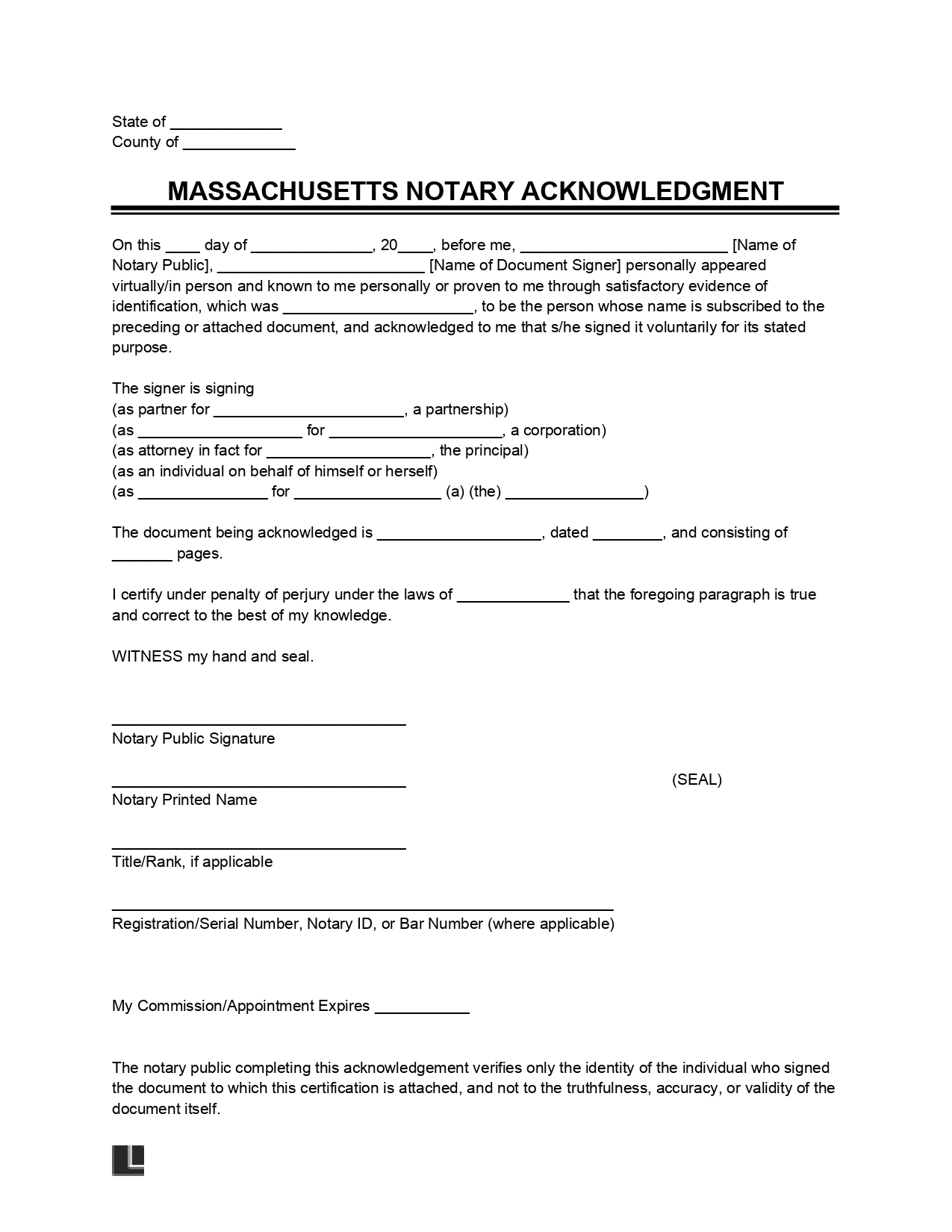
Sample Notary Acknowledgment for Massachusetts
View an example of our sample notary statement for Massachusetts to see how to structure your notary block. Customize your own with the signer’s name and date of notarization using Legal Templates’s form. Then, download it in PDF or Word format and present it to a notary public who can legally complete the form.