What Is a New Hampshire Notary Acknowledgment?
A New Hampshire notary acknowledgment form authenticates a signature on a legal document. It does not confirm the accuracy of the document’s contents. Instead, it only verifies that the signer appeared before a notary public and signed the document for its stated purpose.
The signer must personally appear before the notary public (NH Rev Stat § 456-B:2-a) and prove their identity. The notary public may accept the following types of evidence for identity proof (NH Rev Stat § 456-B:2-b):
- Personal knowledge of the signer
- An acceptable government-issued ID card with a photo
- An oath from a credible witness
If it’s more convenient, a signer can sign their legal document before appearing in front of the notary public. If they don’t, they must sign before the notary public. In either case, the signer must acknowledge the signature as their own and that they are signing freely without coercion. Once they sign and the notary public takes the acknowledgment, they can complete the form and affix it to the original legal document that the signer signed.
A signer may appear before a New Hampshire notary public or Justice of the Peace. Either officer must follow the New Hampshire notary rules and take an oath to act in their official capacity under NH Rev Stat § 92-2.
Documents That Typically Require Notarization in New Hampshire
Local Registries of Deeds, circuit courts, banks, and other entities often demand notarization for certain real estate and financial documents. With notarization, they can endorse documents as being properly executed. This precaution can prevent fraud and ensure that documents are accepted and recorded efficiently. Here are some examples of documents that typically require notarization in New Hampshire:
- Durable power of attorney
- Non-durable power of attorney
- Limited power of attorney
- Real estate power of attorney
- Minor power of attorney
- Power of attorney revocation
- Warranty deed
- Quitclaim deed
- Living trust
Other documents may not officially require notarization. However, you may still consider getting them notarized to enhance their authenticity and prevent questions over their legitimacy. Examples of documents that may benefit from notarization in New Hampshire include the following:
What to Include in a New Hampshire Notary Acknowledgment
When completing a New Hampshire notary acknowledgment form, a notary public should include the following details (NH Rev Stat 456-B:7):
- The notary public’s name
- The signer’s name
- The venue where the acknowledgment is taking place
- The date of the acknowledgment
- The capacity of signing
- The words “Notary Public”
- The words “New Hampshire”
- The expiration date of their commission
New Hampshire does not issue commission numbers to notaries public, so you may write “N/A” in the field that requests this detail on Legal Templates’s form.
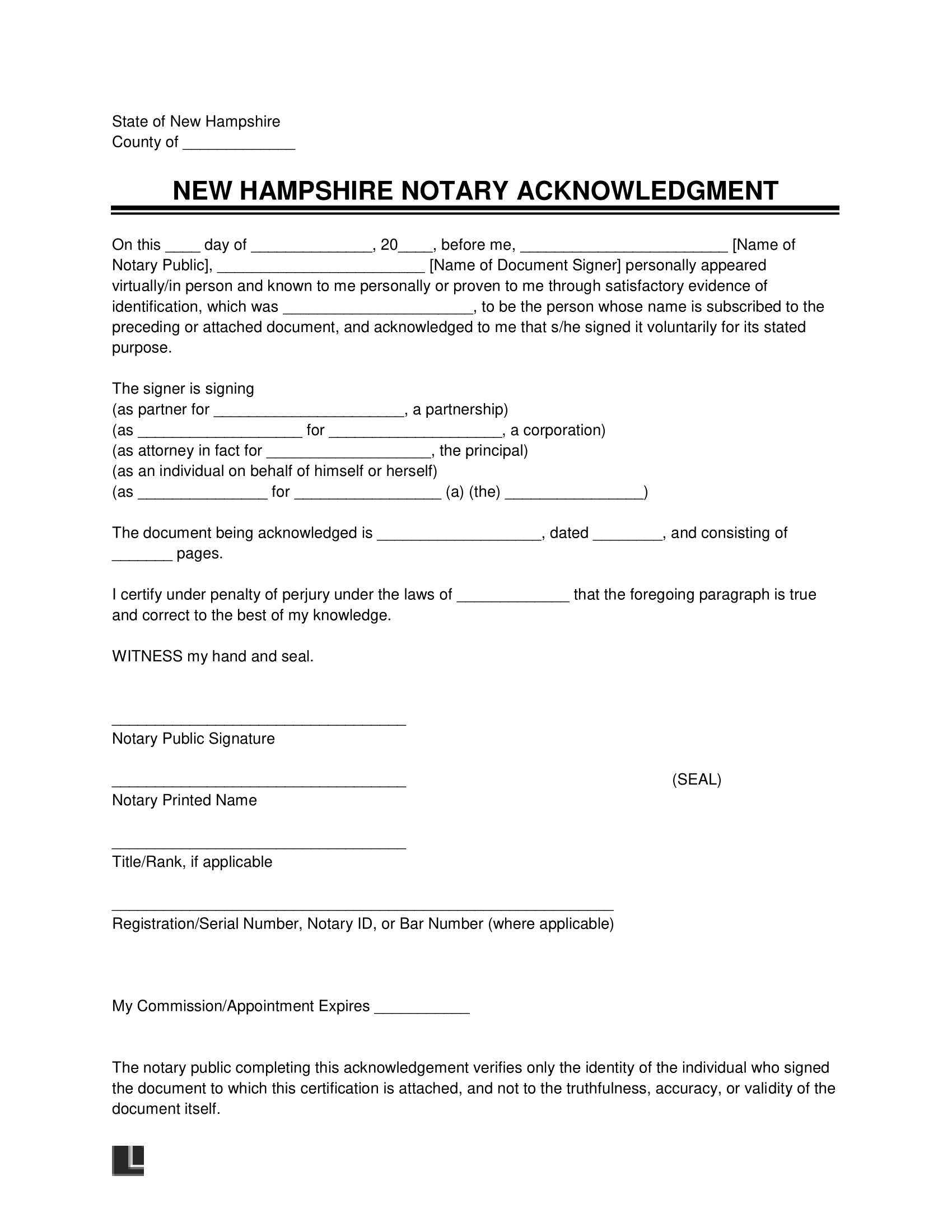
Sample New Hampshire Notary Acknowledgment
View our sample New Hampshire notary acknowledgment form to see how to add your details, including the legal form being acknowledged and the evidence used to confirm the signer’s identity. Fill out yours using Legal Templates’s guided questionnaire, then download it in PDF or Word. Take your NH notary acknowledgment form to a notary public, who will take your acknowledgment and add their seal and stamp.
Is Remote Online Notarization Legal in New Hampshire?
Yes, New Hampshire permits remote online notarization (RON). Senate Bill 134, which became effective on February 6, 2022, legalized RON. RON is performed via a live, uninterrupted, two-way audio-video recording of the entire signing act. Here are the rules for RON in New Hampshire.
- The notary public must be located in New Hampshire.
- The signer can be located anywhere, including in a different state or country. If they are located outside of the US, the document being acknowledged must relate to a US affair.
- The notary public must prove the signer’s identity via personal knowledge, an oath from a credible witness, or at least two types of identity proofing (NH Rev Stat § 456-B:6-a).
- The NH notary acknowledgment form must explicitly state that RON was used.
- The notary’s digital signature must use a digital certificate meeting X.509 cryptographic standards.
- The notary must keep a record of the act for 10 years.
Senate Bill 134 also permits electronic notarization, which involves the digital signing of a document when the notary public and signer are in the same room.