What Is a South Carolina Notary Acknowledgment?
A South Carolina notary acknowledgment form is attached to a legal document to verify that a signer appeared before a notary public and acknowledged signing the document voluntarily. It confirms the signer’s identity and that they acknowledged their signature, not that the document’s contents are true. The signer may sign before or during their meeting with the notary public.
It helps the signer (the principal) meet legal requirements when notarization is required or strongly encouraged. The notarization is not valid unless the signer appears physically before the notary. This way, the notary public can accurately confirm the signer’s identity via personal knowledge, a credible witness, or government-issued photo ID.
Is Electronic Notarization Legal in South Carolina?
Yes. A notary public can perform an electronic notarization (also called an e-notarization) in South Carolina. This is permitted under the SC Electronic Notaries Public Act.
However, the notary public and the signer must be in the physical presence of each other for the notarization to be valid. Remote online notarization (RON), which occurs when the notary public and the signer are not in the same location, is not permitted in South Carolina.
South Carolina banks and courts may accept documents notarized by other out-of-state notaries.
What to Include in a South Carolina Notary Acknowledgment
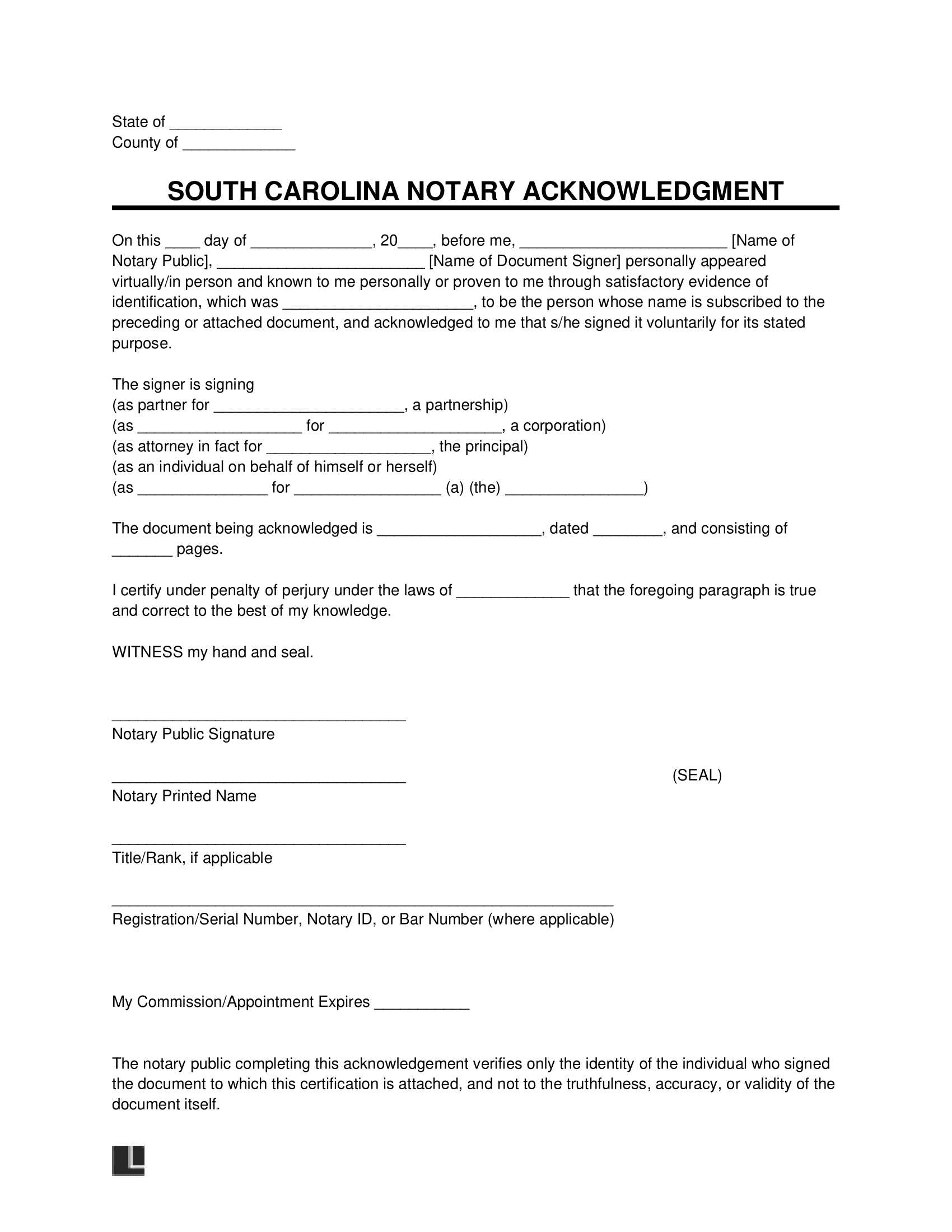
Here are the key elements of an SC notary acknowledgment form:
- The state and county of notarization
- A statement verifying that the signer appeared before the notary and acknowledged their signature
- The notary’s signature (it should appear exactly as it does on their commission)
- The notary’s rubber stamp or embosser seal (required under SC Code § 26-1-60)
- The date that the notary’s commission expires
- The notary’s title (often listed as “Notary Public for South Carolina”)
Most SC notary acknowledgment forms will contain similar details. The elements included may vary depending on the capacity in which the signer is completing it. SC Code § 26-3-70 offers statutory short forms of acknowledgment for the following parties:
- For individuals acting in their own right
- For corporations
- For partnerships
- For individuals serving as attorneys-in-fact
- By any public officers, trustees, or personal representatives
Resources for SC Notaries Public
Notaries public in SC should ensure they adhere to the SC Notary Public Reference Manual to perform a valid notarization. If you are a signer looking for someone to notarize your legal document, you can use the South Carolina notary search tool available from the Secretary of State.
Sample South Carolina Notary Acknowledgment
View an example of a South Carolina notary acknowledgment form to see how to fill out your own. Legal Templates helps you record the key details, and then you can download it as a PDF or Word document. Present your SC notary signature template before a notary public to complete the process.
Documents That Typically Require Notarization in South Carolina
It’s common for various South Carolina legal documents to require notarization for them to uphold their legitimacy. Here are some examples of forms that require a notary public’s seal and signature (ensure that you confirm other witnessing requirements):
- Durable power of attorney
- Non-durable power of attorney
- Limited power of attorney
- Real estate power of attorney
- Minor power of attorney
- Power of attorney revocation
- Self-proving affidavit
- Warranty deed
- Quitclaim deed
- Living trust
State law does not explicitly require notarization for some documents, forms, and contracts. However, you should consider going before a notary public for the following forms to give them an extra layer of legal protection:
- Loan agreement
- Promissory note
- Vehicle bill of sale
- Prenuptial agreement
- Postnuptial agreement
- Commercial lease agreement
Do South Carolina titles need to be notarized?
No. Vehicle titles in South Carolina do not have to be notarized in order for the ownership to transfer. Instead, the seller only needs to sign and print their name and record the mileage and price on the back side of the title.