What Is a Wisconsin (Minor) Child Power of Attorney?
A Wisconsin minor (child) power of attorney form is a legal document that allows a parent or legal guardian to temporarily give another adult the authority to care for their child. This can include making decisions about the child’s healthcare, education, and other daily needs.
Under WI Stat § 48.979, all parents with legal custody can assign these responsibilities to a trusted person, often called an agent. This arrangement is typically used when a parent is unavailable for a period of time. This can be due to travel, illness, or work obligations.
It is important to understand that this document does not transfer legal custody of the child. The parent or guardian retains all their parental rights. They can still make a decision for their child at any time. A minor child’s POA in Wisconsin is used only for short-term arrangements, not for permanent care.
If you need long-term care arrangements, you may need a minor guardianship instead of a power of attorney. Wisconsin law also allows a standby guardian in certain situations under WI Stat § 48.978.
Legal Requirements for a Minor (Child) Power of Attorney in Wisconsin
Here are a few basic legal requirements you must meet when creating a minor (child) power of attorney in Wisconsin.
Who Can Create The Form
Only a parent or a legal guardian with custody of the child can create this document (WI Stat § 48.979(2)). If more than one parent has legal custody, both may need to sign the document for it to be valid.
Who Can Be Appointed as an Agent
In Wisconsin, you can choose any trusted adult to act as the agent. This person should be able to care for the child and handle responsibilities, including healthcare and school decisions.
If an organization helps arrange the power of attorney, it may need to review the agent’s background, fitness, and ability to take care of the child under WI Stat § 48.979(3)(b)(2).
Who Should Sign
A minor (child) POA should be signed by both parents or a legal guardian. The document should also be properly notarized to help confirm its validity. Legal Templates offers a free Wisconsin notary acknowledgment form that complies with state laws and can be filled out quickly.
When Does a Wisconsin Minor (Child) POA Form Take Effect?
A Wisconsin minor (child) power of attorney typically becomes effective on the date it is signed, unless you specify a future start date in the form. You can choose the exact start date when completing the document.
How Long Does a Wisconsin Minor (Child) Power of Attorney Last?
Under WI Stat § 48.979(1)(am), the document may remain in effect for up to one year. If you do not list an end date, it will automatically expire one year after it begins. In some instances, however, the arrangement may last longer than one year, such as when:
- The agent is a relative of the child
- A court approves a longer period (WI Stat § 48.979(1m))
How to Revoke a Minor (Child) Power of Attorney in Wisconsin?
Only a parent or a legal guardian can revoke a Wisconsin minor (child) power of attorney at any time. As per WI Stat § 48.979(1)(e), you must revoke the document in writing. Verbal notices are not enough to terminate the document.
Create a written revocation that clearly states that you are canceling the power of attorney. Also, be sure to inform any third parties who are relying on the document, such as schools or healthcare providers.
Sample Wisconsin Minor Child Power of Attorney
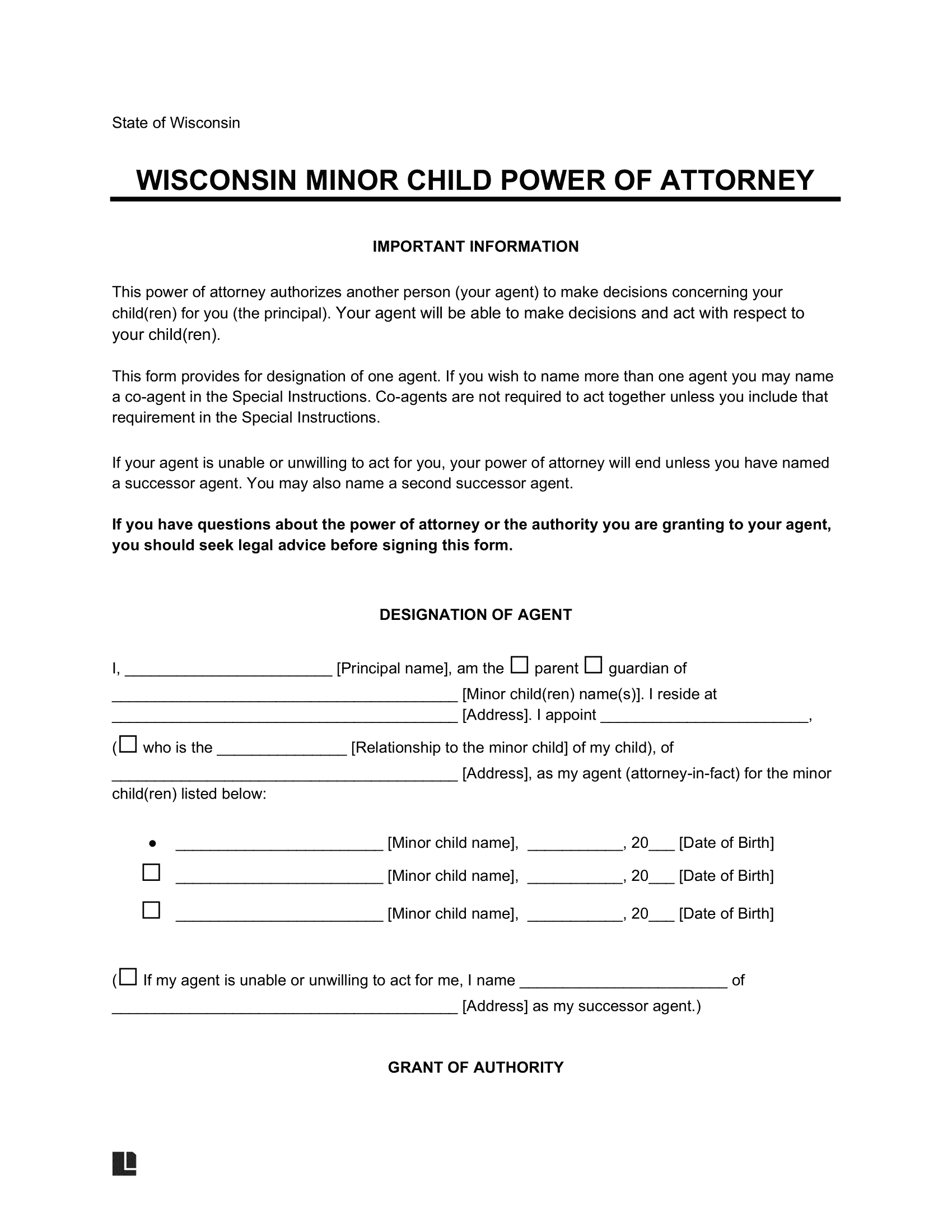
See a sample Wisconsin minor (child) power of attorney template below to understand what details you’d need to include. Then, once you’re ready, answer a few simple questions in our guided form to customize and download yours in PDF or Word format.
Other Considerations for a Wisconsin Minor POA
There are a few important legal limits that apply to a Wisconsin minor (child) power of attorney form that you should be aware of, including that:
- It does not prevent abuse or neglect investigations: Authorities can still investigate suspected abuse or neglect, and a power of attorney doesn’t prevent such investigations (WI Stat § 48.979(1)(d)1).
- It does not override court authority: Creating a Wisconsin minor power of attorney form does not prevent a court from taking action involving the child. The court can still make decisions about custody and the child’s safety when needed (WI Stat § 48.979(1)(d)2-4).
- Special rules may apply to Indian children: If the child is Native American, additional legal protections may apply. These rules may give tribal authorities a role in decisions regarding the child’s care (WI Stat § 48.979(1)(dm), § 48.028).
- Additional requirements may apply if an agency is involved: In Wisconsin, if an organization helps set up the minor power of attorney, it may need to review the agent’s background and ability to care for the child (WI Stat § 48.979(1)(b)).