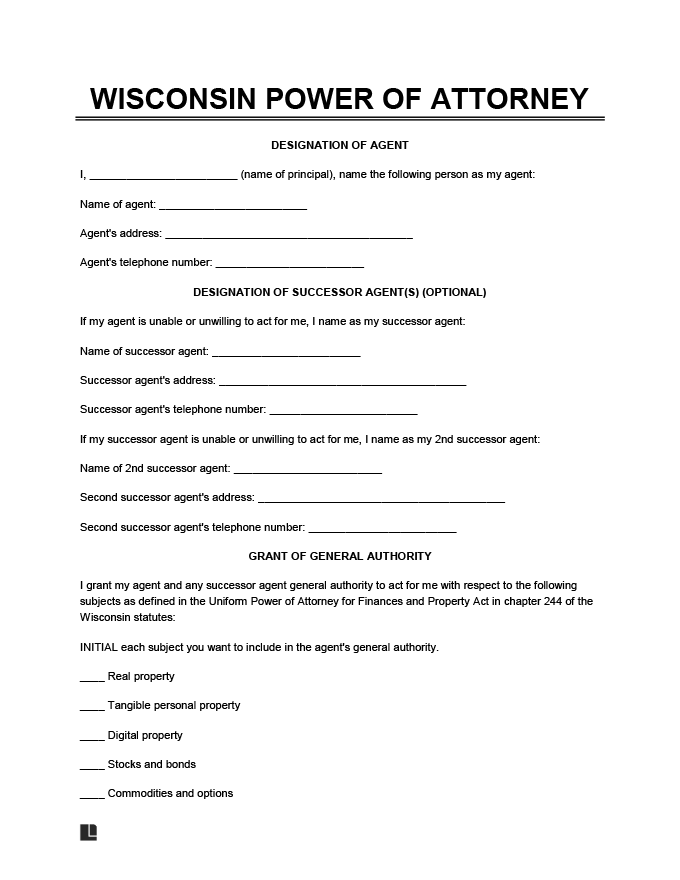
What Is a Wisconsin Power of Attorney?
A Wisconsin power of attorney (POA) is a legal document that grants someone else the authority to act on your behalf. This person is referred to as your agent (or attorney-in-fact), and you are the principal.
You can choose what powers to give your agent. These may include managing your finances, property, legal matters, or healthcare decisions. You can also add specific instructions about what they can and cannot do.
In the state of Wisconsin, POAs are governed by Wisconsin Statutes Chapter 244 (the Uniform Power of Attorney for Finances and Property Act). If you are creating a healthcare power of attorney, it must follow Wisconsin Statutes Chapter 155 (Power of Attorney for Health Care).
To create a valid POA, the principal must be at least 18 years old and mentally competent at the time of signing (WI Stat § 244.05).
Types of Power of Attorney in the State of Wisconsin
Wisconsin recognizes that various types of power of attorney (POA) are based on the decisions the agent is authorized to make and the duration of their authority. Some POAs are broad, while others apply only to specific tasks or situations.
General Power of Attorney
A general POA gives your agent broad legal and financial powers. However, Wisconsin law requires that you expressly grant each power in the POA document (WI Stat § 244.41). These typically include:
- Managing bank and investment accounts
- Buying, selling, or maintaining real estate or personal property
- Filing taxes or handling government benefits
- Managing insurance, retirement accounts, or business interests
Durable & Non-Durable Powers of Attorney
A durable POA stays in effect even if you become incapacitated. In Wisconsin, POAs are presumed durable unless the document states otherwise. A non-durable POA ends if you lose mental capacity. If you want your POA to be non-durable, you must say so clearly in the form (WI Stat § 244.04(2)).
Financial Power of Attorney
A Wisconsin financial POA lets your agent manage your money and property. You can choose which powers to grant. Possible powers include:
- Accessing bank accounts and using credit cards
- Buying or selling real estate or personal property
- Filing taxes and handling insurance
- Managing business or investment matters (WI Stat § 244.45–§ 244.48)
Medical Power of Attorney
In Wisconsin, a medical POA, also called a health care POA, lets your agent make medical decisions for you if you can’t make them yourself due to illness or incapacity.
Health care POAs are governed by Wisconsin Statutes Chapter 155 and only take effect if two physicians, or one physician and one licensed psychologist, declare you incapacitated following a personal examination. You must sign the form in front of two qualified adult witnesses (WI Stat § 155.10–155.70).
Limited Power of Attorney
A limited POA in Wisconsin allows your agent to act on your behalf for a specific task. You can use this type of POA when you’re unavailable to handle something personally but don’t want to give full or long-term authority to your agent. Here are some common situations where you may choose a limited POA:
- Letting your agent sign closing documents if you’re out of state
- Giving your agent temporary control of a vehicle title transfer
- Allowing your agent to file business forms or legal paperwork on your behalf
Under Wisconsin law, a POA is effective once signed unless it clearly specifies a future date or event, such as your absence or incapacity. A limited POA automatically ends when the stated task is completed or the POA’s expiration date passes (WI Stat § 244.09).
Durable (Financial)
An agent may continue to act on behalf of a principal who becomes incapacitated.
Signing Requirements: Notary public (§ 244.05).
Medical
Use so your medical wishes become legally enforceable if you become incapacitated.
Signing Requirements: Two witnesses (§ 244.05).

Limited (Special)
Use for a very specific purpose, such as for real estate or property transactions.
Signing Requirements: Notary public (§ 244.05).
Non-Durable (General)
Nominate a third party (agent) to take care of your business and financial affairs.
Signing Requirements: Notary public (§ 244.05).
Springing
Comes in effect at a future time and only when a specific event occurs, such as the incapacitation of the principal.
Signing Requirements: Notary public.
Vehicle
Lets you delegate someone to represent your interests regarding your vehicle.
Signing Requirements: Notary public.
Real Estate
Entrust someone to handle decisions relating to your property.
Signing Requirements: Notary public.
Minor (Child)
Delegate an attorney-in-fact to make decisions on your child's behalf.
Signing Requirements: Notary public and one optional witness.
How to Get a Power of Attorney in Wisconsin
Follow these steps to create a valid and enforceable POA under Wisconsin law.
- Name the Principal and Agent: List the full legal names of the principal and the agent. In Wisconsin, your agent can be any trusted adult. There are no residency or relationship restrictions. Under WI Stat § 244.14, agents must act in good faith, follow your instructions, and act in your best interests.
- Choose the Powers to Grant: Clearly state what your agent can and cannot do on your behalf. You may grant authority over finances, property, business affairs, or other personal matters. You can limit or expand these powers as needed (WI Stat § 244.41).
- Decide When it Takes Effect: In Wisconsin, your POA takes effect immediately upon signing unless you specify a future date or condition, like if you become incapacitated. This is known as a springing POA (WI Stat § 244.09).
- State Whether It is Durable or Non-Durable: Wisconsin POAs are durable by default, meaning they stay valid if you become incapacitated. Therefore, if you want your POA to end upon incapacity, you must clearly state that within the document (WI Stat § 244.04).
- Keep Copies: Store your completed POA in a secure place. Provide copies to your agent and any institutions that may need to rely on it, such as your bank or doctor’s office.
Wisconsin Power of Attorney Requirements
For a POA to be legally valid in Wisconsin, your POA must meet specific state requirements. These rules ensure that your document will be accepted by banks, hospitals, and courts. Legal Templates makes it easy to create a POA that meets these rules. Simply answer a few questions to customize and download your form in PDF or Word format.
Writing and Signature
Your POA must be in writing and signed by you (the principal) or signed at your direction in your presence (WI Stat § 244.05).
Notarization and Witnesses
Wisconsin has different rules for how a POA must be signed and witnessed, depending on the type of POA you create.
- For Financial POAs: Notarization is not officially required but strongly recommended for financial POAs. A notarized signature is presumed genuine and may be more readily accepted by third parties (WI Stat § 244.05(2)).
- For Medical POAs: In Wisconsin, you must sign your health care POA in front of two qualified adult witnesses. These witnesses cannot be related to you, entitled to inherit from you, or involved in your healthcare (WI Stat § 155.10(c))
Revocation Rules
You can cancel (revoke) your POA at any time as long as you are mentally competent. The revocation should be in writing and shared with your agent or anyone else relying on the POA.
Under WI Stat § 244.10, a POA ends when:
- You revoke it
- The POA has a set end date that has passed
- The purpose of the POA is fulfilled
- You become legally incapacitated, and the POA is not durable
- The agent resigns, dies, or becomes incapacitated, and no new agent has been named
- A court terminates it
- Upon separation or divorce, if the agent is a spouse, unless the document provides otherwise
Your agent’s authority ends as soon as they are notified of the termination. However, if a bank or other third party doesn’t know you revoked the POA and acts in good faith, their actions may still be legally valid (WI Stat § 244.10).