What Is a Missouri Quitclaim Deed?
A Missouri quitclaim deed lets you transfer real property without providing warranties about the title. In this document, the grantor gives up their interest to the grantee without assurances. As a result, the property may be transferred while still having liens or claims against it.
It’s best to use this deed in situations where the parties know each other well. For example, it can be used in a divorce or a transfer between family members. If there’s trust between the grantor and grantee, you may not have to worry about whether the property has undisclosed title issues.
What to Include in a Missouri Quitclaim Deed
When writing your document, it’s important to include the following Missouri quitclaim deed requirements:
- Document title
- Grantor’s name, marital status, and mailing address
- Grantee’s name and mailing address
- The amount paid for the property (the “consideration”)
- The document preparer’s name and return address
- The date of the deed’s execution
Two other key requirements are:
-
A legal description of the property: In Missouri, a legal description of a property includes one or more of several identification methods. The options for property identification are the following:
- The block, plat number, plat book, and page of the recorded plat
- A metes and bounds description with acreage
- The quarter or quarter section and township
- An attached document describing the property, such as a previous deed
- A statement of conveyance: The MO quitclaim deed should clearly state that the grantor intends to “remise and quitclaim” their interest in the property to the grantee. The document should not use the words “grant,” “bargain,” or “sell,” as these may imply a warranty (MO Rev Stat § 442.420).
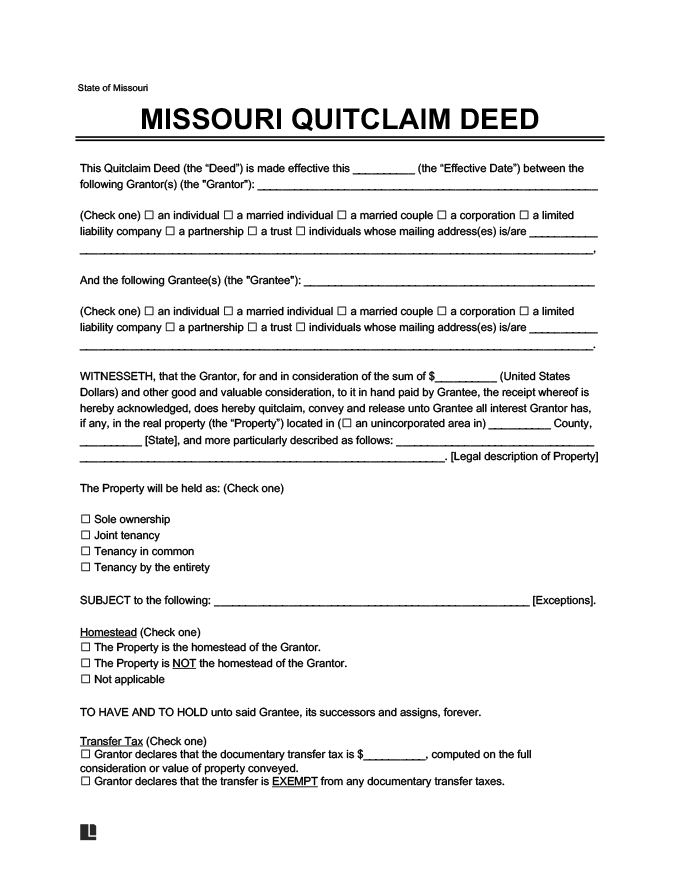
Sample Missouri Quitclaim Deed
Below is a free sample Missouri quitclaim deed. You can personalize this template using our guided questionnaire and download it as a PDF or Word file.
Formatting Requirements for Quitclaim Deeds in Missouri
MO Rev Stat § 59.310 governs the formatting requirements that all quitclaim deeds in the state must follow. These requirements stipulate that the:
- Paper size must be standard letter (8.5 x 11)
- Paper color must be white or another light color
- Font size must be a minimum of eight points
- Font color must use black or dark ink
- Pages must be printed on one side only
- The first page must have a three-inch top margin for the recorder’s official use
- Remaining sides and pages must have ¾-inch margins
Any Missouri quitclaim deed not originally written in English must include an attached sworn translation. Also, no permanent binding can be applied to the document; staples are acceptable.
How to File a Quitclaim Deed in Missouri
Filing a quitclaim deed in Missouri is simple when you follow the right steps. Recording your deed correctly protects your ownership rights and makes the transfer official.
Step 1 – Download a Missouri Quitclaim Deed Form
Locate and download a Missouri-specific quitclaim deed form template that can help keep you in line with state regulations. Fill it out using the details specific to your transaction, ensuring you abide by the formatting and elements noted above.
Step 2 – Get the Proper Parties to Sign and Acknowledge the Deed
The grantor must sign in the presence of a notary (MO Rev Stat § 442.130), who will officially acknowledge the signature. In the city of St. Louis, Missouri, the grantee must also sign.
If the grantor is married, the grantor’s spouse must also sign the document in front of the notary.
Step 3 – Record the Deed
Record the completed deed at the Missouri county recorder’s office in the county where the property is located. Pay all necessary filing fees, set by each county, at the time of filing.
How Much Does a Quitclaim Deed Cost in Missouri?
In Missouri, quitclaim deed costs include minimal filing fees and federal taxes. Unlike other states, Missouri does not often impose any state-level tax on property transfers.
Filing Fees
The minimum recording fees for a quitclaim deed in the state of Missouri are laid out in MO Rev Stat § 59.310. They are:
- $5 for the first page
- $3 for each additional page
However, each county in Missouri reserves the right to set its own filing fees above these minimums, and many do. Check with the Missouri county recorder’s office for the county in which the property is located to determine how much you may owe in filing fees.
Documentary Transfer Tax (DTT)
Missouri, unlike many other states, does not impose a real estate transfer tax on conveyances of real property. This means that Missouri grantors and grantees are typically subject to less tax than property transferors and receivers in other states.
US Gift Tax (Form 709)
Missouri itself imposes no state-specific gift tax. The federal government, however, does impose a gift tax on property valued over a certain amount that is given for little to no payment or “consideration.” The amount of property value that triggers the tax changes from year to year.
The form used for the federal gift tax is IRS Form 709. You can follow the instructions on the form to find out if you owe gift tax, how much you may owe, and details of how and when to pay this tax.
Capital Gains Tax
Missouri does not charge capital gains tax on real property transfers. In fact, the state got rid of capital gains tax altogether on January 1, 2025.
IRS Topic No. 409 and IRS Publication 551 describe the details of the federal capital gains tax. Use these two IRS resources to check the amount you may owe and learn about any possible exemptions and deductions.