What Is a Temporary Guardianship Agreement?
A temporary guardianship agreement allows a parent to give another adult the authority to care for their child for a limited time. Parents often use it when they’re traveling, dealing with a medical issue, or facing a short-term situation that makes daily care difficult. The arrangement is temporary by design, lasting only for the time period written in the agreement. Parents can revoke it at any time.
Parents keep legal custody and full parental rights during the arrangement. The caregiver receives only the authority listed in the agreement and can act within that scope without asking the parent for permission each time.
Depending on state law, similar arrangements may also go by other names, such as a delegation of parental authority, temporary caregiver authorization, or a power of attorney for a minor. The authority granted can vary from state to state.
Some states don’t accept a temporary guardianship agreement for this purpose. In those cases, you’ll need to use a power of attorney for a minor to give another adult legal authority to act on your child’s behalf.
Can Parents Assign Temporary Guardianship Without Going to Court?
In many states, parents can authorize another adult to care for their child without going to court by signing a written agreement. In some cases, state law requires a specific statutory form or asks parents to file the document with a court instead. That said, court-appointed or standby guardianships are different and usually involve a more formal legal process.
Temporary guardianship agreements are designed for short-term caregiving, so they don’t transfer custody or create a permanent guardianship. Even in states that require filing or approval, the agreement still helps document the parents’ consent and gives caregivers something to rely on when making decisions.
When Should You Use a Temporary Guardianship Agreement?
Use a temporary guardianship agreement when your child needs another adult you trust to step in for a short time, but you don’t want to transfer custody. It works well in situations like these:
- You’ll be away from your child for a period of time.
- You’re seriously ill, hospitalized, or temporarily disabled.
- You’re being deployed for military service.
- You’re facing immigration proceedings or possible separation.
- You’re facing an arrest, detainment, or incarceration.
- You need your child to have stable care from another adult for a short-term situation.
Many parents choose this option because it avoids court involvement while still letting a trusted adult care for their child when needed. Some states may require specific forms or filing steps, so it’s a good idea to check your local rules before creating your agreement.
When a Different Form May Be Better
A temporary guardianship agreement gives someone broad authority to care for your child. If you only need limited permission, a simpler form may be the better choice:
- Everyday childcare only: Use a babysitting or nanny contract
- Travel without parents: Use a child travel consent form
- Medical permission only: Use a child medical consent form
Choose the form that matches your situation so you only give the authority that’s truly needed.
What Can a Temporary Guardian Legally Do?
A temporary guardian can handle the responsibilities the parent lists in the agreement, as long as state law allows it. Parents usually give authority for everyday decisions, so the child’s day-to-day care stays consistent. In many cases, the guardian may be allowed to:
- Enroll the child in school and handle school decisions
- Access school and medical records
- Make medical decisions
- Provide daily care and supervision
- Approve domestic or international travel
- Sign documents on the child’s behalf
The agreement sets the limits. If a responsibility isn’t listed, the guardian usually doesn’t have authority to handle it. Parents keep legal custody and stay in control throughout the arrangement.
A temporary guardianship agreement can’t override existing court orders. If there’s a custody order, divorce decree, or a court-appointed guardian already in place, those orders still apply. Schools, hospitals, and other institutions may also have their own rules about what documents they require before recognizing a guardian’s authority.
What to Include in a Temporary Guardianship Form
A temporary guardianship form should clearly name the child, the adult stepping in, and what that person can and can’t do. It should also confirm the parent’s authority so everyone understands their role and what to expect. Make sure your form covers the following details:
- The parent or legal guardian creating the agreement (one or both)
- The full names and number of children covered
- The temporary guardian’s full name and relationship to the child
- The guardian’s contact information (address, state, phone, email)
- An optional backup guardian if the primary can’t serve
- The exact authority granted (school decisions, medical care, daily supervision, travel, signing documents)
- HIPAA authorization, if you want the guardian to speak directly with doctors
- Any limits, such as no international travel or no non-emergency treatment
- Special care instructions, including allergies, medications, insurance details, and emergency contacts
- A start date (immediate or future)
- A clear end date in compliance with state law
- A statement confirming the parent has legal authority to grant temporary guardianship
- A statement confirming no conflicting custody order exists
- A statement that the agreement is temporary and can be revoked
- A statement that parental rights remain with the parent
- Notarization, if required or preferred under state law
With these details in place, schools can accept the guardian’s signature, doctors can share information, and caregivers know exactly what they can handle while parents stay in control. Legal Templates walks you through each step and turns it into a ready-to-sign document.
Give your caregiver what they need to step in quickly, including:Helpful Documents to Share With Your Caregiver
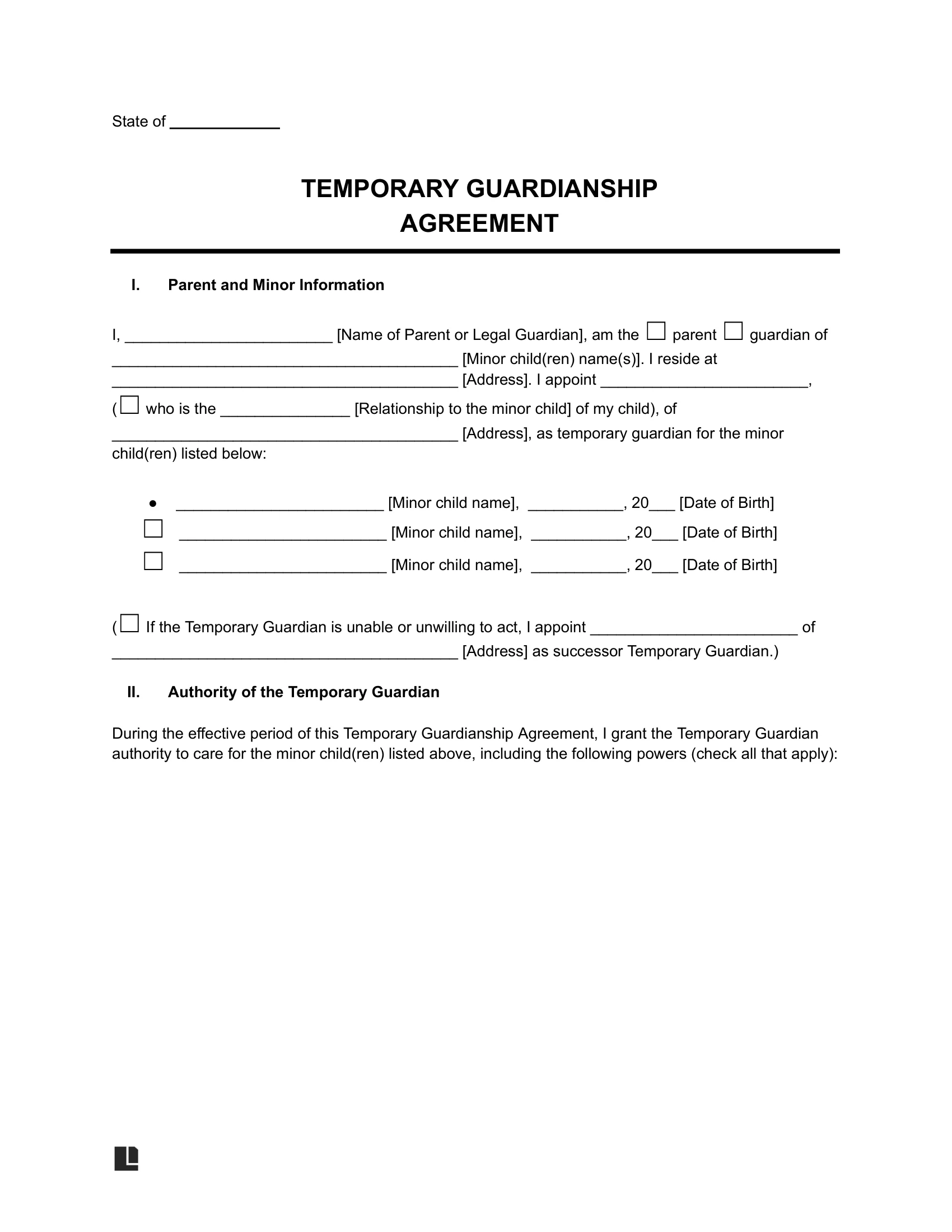
Sample Temporary Guardianship Form
Take a look at a sample temporary guardianship agreement to see how the form is set up. Then customize your own temporary guardianship form and download it in Word or PDF.
Does a Temporary Guardianship Form Need to Be Notarized?
Many states require a temporary guardianship form to be notarized. Usually, the parent signs the document in front of a notary public. In many states, the temporary guardian must also sign in front of a notary. Notarization confirms that the signatures are valid and helps schools, doctors, and other organizations accept the caregiver’s authority.
Some states require notarization but do not require the document to be filed with a court. Others may require the agreement to be filed or recorded with a probate court or similar office. There are also exceptions. In New Hampshire, for example, notarization isn’t required. Instead, two adults who are at least 18 years old need to witness the signatures. Check your state’s rules before signing.
If a temporary guardianship form is not signed correctly, schools may reject it, doctors may refuse treatment authorization, and agencies may question whether the agreement is valid.
How Long Does a Temporary Guardianship Last?
The length of a temporary guardianship depends on state law. In many states, temporary caregiving authority lasts six months to one year, depending on the statute used. Other states allow shorter periods or require renewal after a certain time.
Military parents may receive additional time, often for the length of active duty plus 30 days or up to one year. The table below shows the maximum duration allowed in each state.
State
Maximum Duration
Statutory Citation
Alabama
1 year
AL Code § 26-2A-7
Alaska
1 year (military: active duty + 30 days)
AK Stat § 13.26.066
Arkansas*
Up to 45 days (+90-day extension, max 135 days)
AR Code § 28-65-222
Arizona
6 months
AZ Rev Stat § 14-5104
California**
6 months
CA Fam Code § 6550
* Temporary guardianship must be appointed by a court. A private agreement may show parental intent, but does not create legal guardianship on its own.
** California typically uses a Caregiver’s Authorization Affidavit rather than a temporary guardianship agreement. Schools and medical providers often require the statutory affidavit format under CA Fam Code § 6552.
*** Delaware provides a statutory caregiver medical consent affidavit (13 DE Code § 708). This form may document parental permission, but does not replace it.
**** Maryland uses a standby guardian designation. A separate statutory designation may be required.
***** Texas provides a statutory Authorization Agreement for Nonparent Caregivers (TX Fam Code Ch. 34). A rider may be required when the caregiver is not a relative.
How Do You End a Temporary Guardianship?
A temporary guardianship can end in several ways. In most cases, a parent can cancel it at any time because the arrangement is voluntary. To do this, the parent usually signs a written revocation ending the agreement, and the child returns to the parent’s care.
Many temporary guardianships also end automatically when the time period in the agreement expires, which typically lasts 6 months to one year. If care is still needed after that, the parent can create a new agreement.
A temporary guardianship may also end earlier if the child returns to live with the parent before the end date. In some cases, it ends if a court issues a new custody or guardianship order that replaces the arrangement. Because the rules vary by state, it’s a good idea to review local requirements before ending the agreement.