What Is a Demand Letter for Breach of Contract?
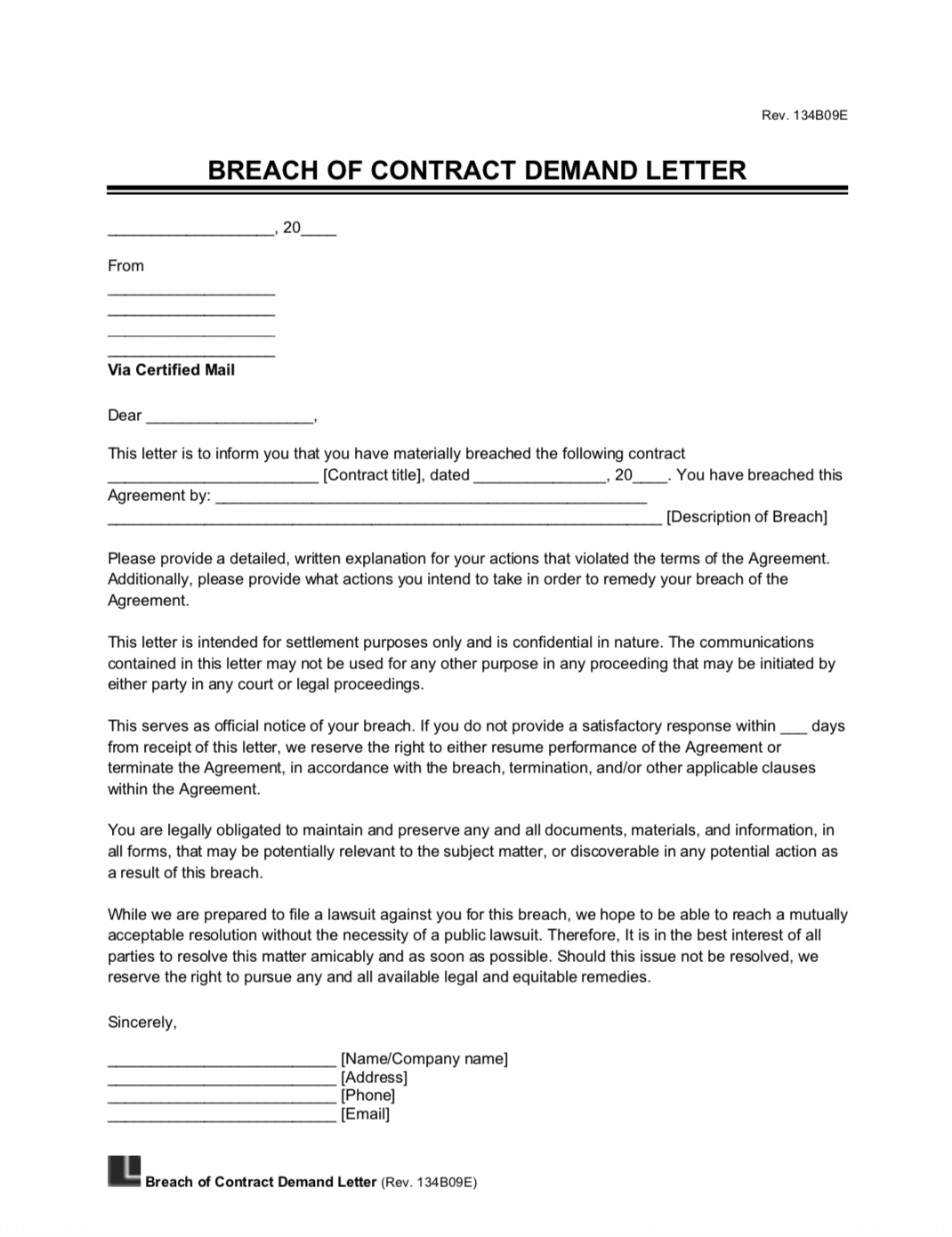
A demand letter for breach of contract is a written notice that informs a party to a contract that they have failed to adhere to the agreed-upon terms. It refers to the original agreement and states where the other party went wrong. It also usually contains a demand for compliance or payment for the breach.
By writing a breach of contract letter, you can show you are serious about enforcing the terms of your original contract. You can also declare that you will pursue legal action if necessary. This statement can make your letter an effective pre-litigation strategy. You can also encourage obedience and open dialogue rather than going straight to court.
You can use a demand letter for intentional and unintentional contract violations. In fact, this letter can help inform someone who didn’t realize they broke a contract in place, explaining what happened and why they need to address the issue right away.
When to Use a Demand Letter for Breach of Contract
Here are some various instances when a demand letter for breach of contract would be helpful:
- A client fails to pay for services that you completed as an independent contractor.
- A vendor doesn’t deliver the products you paid for.
- A contractor does not finish the work they agreed to do on your home.
- A business partner fails to adhere to the terms of a partnership agreement.
- A buyer refuses to complete a property sale after signing a purchase agreement.
- A service provider cancels at the last minute without giving the notice required in the service contract.
- An employer doesn’t provide benefits or pay that were promised in your employment contract.
What to Consider Before Writing a Breach of Contract Demand Letter
If the other party broke your contract, you only have a limited amount of time to take legal action. Each state has its own statute of limitations for written contracts, so it’s important to know your deadline. This information helps you decide when to send your demand letter and when you may need to move forward with a lawsuit if the issue isn’t resolved.
| State | Statute of Limitations for Written Contracts | Law |
|---|---|---|
| Alabama | 6 years (or 10 years for contracts under seal) | AL Code § 6-2-34 (or AL Code § 6-2-33) |
| Alaska | 3 years | AK Stat § 09.10.053 |
| Arizona | 6 years | AZ Rev Stat § 12-548 |
| Arkansas | 5 years | AR Code § 16-56-111 |
| California | 4 years | CA Civ Pro Code § 337 |
How to Write a Demand Letter for Breach of Contract
A breach of contract demand letter helps you inform a party of their violation and seek remedies. Follow these steps to write your own contract breach letter following Legal Templates’s guided form.
Step 1 – Include Party Information
As the claimant (the party that is the victim of the breach of contract), you should provide your name and legal address. Specify if you’re writing as an individual or entity that’s been affected by the breach of contract.
Also, add the respondent’s name. The respondent is the party whom you’re accusing of violating the contract. They will receive the letter and will be responsible for responding to it.
Step 2 – Add Details About the Breach
Add details about the contract violation, including the following:
- The title and date of the original contract
- A statement about how the respondent broke the contract, citing specific sections of the agreement if necessary
- A statement about how the breach affected the claimant (e.g., lost revenue, reduction in the effectiveness of business operations)
Step 3 – Give a Deadline for a Response
Give a deadline by which the recipient should respond to your breach of contract notice. A typical deadline ranges from 10 to 30 days, but the exact period you provide depends on your situation. Try to make it urgent enough to convey seriousness, but still give enough time to allow for a satisfactory correction.
Step 4 – List the Consequences of No Response
Explain what will happen if the recipient ignores the letter or fails to comply with your demands. Possible consequences include the following:
- Contract termination
- Resumption of the contract
- Activation of breach of contract clauses (which may demand compensation)
- Pursuing arbitration or other dispute resolution methods
- Filing a complaint for breach of contract litigation in court
Step 5 – Remind the Respondent of Their Duties
Communicate the importance of compliance to the respondent. Also, remind them that they must maintain and preserve the documents related to the breach in case the situation needs to go to court.
Step 6 – Reaffirm the Desire to Resolve the Issue Amicably
Inform the recipient that you are willing to go to court if a lawsuit is needed as a legal remedy, but tell them you’d prefer to reach a mutually acceptable resolution. This way, you may be able to avoid a public lawsuit and come to a decision that’s acceptable for all parties involved.
Step 7 – Sign the Letter
Sign your name as the claimant to confirm that the statements you made in the letter are accurate to the best of your knowledge and deliver it to the other party.
Breach of Contract Demand Letter Example
View an example of a demand letter for a construction-related breach of contract:
December 7, 2025
Evergreen Homeowners, LLC
1458 Willow Creek Drive
Fort Collins, CO 80528
Dear NorthStar Construction Group,
This letter is to inform you that you have materially breached the following contract: Residential Kitchen Remodel Agreement, dated October 3, 2025. You have breached this Agreement by: failing to complete the agreed-upon work, abandoning the project site for more than 30 days without explanation, and using materials that do not meet the specifications listed in the contract.
Please provide a detailed, written explanation for your actions that violated the terms of the Agreement. Additionally, please provide what actions you intend to take in order to remedy your breach of the Agreement.
This letter is intended for settlement purposes only and is confidential in nature. The communications contained in this letter may not be used for any other purpose in any proceeding that may be initiated by either party in any court or legal proceedings.
This serves as official notice of your breach. If you do not provide a satisfactory response within 20 days from receipt of this letter, we reserve the right to either resume performance of the Agreement or terminate the Agreement, in accordance with the breach, termination, and/or other applicable clauses within the Agreement.
You are legally obligated to maintain and preserve any and all documents, materials, and information, in all forms, that may be potentially relevant to the subject matter, or discoverable in any potential action as a result of this breach.
While we are prepared to file a lawsuit against you for this breach, we hope to be able to reach a mutually acceptable resolution without the necessity of a public lawsuit. Therefore, it is in the best interest of all parties to resolve this matter amicably and as soon as possible. Should this issue not be resolved, we reserve the right to pursue any and all available legal and equitable remedies.
Sincerely,
Evergreen Homeowners, LLC
1458 Willow Creek Drive
Fort Collins, CO 80528
(970) 555-2940
[email protected]
Sample Demand Letter Breach of Contract
View an example of a breach of contract letter to learn how to phrase your demand to a violating party. Then, create your own using Legal Templates’s form and download it as a PDF or Word file, which will be ready to distribute.
Sending a Breach of Contract Demand Letter
When you send a breach of contract demand letter, it’s recommended to send it via certified mail. This service requires a signature by the recipient or other person for proof of delivery. This is essential proof that the other party was aware of the demand, so they cannot later claim they were unaware of it.
Other ways to send a breach of contract demand letter are by regular mail or personal service (hand-delivery to the recipient or posting it on their property). These methods can be effective, but they may not offer the proof needed in some states to file a breach of contract action.