What Is a Lady Bird Deed?
A Lady Bird deed, also called an enhanced life estate deed, is a unique type of deed. Property owners use it to transfer ownership to their beneficiaries after death without going through probate. It’s limited to real estate, most often covering a primary home or a plot of land. It cannot be used to transfer other assets, such as investments or bank accounts.
With a Lady Bird deed, the owner retains full ownership during their lifetime. They can do whatever they’d like, whether that includes selling, mortgaging, or living on the property. Upon their death, ownership passes to the beneficiaries.
Another benefit for the property owner is that a Lady Bird deed preserves Medicaid eligibility. Because the homeowner keeps control of the property, no completed transfer occurs, so the deed doesn’t trigger Medicaid’s five-year lookback rule. By contrast, if the owner transfers the home outright using a quitclaim deed or another instrument, they may trigger a penalty period that delays Medicaid coverage.
Why Is It Called a Lady Bird Deed?
An enhanced life estate deed is called a Lady Bird Deed because of its use by former President Lyndon B. Johnson to transfer property to his wife, “Lady Bird” Johnson. Even though its use extends beyond this case, her high-profile status helped the deed develop its name. You may also see it referred to as a “ladybird deed.”
What States Allow Lady Bird Deeds?
Lady Bird deeds are not allowed in every state. In fact, only five states allow them based on common law:
- Florida
- Michigan
- Texas
- Vermont
- West Virginia
If you live in a state besides one of these five, it’s likely that a Lady Bird deed won’t be legally permissible. If you want a similar tool, you may be able to use a transfer-on-death deed. This deed operates in the same way as a Lady Bird deed and is supported by statutory laws in 31 states.
| Feature | Lady Bird Deed | Transfer-on-Death Deed |
|---|---|---|
| Legal Basis | Common law (not created by statute) | Statutory law |
| State Availability | Only recognized in 5 states | Recognized in 31 states |
| Primary Benefits | Medicaid planning and probate avoidance | Probate avoidance where Lady Bird deeds are not available |
| Creates a Present Interest for a Beneficiary? | Technically yes (remainder interest), but no control | No present interest |
How to File a Lady Bird Deed
If you’re wondering whether you can do your own Lady Bird deed, you can thanks to Legal Templates’s guided form. It’s as simple as filling out our template, then recording it with your local county recorder’s office. Follow these steps to write and file your Lady Bird deed.
Step 1 – Choose Your Remaindermen
Start by choosing your remaindermen, the beneficiaries under a Lady Bird deed. Provide each beneficiary’s name, mailing address, and marital status.
Your beneficiaries will not have control or ownership of the property they are to eventually inherit while you (as the grantor) are alive.
Step 2 – Fill Out the Form
Once you choose your beneficiaries, you can begin filling out your Lady Bird deed with their details and other information:
- The state where the property is located
- The property’s street address and legal description
- The number of grantors who own the property
- The names and mailing addresses of each grantor
- Each grantor’s marital status (it determines whether a spouse must also sign the Lady Bird deed)
- Whether the property is the grantor’s homestead or primary residence
- Information on the property’s prior deed (e.g., quitclaim deed, warranty deed)
- A statement confirming that the grantor keeps full control of the property during their lifetime and that the beneficiary receives ownership only after the grantor’s death
- Details about the document’s preparer
Step 3 – Execute the Deed
Only the grantor signs a Lady Bird deed; beneficiaries do not need to sign. However, depending on common law principles in your state, you may need to sign before a notary public and/or witnesses. Here are the general state guidelines, but you may consider checking with an attorney for clarification:
- Florida: Notary public and two witnesses.
- Michigan: Notary public.
- Texas: Notary public.
- Vermont: Notary public.
- West Virginia: Notary public.
Can a Power of Attorney Sign a Lady Bird Deed?
An agent in a power of attorney (POA) can sign a Lady Bird deed only if the POA grants explicit authority to transfer real estate. If an agent is signing a Lady Bird deed, the deed should acknowledge the agent’s role. Otherwise, it may be deemed invalid.
Step 4 – Record the Deed
Ensure that your deed notes how it should be recorded. Most Lady Bird deeds are recorded as quitclaim deeds, but you may need to record yours as a general warranty deed or special warranty deed, depending on your state’s procedures.
To make your Lady Bird deed official, you must record it with your county recorder’s office. Below are links to the recorder’s offices in the states that recognize Lady Bird deeds:
- Florida (Court Clerk & Comptroller’s office)
- Michigan (Register of Deeds office)
- Texas (County Clerk’s office)
- Vermont (Town Clerk’s office)
- West Virginia (County Clerk’s office)
Step 5 – Update as Needed
Update your Lady Bird deed as needed, as significant life events (such as a marriage, a divorce, the death of a beneficiary, or the desire to change a beneficiary) can impact your transfer of property. You can change a Lady Bird deed by creating a new one, making it clear that the new one revokes the old one. You must record the new one in the appropriate county recorder’s office.
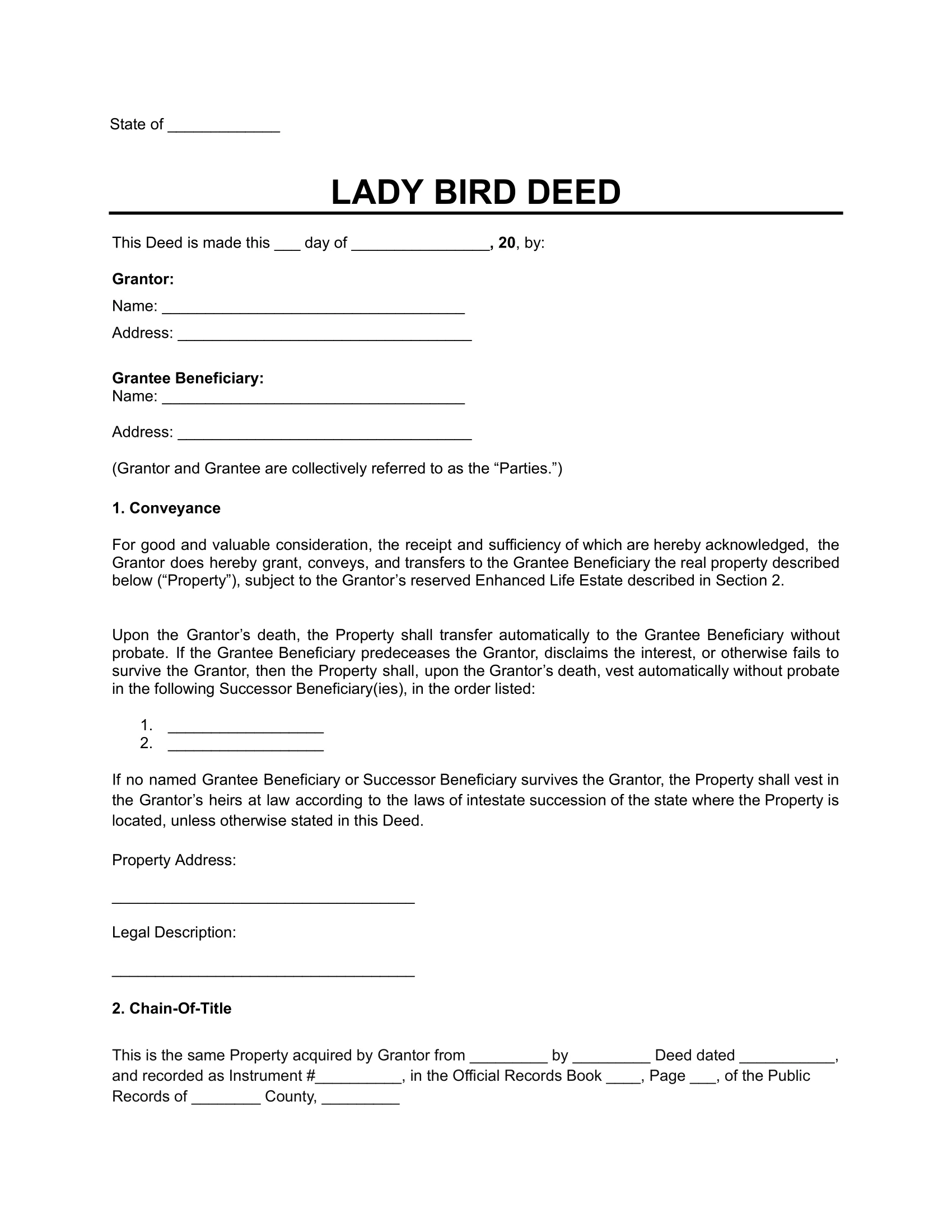
Sample Lady Bird Deed
See what a Lady Bird deed looks like by viewing an example below. When you’re ready, you can assign your beneficiaries and fill in your property details using our guided form. Then, download it as a PDF or Word document for your records and to file with the county recorder’s office.
Can a Lady Bird Deed Be Contested?
A Lady Bird deed can be contested, but it must be on the basis of fraud, undue influence, or a lack of mental capacity when the grantor signed it. It cannot be challenged simply because a family member did not like the property being passed to a particular beneficiary. If someone wants to challenge the deed, they must go to court and show a legal reason why it should not be valid.
How Much Does a Lady Bird Deed Cost?
Creating a Lady Bird deed with an attorney’s guidance can cost between a few hundred and a few thousand dollars, depending on the complexity. You’ll also have to pay the recording costs.
However, you can save a significant amount by writing the document with Legal Templates’s guided form. It costs a fraction of the price of an attorney-prepared document, but you won’t skip out on any of the legalities. Our template contains attorney-approved language; all you have to do is fill in the details as they relate to your situation.