What Is a Florida Notary Acknowledgment Form?
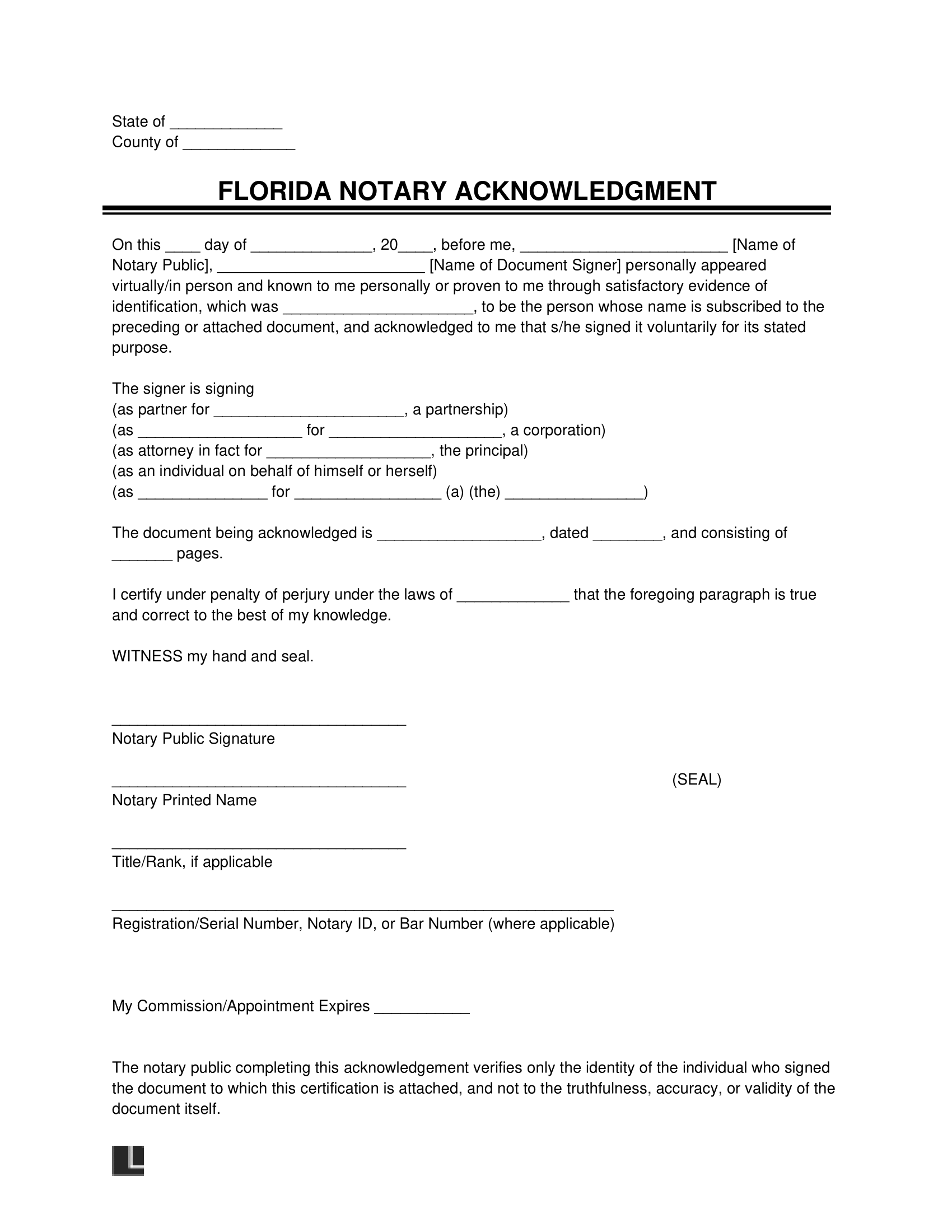
A Florida notary acknowledgment form is a certificate attached to a legal document that verifies that the signer appeared before a notary public. It proves that the notary confirmed the signer’s identity and shows they signed it of their own volition. When a legal document has a Florida notary block, third parties can rely on it as properly executed.
Notary acknowledgment also helps comply with Florida statutory requirements. The statutory form is present in FL Stat § 695.25. A Florida notary acknowledgment form can be completed for different signers, including the following:
- An individual
- A corporation
- An LLC
- A partnership
- An individual acting as an attorney-in-fact
- Any public officer, trustee, or personal representative
How to Complete a Notary Acknowledgment in Florida
A Florida notary acknowledgment can be completed in three simple steps. It starts with identifying the signer, then proceeds to completing the Florida notary block and adding the notary’s signature. Learn more about the process below.
Step 1 – Identify the Signer
Begin by identifying the signer. FL Stat § 117.05(5) states that the notary public must personally know the signer or have satisfactory evidence that the signer is who they say they are. Satisfactory evidence confirms identity with no reasonable doubt about who the person is. It can be confirmed in one of two ways:
-
Credible witnesses: One witness will be sufficient if the witness is personally known to the notary. Two witnesses are sufficient if they present ID. All witnesses (whether one or two are used) must verify the following:
- The signer is who they claim to be.
- The witness personally knows the signer.
- The signer cannot reasonably obtain other identification.
- The signer does not have acceptable forms of ID.
- The witnesses have no financial interest in the transaction.
-
Valid identification: The signer presents an ID that is current or issued within the last five years. It must include a unique identifying number. Some examples of acceptable IDs include the following:
- A driver’s license or state ID (Florida or another state)
- A US or qualifying foreign passport
- A military or veteran ID
- Certain inmate identification cards
- A USCIS-issued identification card
Step 2 – Prepare the Florida Notary Block
There is no required notary public verbiage in Florida. However, per FL Stat § 117.05(4), you should include the following elements in a Florida notary block:
- The county where the notary public is notarizing the document
- The type of notarial act performed (use “acknowledged” for an acknowledgment)
- Whether the signer appeared in person or remotely
- The date of the notarial act
- The name of the signer
- Whether the notary public is relying on personal knowledge or satisfactory evidence of the signer’s identity
- The notary public’s official signature
- The notary public’s name (must be typed, printed, or stamped below the signature)
- The notary public’s official seal (must be affixed below or to either side of their signature)
For documents requiring notary acknowledgment, the signer can sign the document before appearing before a notary public. However, if the document requires a jurat, which is a sworn statement or oath, the signer must sign the document in the notary public’s presence.
Step 3 – Sign & Acknowledge
Have the signer sign their name on the document being acknowledged (if they haven’t already done so). Then, after confirming their identity, you can add your acknowledgment as the notary public. Sign your name and affix your official seal.
Fees for Florida Notary Acknowledgments
Notary publics in Florida cannot charge more than $10 for a standard notarial act (FL Stat § 117.05(2)(a)). They can charge up to $25 for an electronic notarial act (FL Stat § 117.275).
Sample Florida Notary Acknowledgment Form
View an example of a Florida notary acknowledgment form so you can see how legal documents are authenticated. Fill out yours with Legal Templates’s guided form, which is available to download in PDF or Word format. Then, have a notary public acknowledge the signer’s identity and signature.
Is Online Notarization Legal in Florida?
Yes, notaries in Florida are allowed to conduct remote online notarization. In June 2019, Florida Governor Ron DeSantis signed HB 409 “Electronic Legal Documents” into law. This resulted in FL Stat § 117.265, which allowed remote notarizations to start as early as January 1, 2020.
Florida notaries must meet the requirements outlined in FL Stat, Chapter 117, Part II (Online Notarizations), which include the following:
- Maintain secure electronic journal records for each online notarization
- Provide evidence of each subject and the fee charged for the notarization
- Take reasonable steps to ensure the integrity, security, and authenticity of the online notarization
- Keep an uninterrupted copy of the audio-video communication recording of the online notarization for at least 10 years
Under FL Stat § 117.021, any document requiring notarization in Florida may be notarized electronically. However, the document must state whether the notarization took place in person or electronically.
Documents That Typically Require Notarization in Florida
Consider the following documents that typically require notarization in Florida:
- Durable power of attorney
- Non-durable power of attorney
- Limited power of attorney
- Real estate power of attorney
- Minor power of attorney
- Power of attorney revocation
- Self-proving affidavit
- Warranty deed
- Quitclaim deed
- Lady Bird deed
- Living trust
Some documents don’t explicitly require notarization, but it can still enhance their authenticity. Here are some examples of documents where notarization is highly recommended: