What Is an Iowa Notary Acknowledgment Form?
An Iowa notary acknowledgment form identifies someone as the signer of a legal document. It’s completed by a notary public, who has authority under IA Code § 9B.4. It’s the notary public’s responsibility to confirm that the signer signed in their own name without coercion.
The signer must present an Iowa notary acknowledgment form to a notary public and recognize the need for notarization. The notary public may not suggest using a notary acknowledgment form.
Once the signer knows they need their legal document notarized, they can prepare to go before a notary public. They may sign their document in advance or wait until they’re in the notary’s presence. Either way, personal appearance before the notary is required (IA Code § 9B.6).
The notary public may identify the signer using one of the following methods:
- Personal knowledge of the signer
-
Satisfactory evidence of the signer’s identity, which may include the following:
- Government-issued ID (must be current or expired not more than three years before the notarial act is performed)
- Oath of a credible witness who can be identified by the notary public
The signer must acknowledge that the signature is their own and that they signed the document for its stated purpose. The notary public confirms these facts, but they don’t attest to the accuracy of the legal document’s contents.
What to Include in an Iowa Notary Acknowledgment Form
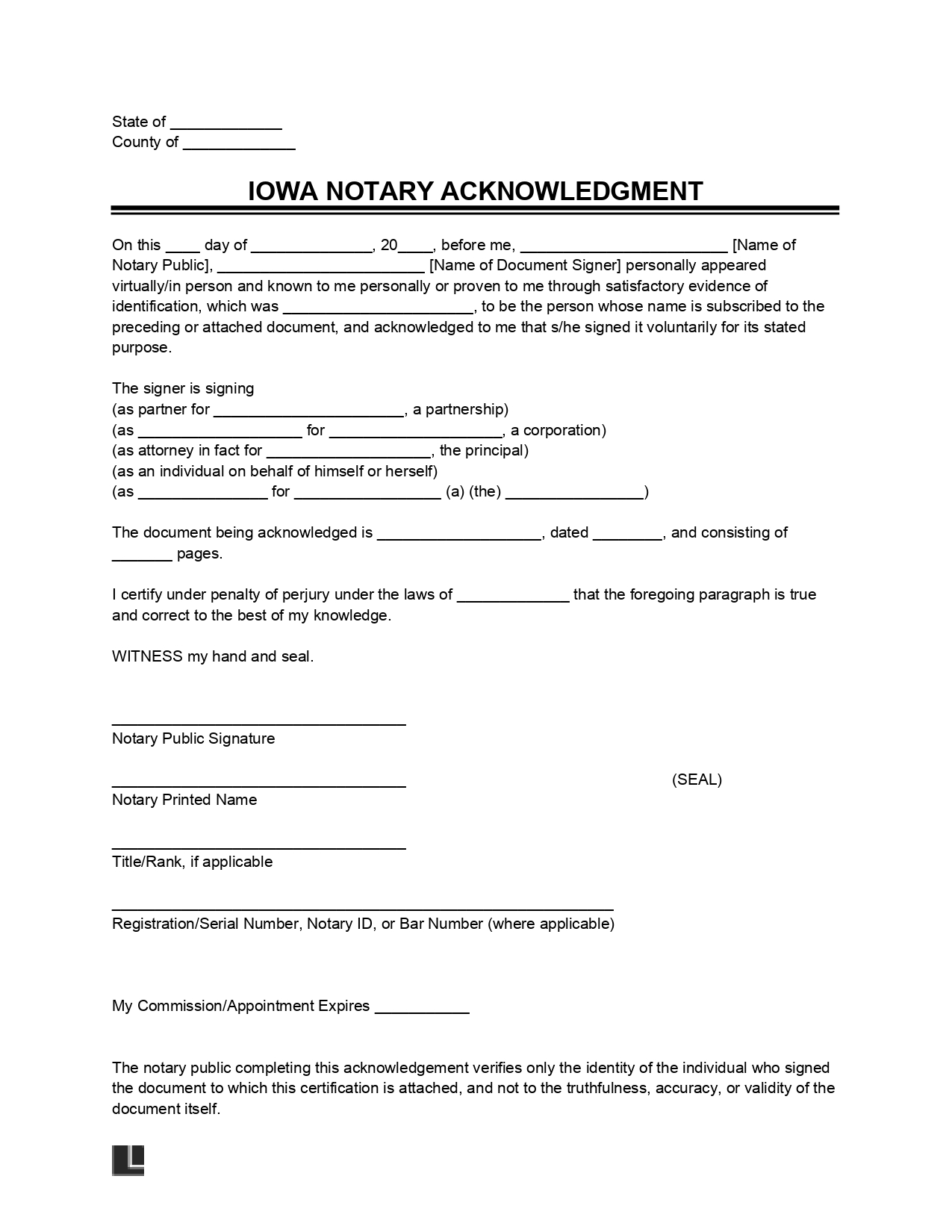
All notarial acts in Iowa must be evidenced by a notarial certificate (IA Code § 9B.15(1)). Here are the elements you must include in your Iowa notary acknowledgment form:
- The notary public’s name and title of office
- The notary public’s signature (must correspond with their signature on file with the Secretary of State)
- The notary public’s commission expiration date
- The date of the acknowledgment
- The jurisdiction in which the notarial act is performed
IA Code § 9B.16 provides several short-form certificates. These statutory templates dictate the precise language required for the notary block, which varies depending on whether the signer is acting in an individual or representative capacity.
If the principal of a legal document cannot physically sign the record, they may direct someone else other than the notary public to sign their name on their behalf (IA Code § 9B.9). If the principal chooses this route, the notary public must state that the signature was affixed by someone else at the principal’s direction.
Sample Iowa Notary Acknowledgment Form
View an example of our Iowa notary acknowledgment form to see how to fill out your own notarial certificate. Legal Templates’s guided form makes it easy to fill out the initial details of your IA notary acknowledgment. When you’re done, you can download the form in PDF or Word format and print it as needed. Present the form to a notary public, who can complete the certificate in accordance with state standards.
Is Remote Online Notarization Legal in Iowa?
Yes, remote online notarization (RON) is legal in Iowa, thanks to the passage of Senate File 475, which went into effect on July 1, 2020.
Similar to in-person notarization, a remote notary public must verify the signer’s identity either through personal knowledge or a credible witness. Alternatively, they may obtain satisfactory evidence through at least two different types of identity proofing (IA Code § 9B.14A).
Other key points about RON in Iowa include the following:
- The remote notary public must use approved audio-video communication technology.
- The notarial act must be recorded, and the notary public must retain the recording for at least 10 years.
- The notarial certificate must specify that communication technology was used to complete the notarization.
- The notary public must be physically present in Iowa.
- The signer can be located in Iowa or in another US state.
- The signer may be located outside of the US, but the legal document must relate to a matter connected to the US.
- Notaries public must notify the Iowa Secretary of State before they perform a remote notarial act.
Documents That Typically Require Notarization in Iowa
In many legal documents, your signature alone won’t suffice. Courts and requesting organizations often want further assurance that you willingly signed a document on your own accord. This way, they can be more confident when executing it and following the permissions within it, whether that’s assigning temporary authority over your affairs to someone else or granting specific real estate rights.
Here are some examples of documents that typically require notarization before they can be recognized by certain authorities:
- Durable power of attorney
- Non-durable power of attorney
- Limited power of attorney
- Real estate power of attorney
- Minor power of attorney
- Power of attorney revocation
- Warranty deed
- Quitclaim deed
- Living trust
Other documents may not explicitly require notarization under state law. However, having the signer appear before a notary public and acknowledge their signature on certain documents can enhance their authenticity. Here are some examples of legal forms that you should strongly consider getting an Iowa notary acknowledgment for:
Prohibited Notarial Acts in Iowa
IA Code § 9B.25 prohibits a notary public from performing the following acts:
- Providing legal advice
- Drafting legal documents
- Offering advice on immigration matters
- Representing someone in immigration-related court proceedings
- Misrepresenting themselves as an attorney
- Advertising unauthorized legal services through a notary acknowledgment
- Charging fees for legal or immigration services that they are not permitted to provide
- Withholding original documents from the person requesting the notarization