What Is a Kansas Notary Acknowledgment?
A Kansas notary acknowledgment form is a statement certifying that a signature belongs to a signer and was performed voluntarily. The signer personally appears before a notary public and confirms their identity. Proof of identity can occur by the signer showing ID or other satisfactory evidence (KS Stat § 53-5a05). If the notary public has personal knowledge of the signer, that knowledge may suffice.
When a document is notarized in Kansas, banks, lenders, and real estate agents can see that it was signed by the appropriate person. While the acknowledgment doesn’t confirm the document’s truthfulness, it shows that it was signed willingly and for the purposes stated in the record.
What to Include in a Kansas Notary Acknowledgment
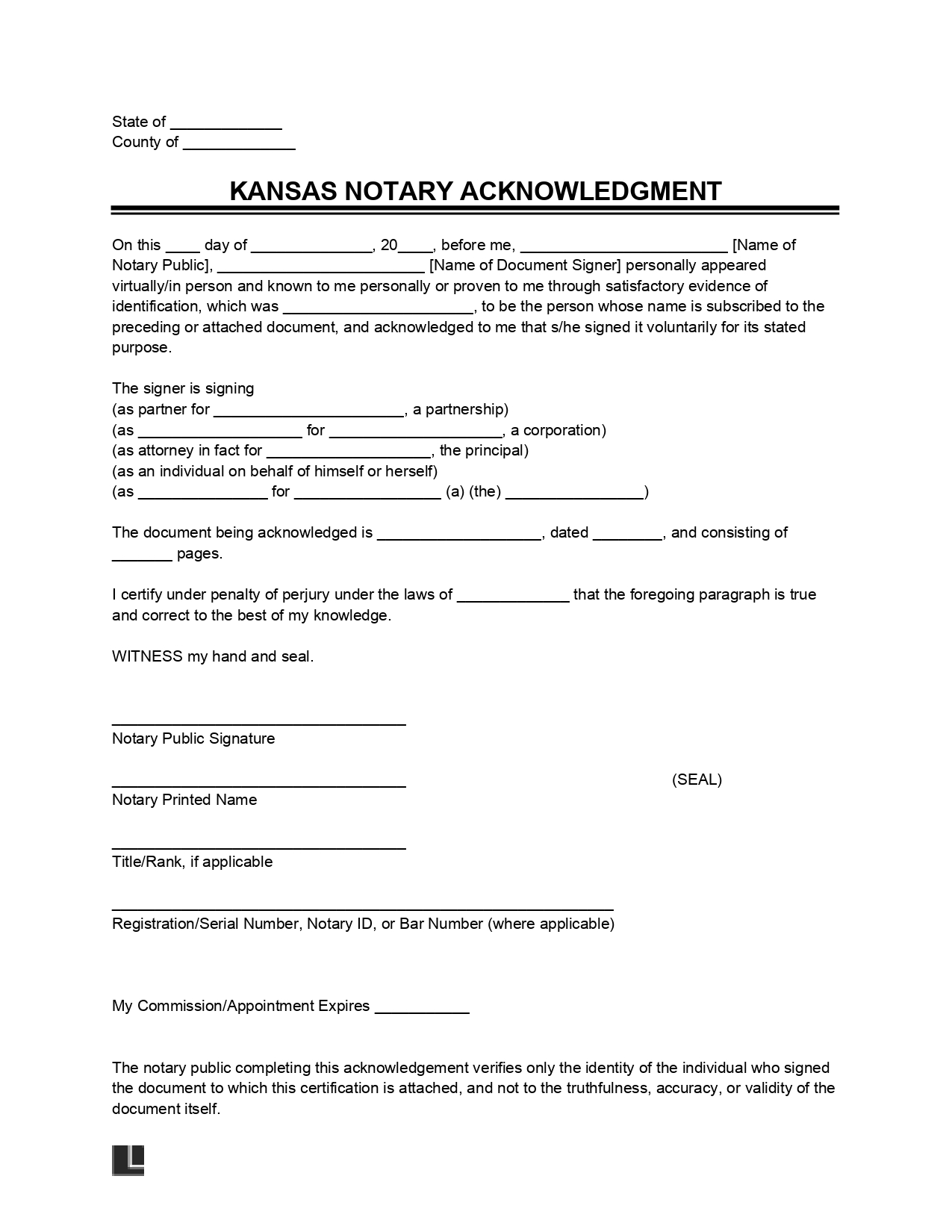
KS Admin Regs 7-43-17(a) outlines the short-form version of a Kansas notary acknowledgment. The short form is preferred because it reduces the risk of error and keeps the stamp and other content on the same page. Here are the key elements that you must include in your state of Kansas notary acknowledgment form:
- Venue: List the state (Kansas) and county name.
- Date: Write the date of the acknowledgment.
- Capacity of signing: Specify whether the document signer is signing in an individual or representative capacity.
- Signer’s name: Record the signer’s name as the person acknowledging the signature in front of the notary public.
- Signature of notarial officer: Your Kansas notary block should include the notarial officer’s signature, as this authenticates the document.
- Date of commission expiration: If the notarial officer is a notary public, list the date that their commission expires.
- Notarial officer’s title: Clarify the notarial officer’s title. If not a notary public, it might be a judge, county clerk, or court clerk.
- Official stamp: Each notary public must have a seal, which must contain the notary’s name and the words “notary public” and “state of Kansas.” The seal must either be a seal press with an inked or blackened impression or a rubber stamp with permanent ink.
Sample Kansas Notary Acknowledgment Form
View an example of our Kansas notary acknowledgment form to better understand how to structure your document. Customize it with key details, including your name, the date of acknowledgment, and whether you’re signing in an individual or representative capacity. Then, fill out the form using Legal Templates’s guided questionnaire.
When you’re done, you can download the document in PDF or Word format. It will only be complete when you bring it to a notary public for signing, so be mindful of this key step.
Is Remote Online Notarization Legal in Kansas?
Yes, remote online notarization is legal in Kansas. Any document that is remotely notarized has the same legal effect as one notarized in person, provided the parties follow relevant state laws.
A Kansas notary public must specifically register with the Kansas Secretary of State to perform remote notarization services.
The notary public should follow the laws related to remote notarizations as found in KS Stat § 53-5a15, including the requirement to store audio-visual recordings of the notarizations for at least 10 years. KS Admin Regs 7-43-17(b) requires that a statement that’s substantially similar to the following be attached to the Kansas notary public if the notarization is performed remotely:
This notarial act involved the use of audiovisual communication technology.
Documents That Typically Require Notarization in Kansas
Many legal documents, including powers of attorney and real estate documents, require notarization to be properly recorded and recognized. Here are some examples of documents that typically require notarization in Kansas:
- Durable power of attorney
- Non-durable power of attorney
- Limited power of attorney
- Real estate power of attorney
- Minor power of attorney
- Power of attorney revocation
- Warranty deed
- Quitclaim deed
- Living trust
Even if Kansas law doesn’t mandate notarization for a document, you can still consider getting it notarized. Notarization can prevent fraud and give the accepting party greater confidence that the document is legitimate and signed by the correct person. See an example of documents that can be supported by a Kansas notary acknowledgment: