What Is a Kentucky Notary Acknowledgment?
A Kentucky notary acknowledgment form allows a signer to formally declare before a notary public that their signature belongs to them. The notary public must have personal knowledge or satisfactory evidence (like a government-issued ID) of the signer before they can sign the acknowledgment form (KY Rev Stat § 423.315).
A Kentucky notary statement appears at the bottom of the legal document being signed. Alternatively, the signer can attach it as a separate page. It prevents fraud and demonstrates that the signer voluntarily signed a legal document.
A notary block for Kentucky is often used to acknowledge the signature of an individual acting in their own right. However, it can also be used in the following situations, per KY Rev Stat § 423.160:
- For a corporation
- For a partnership
- For an individual acting as a principal by an attorney-in-fact
- By any public officer, trustee, or personal representative
What to Include in a Kentucky Notary Acknowledgment
Here are the key elements to include in your Kentucky notary acknowledgment form:
- Venue: Specify the “State of Kentucky” or “Commonwealth of Kentucky.” List the county name where the document is being acknowledged.
- Date: Provide the date of the acknowledgment.
- Signer’s name: State the signer’s name.
- Notary’s information: Give the notary’s name, title, commission number, and commission expiration date.
Under KY Rev Stat § 423.370, the notary public is not required to use a stamp for a Kentucky notary block. However, if they choose to have a stamp, it must meet the following requirements:
- Include the notary public’s name, title, jurisdiction, commission number, and expiration date
- Be capable of being attached to the notary statement and logically associated with the record being acknowledged
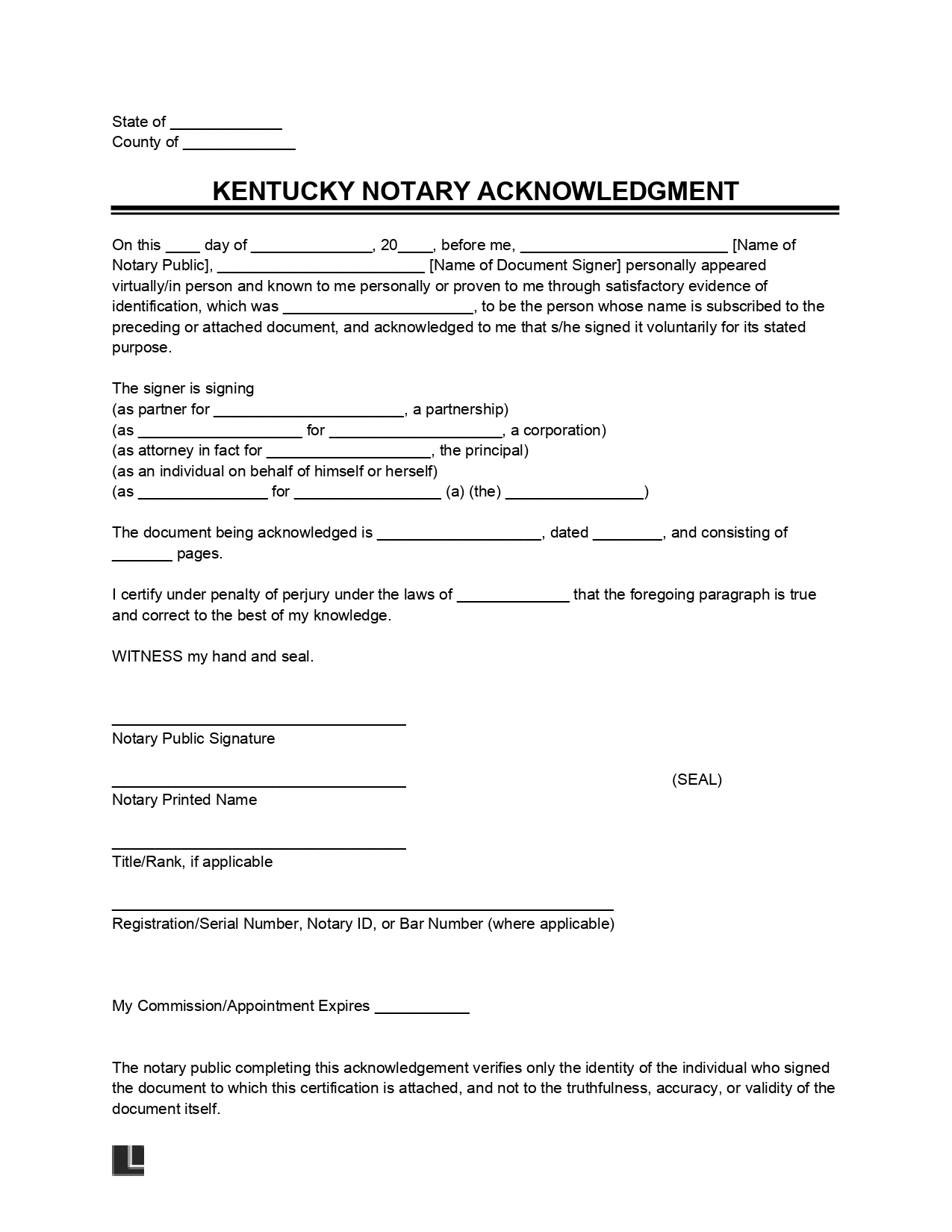
Sample Kentucky Notary Acknowledgment
View an example of a Kentucky notary acknowledgment form to see how to structure your document. Legal Templates’s form is an already-formatted document that leaves space for all the required details, including a stamp if you choose to add one. Fill yours out using our guided form, then download it in PDF or Word format. It’ll be ready to print and present to a notary public, who can complete the final steps of the notarization process.
Is Remote Online Notarization Legal in Kentucky?
Yes, remote online notarization was legal starting on January 1, 2020, thanks to the passage of SB114. Under KY Rev Stat § 423.455, a remotely located individual can comply with the notarization process by appearing before a notary public via communication technology. To perform the online notarization, the notary public must have one of the following:
- Personal knowledge of the individual’s identity
- Satisfactory evidence of identity
- Means to identify the individual through at least two types of identity-proofing processes
The notary public must also create an audio-visual recording of the notarial act, and the certificate must indicate that the act was performed using communication technology. The notary public or a designated repository must retain the recording for at least 10 years. Before performing a notarial act facilitated by communication technology, notary publics must notify the Secretary of State and identify the technology being used.
Documents That Typically Require Notarization in Kentucky
Notarization adds a layer of legitimacy to a legal document, but it’s also a requirement for some forms. Kentucky state law or certain institutions, such as banks, often require a signer to acknowledge their signature before a notary public. Here are some examples of documents that often need to be notarized to be legally effective and properly recorded:
- Durable power of attorney
- Non-durable power of attorney
- Limited power of attorney
- Real estate power of attorney
- Minor power of attorney
- Power of attorney revocation
- Warranty deed
- Quitclaim deed
- Living trust
Even if the law or the requesting organization doesn’t require your document to be notarized, it can still be helpful to have it notarized. When a notary public adds a notary acknowledgment to your document, it verifies that you signed it of your own free will. Here are some documents that are commonly notarized: