What Is a Michigan Notary Acknowledgment?
A Michigan notary acknowledgment is used by a notary public to verify the authenticity of a signature on a legal document. The signer must appear before the notary, show identification, and declare that the signature is theirs and given willingly. Once verified, the notary will fill out the acknowledgment form and provide their signature and seal.
Before a notary public can sign a Michigan notary acknowledgment, they must be able to prove the signer’s identity. MI Comp L § 55-285 provides three different ways that a notary can verify the signer’s identity:
- Personal knowledge of the signer by the notary public
- An oath from a credible witness who personally knows the signer and is personally known by the notary public
- A federal or state-issued government ID that has the signer’s photograph and signature
What to Include in a Michigan Notary Acknowledgment
MI Comp L § 55-287 states that a notary public must sign each acknowledgment exactly as it appears on their application for commission. Furthermore, for each notarial act, the notary should print, type, or stamp the following information:
- The name of the notary public, exactly as it appears on their application for commission
- The statement: “Notary public, State of Michigan, County of (County Name)”
- The statement: “My commission expires (Date of commission expiration)”
- The statement: “Acting in the County of (County Name)”; only required if the notarial act is being performed in a different county than the county of the notary’s commission
- The date of the notarial act
- Whether the notarial act was performed using an electronic notarization system or a remote electronic notarization platform (if applicable)
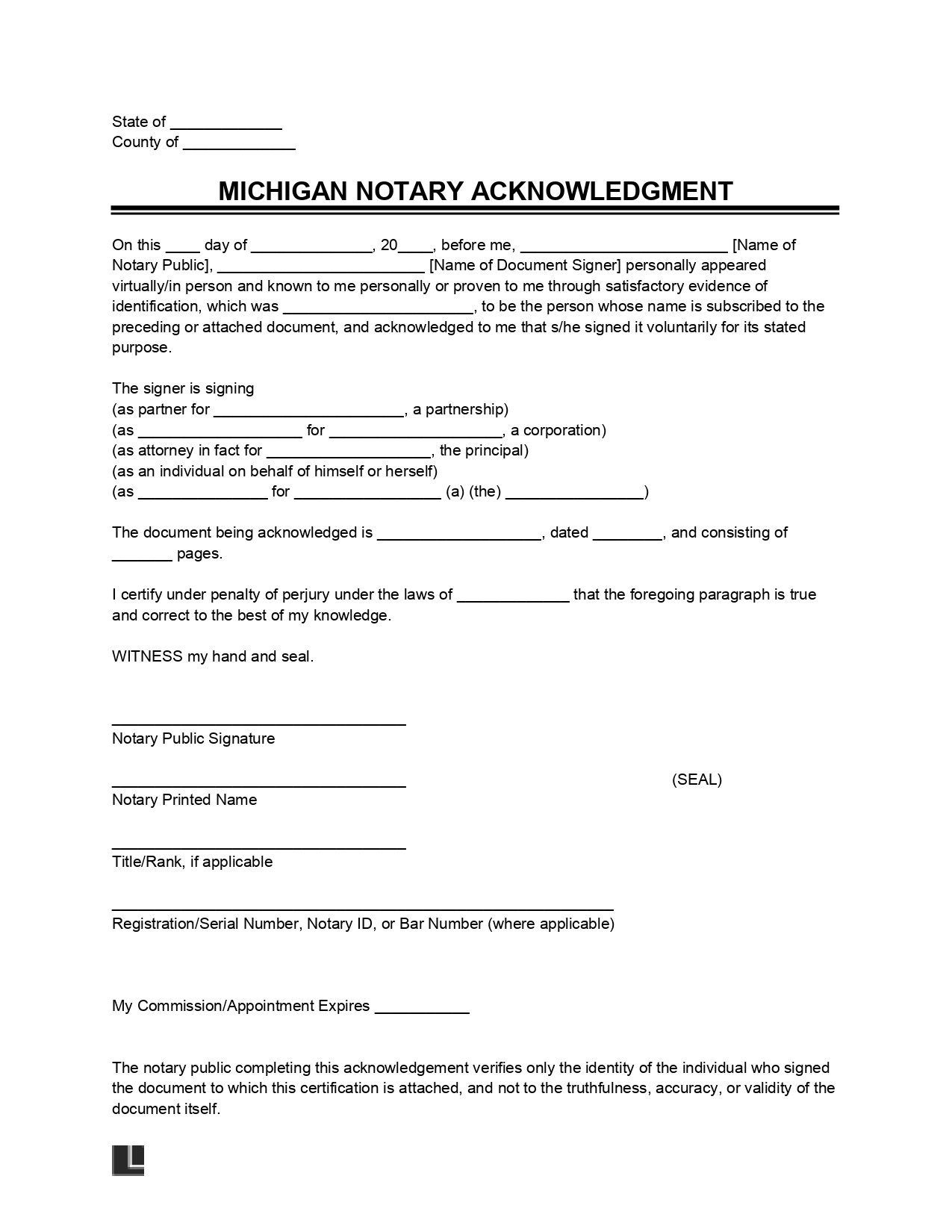
Michigan Notary Acknowledgment Sample
View an example of our Michigan notary acknowledgment form to see how to include the details unique to your situation. Prevent fraud and increase the legitimacy of your legal document with our Michigan notary acknowledgment form. Once you fill out yours with Legal Templates’s guided questionnaire, you can download it in PDF or Word format for completion by a notary public.
Is Remote Online Notarization in Michigan Legal?
Remote online notarization (RON) is legal in Michigan. House Bill 5811 officially authorized it in 2018, followed by amendments to the Michigan Law on Notarial Acts (MiLONA).
The main law supporting and governing RON is MI Comp L § 55.286b. This statute lets the notary notarize a document using audio-visual communication technology for a signer who is not in the notary’s physical presence. The notary must verify the signer’s identity through at least two processes: credential analysis and knowledge-based authentication (KBA). A notary public must create an audio-visual recording of the notarization session and maintain a record for at least 10 years (MI Comp L § 55.286b(7)).
Per MI Comp L § 55.286b(5), a notary cannot use any video software to record the act. They must use a platform that meets specific security standards. They should also notify the Michigan Secretary of State of which RON platform they plan to use before they perform any remote notarial act.
When performing a notarial act that doesn’t follow the traditional in-person format, you should be aware of the laws surrounding it. For example, MI Comp L § 55.286b supports an act when the signer and notary are in different locations and interact via technology like a webcam. Meanwhile, MI Comp L § 55.286a supports in-person electronic notarization, in which the signer and notary are in the same room but sign the document digitally.
Michigan also has a unique law (MI Comp L § 55.286c) that allows a notary to certify a printed version of an electronic record as a true and correct copy.
Documents That Typically Require Notarization in Michigan
Michigan laws require certain documents to be notarized so that they can be legally effective and recorded properly. Here are some examples of documents that typically require notarization in Michigan:
- Durable power of attorney
- Non-durable power of attorney
- Limited power of attorney
- Real estate power of attorney
- Minor power of attorney
- Power of attorney revocation
- Warranty deed
- Quitclaim deed
- Living trust
While notarization may not be required for other documents to be legally recognized, you can still consider notarization to avoid fraud and certify that the signer is who they say they are. Consider attaching a Michigan notary acknowledgment form to documents such as the following: