What Is a New York Notary Acknowledgment Form?
A New York notary acknowledgment form is a document signed by a notary public, who verifies a signer’s signature on a legal document. The signer presents a legal document to a notary public. The document may be signed either before appearing before the notary or in the notary’s presence.
Then, the notary public confirms the signer’s identity. They can do so by confirming one of the following:
- The notary knows the signer personally.
- They view a government-issued identification card.
- A credible witness swears to the signer’s identity.
Once the signer’s identity is known to the notary public, the notary public acknowledges the signer’s signature, confirming its authenticity.
A New York notary public acknowledgment form can be used when a signer is signing for themselves or in a representative capacity.
What to Include in a New York Notary Acknowledgment Form
Based on NY Real Prop L § 309-a, here are the key elements required for a valid New York notary acknowledgment:
- Venue: List the state (New York) and county where the signing occurs.
- Date: Provide the day, month, and year of the meeting with the notary.
- Statement of personal appearance: Explain that the signer personally appeared before the notary public.
- Proof of identity: The notary must confirm they either know the person personally or verified their identity using a driver’s license or another form of “satisfactory evidence.”
- Signature confirmation: The signer must declare to the notary that they are the one who signed the document.
- Capacity: The form must state that the person signed for themselves or on behalf of someone else.
- Witness verification: If a witness is signing instead of the main person, the notary must swear them in and record their home address.
- Notary signature and office: The notary must sign the form and list their official title (Notary Public).
A New York state notary acknowledgment does not require the use of an official seal. However, the notary public must still “print, typewrite, stamp, or electronically affix” the following details, as per NY Exec L § 137:
- Their name as it appears on their commission
- The words “Notary Public, State of New York”
- The name of the county where they originally qualified
- When their current notary term ends
A physical floating seal that creates an embossment is not required, so most New York notary publics use a rubber stamp instead.
Is NY Real Prop L § 309 Relevant?
NY Real Prop L § 309 is mostly outdated for modern New York notarizations. NY Real Prop L § 309-A applies to documents signed in 1999 or later and defines a “person” broadly, allowing this form to be used for individuals, LLCs, corporations, and partnerships.
However, if a document is not about real estate, NY Real Prop L § 309 may apply. It’s typically used for:
- “Corporate-only” paperwork
- Private business contracts that don’t involve land
- Large equipment sales
- Internal company memos
Is Online Notarization Legal in New York?
Yes, online notarization is legal in New York under NY Exec L § 135-c. The New York Department of State permits and regulates the use of audio-video technology to conduct remote online notarizations. The notary public must be in New York State at the time of signing, while the signer can be anywhere.
Remote ink notarization is not allowed in New York. The documents cannot be signed in physical ink before a notary via a video call. Instead, the signatures must be fully electronic during remote notarization.
Most documents can be remotely notarized in New York, but there are some exceptions. For example, New York does not allow for the remote notarization of last wills and codicils.
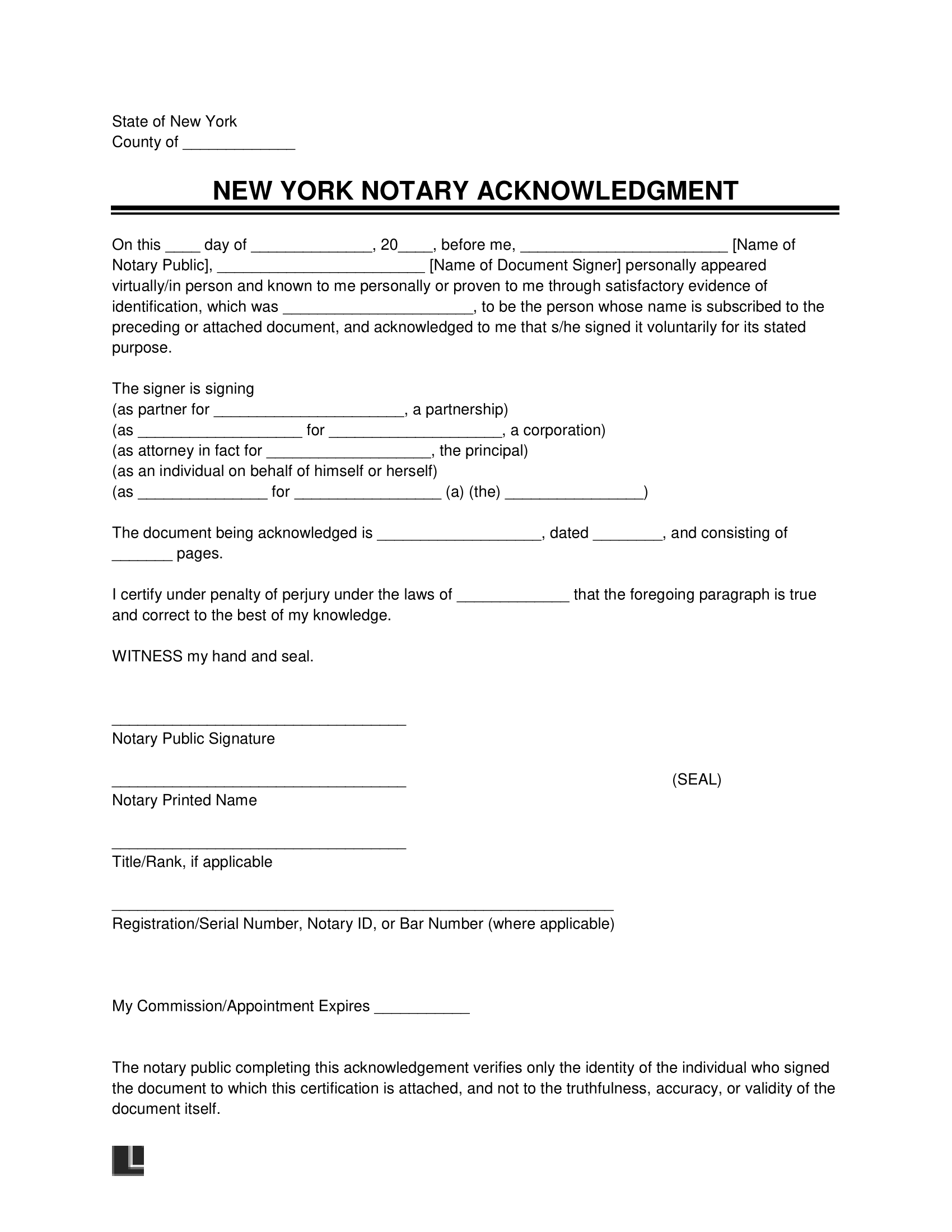
Sample Notary Statement for New York
View an example of our New York State notary acknowledgment form to see how a notary public verifies a signature. Fill out yours online with Legal Templates’s guided form. Once you’re done, you can download it as a PDF or Word document to have for electronic notarization. Otherwise, you can print out a copy and go before a notary public for in-person notarization.
Documents That Typically Require Notarization in New York
New York State requires various real estate and estate planning documents to be notarized. Otherwise, they won’t be legally enforceable. Here are some examples of documents that must be notarized in New York:
- Durable power of attorney
- Non-durable power of attorney
- Limited power of attorney
- Real estate power of attorney
- Minor power of attorney
- Power of attorney revocation
- Self-proving affidavit
- Warranty deed
- Quitclaim deed
- Living trust
Even if New York law doesn’t explicitly require certain documents to be notarized, you can still consider notarization to improve their authenticity. Here are some examples: