What Is a North Carolina Notary Acknowledgment?
A North Carolina notary acknowledgment form is an attachment that confirms the authenticity of signatures on a document. Before a notary public completes it, the signer must either:
- Tell the notary that it’s their signature on the legal document; or
- Sign the document in the notary’s presence
The notary public must also have evidence of the signer’s identity. The signer can either be personally known to the notary, or they may show the notary satisfactory evidence of their identity. Satisfactory evidence can be a government-issued ID card that has a photograph. If the signer can’t show ID, an oath from one credible witness who personally knows the signer is acceptable.
Once the notary confirms all these details, they sign the NC notary statement and add their stamp or seal. At this point, the signer’s document is officially notarized. This safety measure helps protect against identity theft and fraudulent claims.
What to Include in an NC Notary Acknowledgment
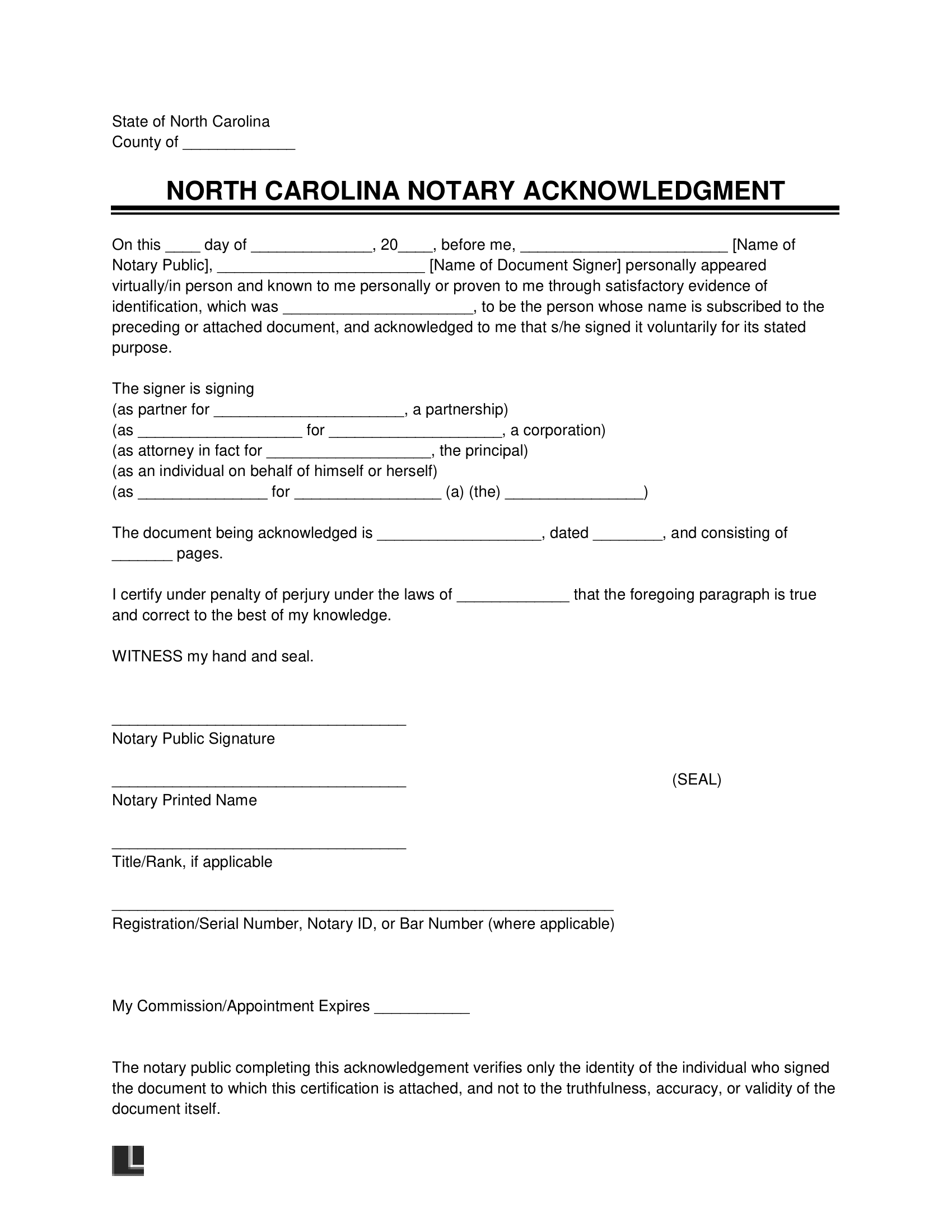
An NC notary statement is valid if it adheres to the statutory form outlined in NC Gen Stat § 10B‑41, or if it contains all of the following elements, per NC Gen Stat § 10B‑40:
- The state and county where the acknowledgment occurred
- The name of the signer who appears before the notary
- Confirmation that the signer appeared in person before the notary
- Confirmation that the signer stated that the signature on the document is their own
- The date of the acknowledgment
- The signature and seal or stamp of the notary who took the acknowledgment
- The notary’s commission expiration date
North Carolina Notary Acknowledgment Sample
Below, you can view a sample NC notary statement to get an idea of the key North Carolina notary acknowledgment requirements. Then, customize your document using Legal Templates’s form.
Our guided questionnaire makes it easy to add the notary location, signer details, and the details for the document being notarized. Then, you can get a printable version, which is also downloadable in PDF or Word format. A notary public can complete the rest, adding their signature and seal to finalize the notarization.
Is Online Notarization Legal in North Carolina?
Yes. House Bill 776, which went into effect on July 1, 2023, made remote online notarization a permanent feature in North Carolina. Chapter 10B – Article 2 governs electronic notarizations in the state. The required elements for an electronic notarization form include:
- The notary’s name, along with the state and county of notarial operation
- The designation “Electronic Notary Public” and the mention of “State of North Carolina”
- The date when the notary’s commission expires
- The notary’s electronic signature
- The completed wording of one of the following notarial certificates: acknowledgment, jurat, verification/proof, or oath/affirmation
Documents That Typically Require Notarization in North Carolina
North Carolina law often mandates notarization for some legal documents, especially those that involve real estate or estate planning. Explore some examples of documents that must be notarized:
- Durable power of attorney
- Non-durable power of attorney
- Limited power of attorney
- Real estate power of attorney
- Minor power of attorney
- Power of attorney revocation
- Self-proving affidavit
- Warranty deed
- Quitclaim deed
- Living trust
While laws may not require notarization for the following documents, you can still consider getting them notarized to increase their legal validity:
Do North Carolina Wills Require Notary Acknowledgment?
No. A last will in North Carolina does not need to be notarized. It only legally requires two witnesses to sign it (NC Gen Stat § 31-3.3). However, adding a self-proving affidavit, which does require a notary, to your last will can simplify the probate process.