What Is a North Carolina Postnuptial Agreement?
A North Carolina postnup records a couple’s assets and debts after marriage. It also assigns ownership and responsibility if the marriage ends in death or divorce. Spouses write a postnup after they wed, which makes it different from a prenuptial agreement that comes before marriage.
If spouses didn’t think to write a prenup or have a new situation to account for, they can create a postnup. For example, a postnup helps protect inherited assets and guards against liability for a spouse’s debts.
North Carolina relies on equitable distribution laws to divide marital property in a divorce settlement agreement (NC Gen Stat § 50-20). The courts will assess factors that vary from couple to couple.
For example, they’ll consider how much money each spouse makes, the tax consequences of the distribution, and each spouse’s health. Because of this, the property isn’t always split 50/50. Instead, it’s divided in a way that the court determines is fair. A postnup lets you and your spouse decide about your property without state intervention. Plus, you can reach an agreement while on good terms.
How to Write a Postnuptial Agreement in North Carolina
A postnuptial agreement in North Carolina must include several components. Legal Templates’ free downloadable form walks you through creating your own postnup recognized by North Carolina courts.
- Complete demographic information: Include the legal first and last names of both spouses. Add your address and children’s names from the marriage or former relationships.
- Disclose finances: Have both spouses confirm that they have revealed all assets.
- Differentiate between separate and marital property: List property acquired by spouses before marriage and marital property owned together. Assign ownership to the property listed.
- Protect business interests: Determine who retains ownership of the business if a divorce occurs.
- Document debts: List each spouse’s debts, like hospital bills, student loans, and personal loans. Then, decide which spouse will be responsible for paying each one.
- Decide tax status: Decide whether your tax filing status will be joint or separate.
- Account for the marital home: Figure out who will keep the family home if you separate, or explain how you’ll divide the money if you decide to sell it. You can also explain how you’ll both handle everyday household costs during the marriage.
- Provide for pets: A pet custody agreement allows you to determine which spouse retains custody of pets.
- Set alimony: State law lists the default payment procedures for spousal support (NC Gen Stat § 50-16.3A). A postnup can overrule the state’s laws, even allowing spouses to waive alimony as long as they agree.
- Add other clauses: You can include other agreements that fit your situation. For example, you may specify who will care for a spouse if they become disabled. You may also address how to handle children from a previous relationship or manage large gifts.
- Determine dispute resolution: Agree on steps for future dispute resolution.
- Sign and notarize: Both parties sign the postnup and provide notary acknowledgment.
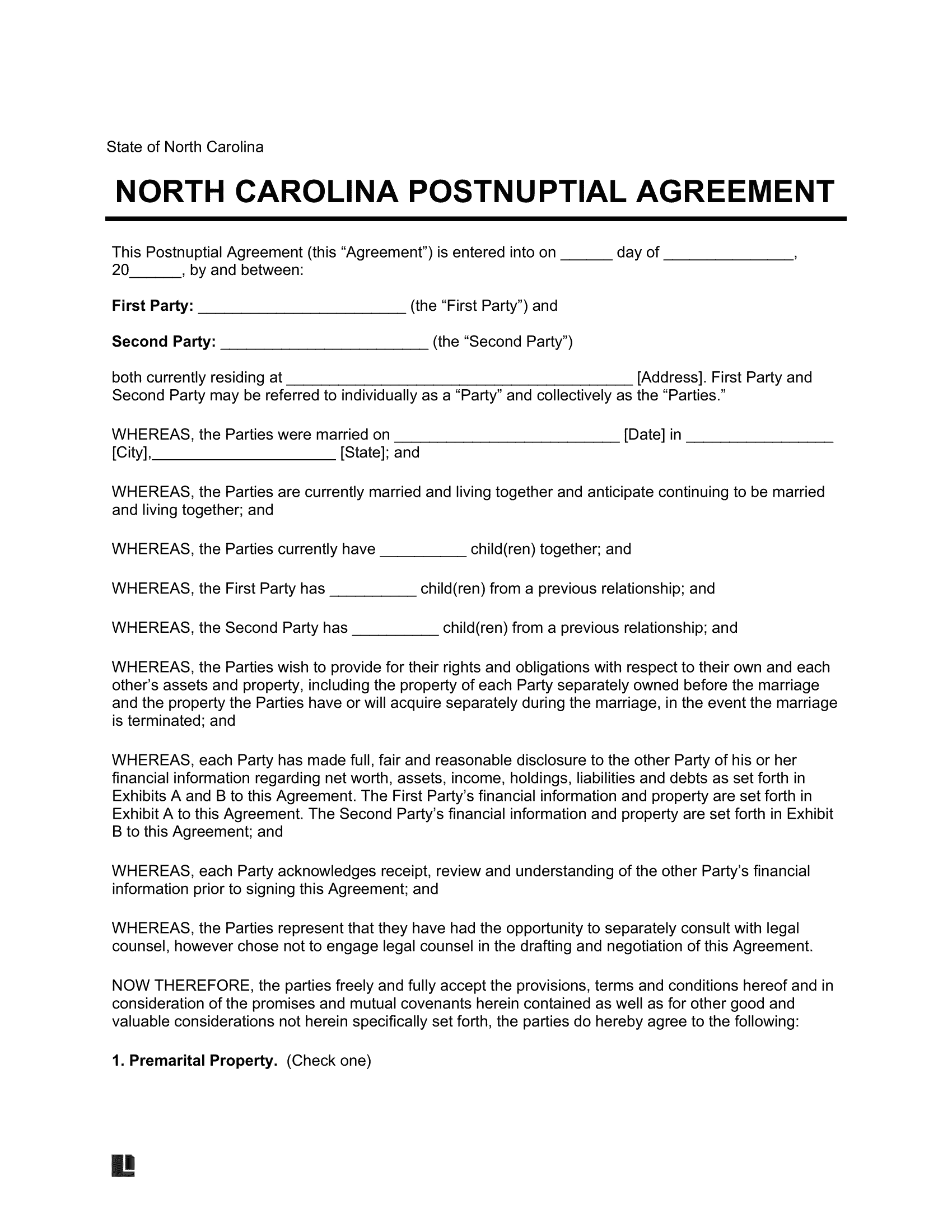
Sample North Carolina Postnuptial Agreement
View a free North Carolina postnuptial agreement to understand its elements. Then, create your own using our document builder. Download the final version in PDF or Word format.
Legal Requirements and Considerations for North Carolina Postnups
So, does North Carolina recognize postnuptial agreements? Yes, as long as they meet specific requirements. For example, the document must be in writing and notarized in the presence of a notary public or another certified officer (NC Gen Stat § 52-10).
Signing Requirements
Both spouses must sign a postnup without signs of duress, coercion, or fraud (Dawbarn v. Dawbarn (2006)). The court may invalidate a postnup if there are indications that one spouse signed under pressure.
Legal Representation
North Carolina doesn’t require a postnuptial agreement attorney. However, it’s recommended that each spouse secure independent counsel to ensure their individual interests are considered and to avoid future legal challenges to the document. Having an attorney can protect the integrity of the agreement if it is later challenged for unfairness.
Excluded Terms
A postnuptial agreement can’t cover issues of child support or custody. They also can’t contain economic incentives encouraging one spouse to leave the marriage (Dawbarn v. Dawbarn (2006)) or violate public policy.
Validity
Postnuptial agreements are not enforceable when fraud is involved (Dawbarn v. Dawbarn (2006)).
Statute of Limitations
North Carolina has a three-year statute of limitations for spousal claims that a postnup was a result of fraud or a mistake. The statute of limitations begins when the protesting spouse discovers the error or evidence of fraud (NC Gen Stat § 1-52). For other types of challenges to the contract, the general rule is that the statute of limitations is three years from the date the agreement was signed or the breach occurred (NC Gen Stat § 1-51(a)(1)).