What Is a West Virginia Notary Acknowledgment?
A West Virginia notary acknowledgment confirms that a signer appeared before a notarial officer and acknowledged a signature. It shows that the signer confirmed the signature was theirs and that they signed the document for its stated purpose.
The signer doesn’t always have to sign the document in front of the notary. Instead, they must acknowledge the signature and confirm they signed the document for the purpose stated in it (WV Code § 39-4-2(1), § 39-4-5).
What to Include in a West Virginia Notary Acknowledgment
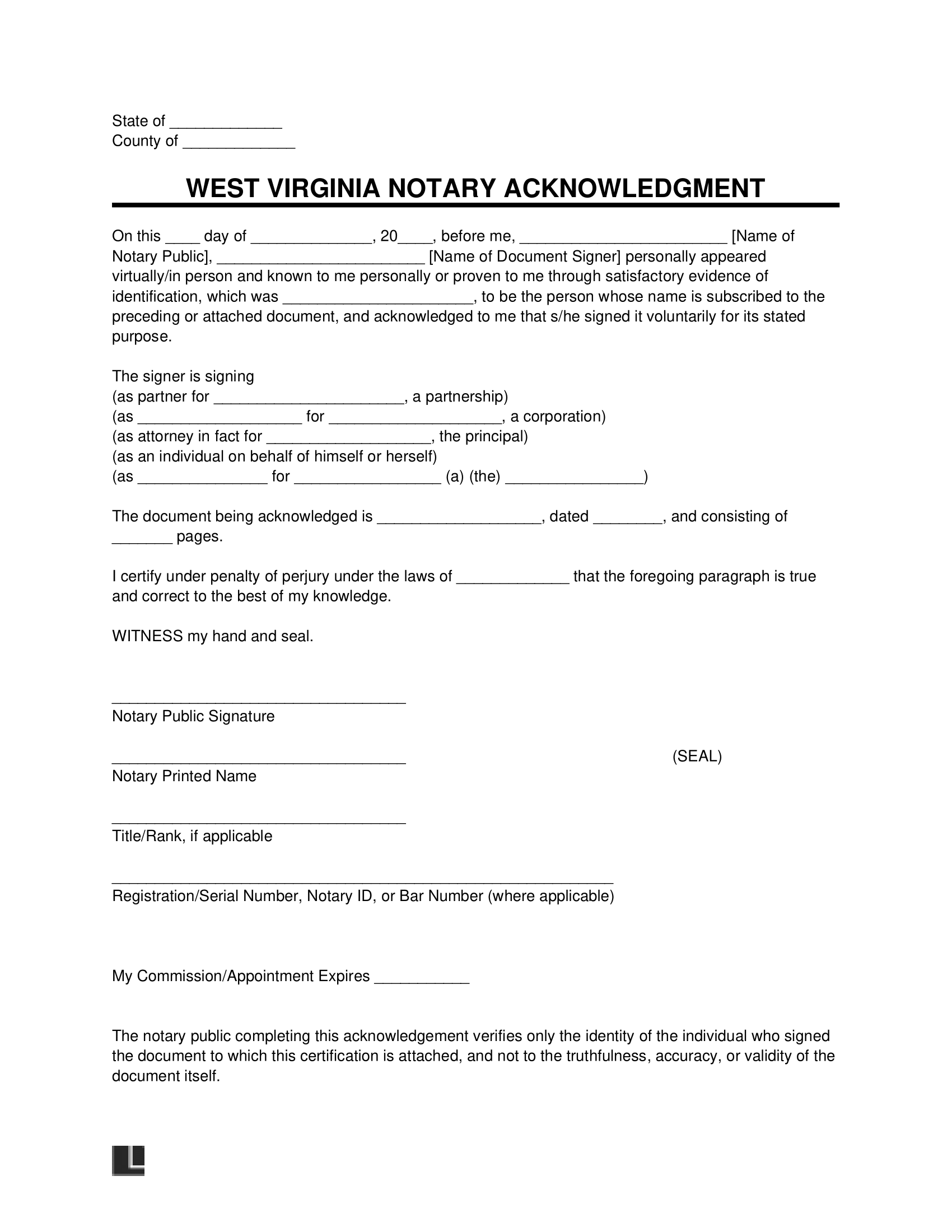
A West Virginia notary acknowledgment should be easy to check. It should show who acknowledged the document, where it happened, and who notarized it. To complete the certificate, complete the following steps:
- Write the date of acknowledgment when the signer acknowledges the document (WV Code § 39-4-15(a)(2)).
- Record the jurisdiction where the acknowledgment takes place, including the state and county (WV Code § 39-4-15(a)(3)).
- Enter the signer’s name so the certificate clearly identifies who acknowledged the document (WV Code § 39-4-16(1)).
- Use an acknowledgment statement saying the record was acknowledged before the notarial officer (WV Code § 39-4-16(1)).
- Include the notarial officer’s signature to complete the certificate (WV Code § 39-4-15(a)(2)).
- Provide the notarial officer’s title of office so the certificate shows the officer’s authority (WV Code § 39-4-15(a)(4)).
- Insert the notary commission expiration date if the notarial officer is a notary public (WV Code § 39-4-15(a)(5)).
- Add the official stamp if a notary public notarizes a tangible record (WV Code § 39-4-15(b)).
Legal Templates walks you through each required detail. Add the signer, date, location, notary, and document information. Then download your completed West Virginia notary acknowledgment form.
West Virginia Notary Acknowledgment Sample
Review a West Virginia notary acknowledgment sample. See how the certificate is structured, add your signer and notary details, then download the finished template in Word and PDF.
Is Remote Online Notarization Legal in West Virginia?
Yes. Remote online notarization is legal in West Virginia. The signer doesn’t have to sit across from the notary in person. Instead, they can appear before a West Virginia notary using approved audio-video technology (WV Code § 39-4-37(b)). For a West Virginia remote notarization:
- The notary must be in West Virginia. The signer can be somewhere else, including outside the United States. However, if the signer is located in another country, the document must relate to a West Virginia matter, property, transaction, court, public official, or government entity (WV Code § 39-4-37(c)).
- The certificate must mention communication technology. If the acknowledgment is completed online, the certificate must say the notarial act was performed using communication technology (WV Code § 39-4-37(d)).
- Remote ink notarization is also allowed. This means the signer and notary communicate in real time by sight and sound, but the document is signed in ink instead of being completed fully electronically (WV Code § 39-4-38).
- The notary must keep the required records. Records of remote notarial acts must be kept for at least five years.
- The technology must meet West Virginia’s rules. The notary must use audio-video technology approved under the state’s standards for electronic notarization, remote online notarization, and remote ink notarization. Prior to the first remote notarial act, the notary public must inform the Secretary of State that they intend to perform remote notarial acts in West Virginia and identify the electronic technology they will use to do so.
Remote notarization can help when the signer is outside West Virginia or can’t meet the notary in person. Just make sure the process follows West Virginia’s remote notarization rules from start to finish.
Documents That Typically Require Notarization in West Virginia
Some West Virginia documents usually need notarization because they deal with important rights, property, or legal authority. A notary acknowledgment helps show that the signer appeared before the notary and confirmed the signature as their own. Documents that typically require notarization in West Virginia include:
- Durable power of attorney
- Non-durable power of attorney
- Limited power of attorney
- Real estate power of attorney
- Minor power of attorney
- Power of attorney revocation
- Warranty deed
- Quitclaim deed
- Living trust
Not every document needs a notary stamp. But when money, property, or major personal commitments are involved, notarization can make the document easier to prove and harder to challenge. Recommended, not legally required: