What Is a Delaware Minor (Child) Power of Attorney?
A Delaware minor (child) power of attorney form is a document that parents or legal guardians can use to appoint another adult whom they trust to care for their child while they are unavailable. It is normally used to cover short-term caregiving needs without changing custody or parental rights. Parents commonly use this form when they are:
- Traveling for work or vacation.
- Serving in the military.
- Receiving medical treatment or recovering from an illness.
- Temporarily unable to care for their child due to personal or family circumstances.
The person receiving the authority in the meantime is known as the agent. This person can make select decisions for the child, such as those relating to their education, medical care, and daily supervision.
Legal Requirements for a Minor (Child) Power of Attorney in Delaware
In Delaware, there aren’t separate laws for a minor (child) power of attorney. It is governed by the same power of attorney principles as those in Delaware Code Title 12, Chapter 49A.
Creation of the Form
A child’s parents or legal guardian can create a Delaware child power of attorney. The person creating the form must have legal authority over the child.
Agent Appointment
The parent or legal guardian can appoint another adult to temporarily care for their child. Common choices include:
- Grandparents
- Adult relatives
- Close family friends
- Temporary caregivers
Under 12 DE Code § 49A-114, the agent must act in good faith and remain within the authorities granted under the form.
Signing and Notarization Requirements
To help ensure the document is readily accepted, parents commonly sign it before the notary public, along with one adult witness. Delaware’s general power of attorney law under 12 DE Code § 49A-105 guides this requirement. You can use a free Delaware notary acknowledgment form to complete this step.
How Long Does a Power of Attorney for a Minor Child Last in Delaware?
Delaware law does not set a specific time limit for a child power of attorney. Since there is no standalone law defining the duration, parents in Delaware should clearly state:
- The date the authority begins.
- The date the authority ends.
- Any event that may cause the arrangement to be terminated.
Even though there is no statutory limit, you should ensure that your document lasts no longer than 12 months. A document with a longer timeframe may be difficult to enforce.
A minor power of attorney becomes effective in Delaware as soon as the parent or guardian signs the form. That is, unless the document specifies a future start
A Delaware minor child power of attorney is best for short-term caregiving arrangements. If a child needs long-term care or supervision, a Delaware guardianship form or standby guardianship under 13 DE Code § 2361 may be more appropriate.
Revoking a Delaware Minor (Child) Power of Attorney
Parents or guardians in Delaware can revoke the child power of attorney at any time. Usually, the revocation must be made in writing. Under 12 DE Code § 49A-110, a power of attorney may end when the principal revokes the document or when a terminating event listed in the form actually occurs. Parents should notify relevant parties relying on the form once the document and the agent’s powers have been revoked. This may involve notifying the school, health care providers, and other people involved in the child’s care.
Use a free power of attorney revocation form to formally cancel your existing document.
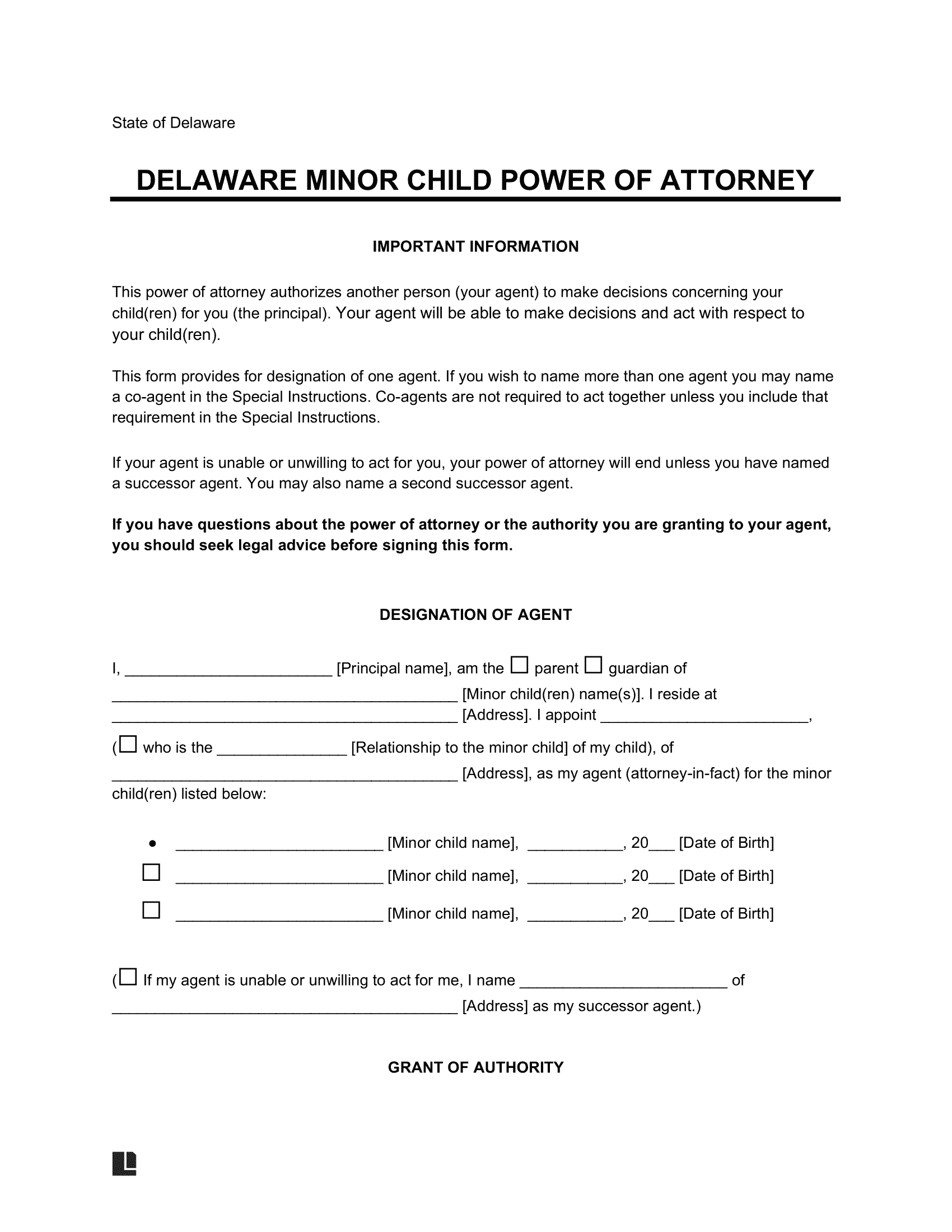
Sample Delaware Minor (Child) Power of Attorney
See below a sample Delaware minor (child) power of attorney form as a reference for temporary caregiving arrangements. Legal Templates’s step-by-step form helps you create a state-compliant minor power of attorney in minutes that includes all relevant details. You can download the form in PDF or Word once completed.