


LLC ownership may evolve over time as your business continues to grow. You may decide to add a partner to invest money in the business or help run the company. Alternatively, an existing partner may decide to leave or sell their share.
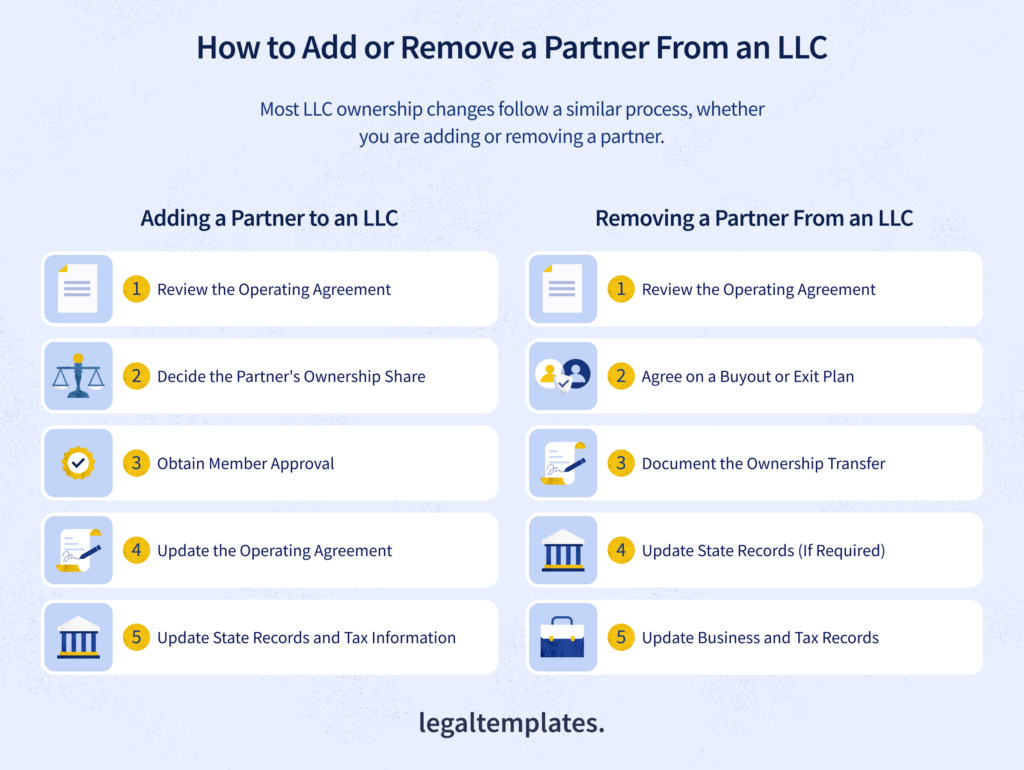
While the exact process of adding or removing a partner from an LLC may vary by state, most limited liability companies follow a similar framework when updating ownership.
Members are usually required to approve the ownership change, document the new ownership structure, and update relevant business records. Taking these steps helps ensure that your LLC remains compliant. It also helps avoid disputes between members.
If you are adding a partner because you’re forming a new business, you may need to create a new LLC instead of modifying an existing one. Learn more in our guide on how to start an LLC.
When Should You Add or Remove a Partner From an LLC?
Changes in an LLC’s ownership may happen for a number of reasons. Businesses often bring in new members to support growth, while others continue operating after an existing partner leaves. Below are some common reasons these ownership changes may occur.
Common Reasons to Add a Partner to an LLC
LLC owners may choose to add a partner to an existing LLC when the business needs additional support to grow or operate efficiently. A new partner can contribute funding, skills, or shared leadership that can help the company move forward.
Common situations where adding a partner may make sense include:
- Raising capital for the business: A new partner may invest money to help fund company expansion, develop new products, or support daily operations.
- Bringing in new skills and experience: A partner may offer industry knowledge, management experience, or valuable business connections.
- Expanding ownership among founders or early contributors: Someone who helped build the business may formally become an owner.
- Converting a single-member LLC into a multi-member LLC: This may happen when a second owner joins the company.
Common Reasons to Remove a Partner from an LLC
Sometimes an LLC may need to move forward without one of its partners. This can happen when a partner chooses to leave the business or when circumstances require a change in ownership.
Common situations where removing a partner may make sense include:
- Retirement or voluntary withdrawal: A partner may decide to step away from the business.
- Selling an ownership interest: A member may transfer their share to another partner or an outside buyer.
- Disputes between members: Disagreements about management, finances, or business strategy can lead partners to separate.
- Death or incapacity of a partner: Ownership may need to be transferred if a member can no longer participate in the business.
- Failure to meet obligations: A partner may fail to fulfill the duties and responsibilities outlined in the operating agreement.
Review Your LLC Operating Agreement First
Before adding or removing a business partner, review your LLC’s operating agreement. This document usually explains the key rules members must follow when ownership changes occur. Your operating agreement may address:
- How new members can be added to the LLC
- Voting requirements for approving ownership changes
- Buyout provisions that explain how a departing partner’s share should be purchased
- Valuation methods used to determine the value of a partner’s ownership interest
Reviewing these terms can help ensure that all members of the LLC comply with the operating agreement and reduce the risk of disputes. If your LLC does not already have one, you can create and update yours using Legal Templates’s free LLC operating agreement template.
State laws also recognize the importance of operating agreements when managing LLC ownership. For example, under California Corporations Code § 17701.10, the operating agreement governs the relationship among the members and the company. Similarly, Texas allows LLC members to define management and ownership rules through an operating agreement (Texas Business Organizations Code Chapter 101).
Since the operating agreement often governs how ownership changes are handled, reviewing it should be the first step before adding or removing a partner.
What if Your LLC Does Not Have an Operating Agreement?
If your LLC does not have an operating agreement, state default rules will usually govern how partners can be added or removed. These rules vary by state and may require member approval or other formal steps before ownership changes can take effect.
How to Add a Partner to an LLC (Step-by-Step)
Before a new partner can join the company, the existing members usually need to approve the change and update their records. Below is a step-by-step guide on how to add a partner to an LLC.
Step 1 – Decide the New Partner’s Ownership Interest
Start by figuring out how much of the business the new partner will own. LLC members should agree on several key details before moving forward, including:
- Ownership percentage: The share of the company that the new partner will receive.
- Capital contributions: Money, property, or services the partner will contribute to the business.
- Voting rights: Whether the new partner will have equal voting power or limited decision-making authority.
Profit and loss distribution: How business income and losses will be shared among the members.
Step 2 – Obtain Member Approval
Most LLCs require approval from existing members before a new partner can join. Your operating agreement typically explains how this approval should occur. Usually, members must vote on the change. This may involve:
- Unanimous consent, meaning all members must agree to the change
- A majority vote of existing members
Be sure to document the approval in writing to record that all members agree to the ownership change.
Step 3 – Amend the LLC Operating Agreement
Once all members agree and approve the new partner, the LLC operating agreement should be updated to reflect this change. You can document this change using an amendment to an LLC operating agreement template. The update may include:
- Adding the new partner’s name to the operating agreement
- Updating ownership percentages
- Adjusting voting rights and profit distribution among members
Step 4 – Update State Records (if Required)
Depending on the state you’re in, you may have to update certain filings for ownership changes, such as:
- Updating information in the articles of organization
- Reporting the change in the company’s annual report
Note that not all states require member names to be listed in public filings. However, it is still important to check your state’s requirements to ensure your records remain accurate and in compliance.
Step 5 – Update IRS and Tax Information
Adding a partner can change how the LLC is taxed at the federal level. When a single-member LLC adds a partner, the business becomes a multi-member LLC. The IRS generally treats multi-member LLCs as partnerships by default.
Most partnerships must file IRS Form 1065 (US Return of Partnership Income) each year. This form reports your LLC’s income, deductions, and overall financial activity. Each member of the LLC also receives a Schedule K-1 (Form 1065). This document shows the member’s share of the company’s profits or losses, which they report on their personal tax return.
LLCs Can Choose a Different Tax Classification
In some cases, an LLC may choose its tax classification rather than use the default IRS classification. Businesses can request a different classification by filing Form 8832 (Entity Classification Election) with the IRS.
How to Remove a Partner From an LLC (Step-by-Step)
Removing a partner from an LLC is often not as straightforward as adding one. This is because removing a partner can raise questions about buyouts, voting rights, and the fate of the partner’s ownership interest. If the partner refuses to leave, the process can become even more complex. The steps below outline how businesses typically handle a partner’s departure:
Step 1 – Check the Operating Agreement for Removal Rules
Start by reviewing your operating agreement. It usually explains when and how a partner can leave an LLC or be removed from it. For example, it may include rules on withdrawal procedures, buyout terms, and the valuation of a partner’s ownership interest.
If the operating agreement does not allow removal or does not clearly explain the process, members may need to negotiate a buyout or consider dissolving the LLC to resolve the ownership change.
Step 2 – Negotiate a Buyout
After all members agree that a partner will leave the LLC, decide what will happen to that partner’s ownership share. In many cases, this involves agreeing on a buyout. The most common options include:
- The remaining members buy the partner’s ownership share
- The partners sell their share to another member or an outside buyer
- The partner voluntarily leaves the business and transfers their interest
Step 3 – Document the Ownership Transfer
Once the members agree on the terms, they should document the arrangement in writing. Typically, this includes updating or amending the operating agreement and recording the transfer or purchase of the departing partner’s ownership share. You may also choose to use a buy-and-sell agreement to formally record the buyout terms and ownership transfer.
Step 4 – Update State Records
Some states require LLCs to update certain filings after an ownership change. You may need to update the articles of organization and the information reported in the LLC’s annual report. It is important to check your state’s rules and update any required records.
Step 5 – Update Business Records and IRS Information
Removing a partner from an LLC may affect how the business reports ownership and income for tax purposes. If one partner leaves and only one member remains, the LLC may return to being treated as a disregarded entity for federal tax purposes. In this case, business income is usually reported directly on the owner’s personal tax return rather than on a partnership return.
Do You Need a New EIN After Changing LLC Ownership?
In most cases, an LLC does not need a new Employer Identification Number (EIN) when adding or removing a partner. However, certain ownership changes can affect the business’s tax classification. If the LLC’s tax classification changes, the business may need to apply for a new EIN using Form SS-4.
Can You Remove a Partner From an LLC Without Their Consent?
In some situations, an LLC may be able to remove a business partner without that person’s consent. Whether this is allowed usually depends on the LLC’s operating agreement and state law. Many operating agreements include rules that allow members to remove a business partner under certain specific circumstances, such as when a partner:
- Violates the operating agreement
- Engages in illegal conduct that harms the business
- Seriously disrupts the company’s operations
Courts may also order the removal of a partner from an LLC in certain situations. For example, under California Corporations Code § 17706.02, a judge can order a member to be removed if they seriously harm the business or repeatedly violate the operating agreement.
That said, removing a partner without their consent is generally more complicated than a partner voluntarily leaving. If your operating agreement does not clearly allow removal, the remaining members of the LLC may need to negotiate a buyout, pursue legal action, or, in some cases, dissolve the LLC.
Final Thoughts
Adding or removing a partner from an LLC is a significant ownership change that requires careful planning and proper documentation. Members should review the operating agreement, approve the changes, and update any company records. It’s also important to ensure that tax reporting reflects the new ownership structure. Taking the time to document these changes properly can help your LLC remain compliant and reduce the risk of disputes.