

Evicting a tenant can help you remove an unwanted inhabitant and ensure you can use your property how you see fit. However, you can’t just kick someone out without following proper legal protocols. Below, you can learn how to evict a tenant and discover other key considerations for the eviction process.
How to Legally Evict a Tenant in 6 Steps
Before you evict a tenant, you must review your lease and identify a legal reason. Then, you can proceed with writing an eviction notice, distributing it, and pursuing an eviction lawsuit. Read about the eviction process in more detail below.
1. Identify a Legal Reason
In most cases, landlords must give a reason for eviction if they signed a fixed-term lease. Legal reasons for eviction include the following:
- Missing rent payments
- Violating the lease terms (i.e., keeping an unauthorized animal in the unit)
- Damaging the property beyond normal wear and tear
- Participating in illegal activities on the property
- Reaching the agreed-upon end of the lease term
Review your lease agreement to determine if your tenant has breached the agreed-upon terms. If they have, you’ll likely have grounds for eviction. Early lease termination without a reason is only allowed if the original lease authorizes it.
If you and your tenant signed a periodic lease, like a month-to-month or week-to-week lease, you likely don’t need to provide a reason. You only need to issue a lease termination letter giving proper notice. This is called a no-cause eviction.
Illegal Reasons for Eviction
You may not evict a tenant for the following reasons:
- Discrimination: Under the Fair Housing Act, it’s illegal for a landlord to evict a tenant because of a characteristic such as their race, gender, or religion.
- Retaliation: A landlord cannot evict a tenant because they’re upset that the tenant reported a health or safety violation.
- Harassment: A landlord cannot threaten or pursue an eviction to harass, frighten, or pressure a tenant.
2. Serve Notice
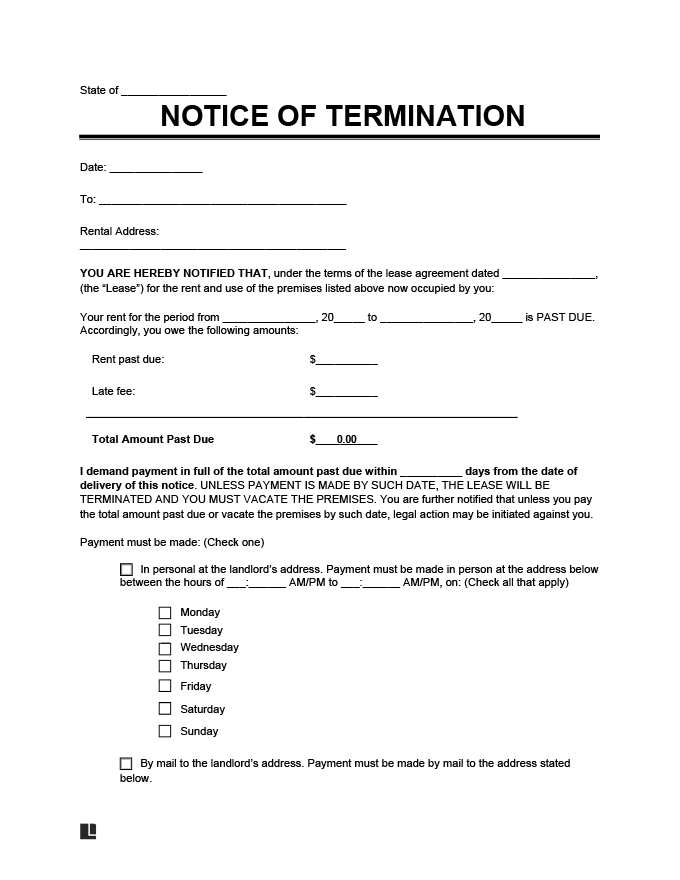
Once you determine a legally valid reason, you can write an eviction notice. Choose one of Legal Templates’s forms that fits your reason (non-payment, non-compliance, or illegal activity). Ensure that you issue the proper amount of notice determined by your state’s laws and the lease agreement.
Serve the completed eviction notice in accordance with your state’s guidelines. Some states require personal delivery or posting on the property, while others will accept delivery via mail or substitute service.
Once you serve the notice, allow the tenant time to vacate the property. If your notice includes an opportunity for the tenant to correct the violation, give them the chance to rectify their breach.
3. File an Eviction Lawsuit
If the tenant doesn’t respond or comply with the notice, you can file an eviction lawsuit in your local court. It might be referred to by a different name depending on your area, such as an unlawful detainer or forcible entry lawsuit.
The court will issue a summons, which notifies the tenant of the eviction case and the date they must appear in court. Tenants usually have a set period to respond to the court, often ranging from 5 to 10 days. In their response, tenants can file a defense and report improper notice from the landlord or unaddressed repairs.
4. Attend the Court Hearing
Both parties attend the court hearing and present their evidence. The judge analyzes the provided evidence and other details, such as the original lease terms, notices given, and applicable state laws.
5. Receive Judgment
The judge uses all of the information from the previous step to deliver a final verdict. If the judge doesn’t agree that the tenant should be evicted, they will determine that the tenant can continue living on the property.
If the judge determines that the landlord has won the case, they will administer a writ of possession (also called a writ of restitution or a warrant of eviction). This type of writ authorizes the removal of the tenant from the property.
6. Wait for the Enforcement of the Eviction
The court will deliver the writ of possession to the local sheriff or law enforcement personnel. Law enforcement gives the tenant a certain amount of time to leave on their own, usually between 24 and 72 hours. If the tenant still refuses to leave, law enforcement may forcibly remove them. The tenant may delay the process by filing an appeal, which will result in the case going to a higher court for a new trial.
How Long Does an Eviction Take?
The eviction process typically includes a waiting period, notice period, court proceedings, and final eviction action. Each step varies depending on the specific situation, but here’s a general overview of the eviction timeline.
| Step | Description | Tentative Time |
|---|---|---|
| Waiting Period Before Issuing Notice | Check local regulations for required waiting periods before issuing an eviction notice. | 3 to 7 days |
| Eviction Notice Period | After serving the eviction notice the tenant has a set number of days to either pay rent, correct the violation, or vacate. | 3 to 7 days |
| Post-Notice Action | If the tenant does not comply with the notice's timeframe, take legal action and file with the court. | 1 to 4 weeks |
| Court Proceedings and Final Eviction | After judgment, a court provides a writ of possession, specifying the final deadline for the tenant to vacate. | 1 to 4 weeks |
The timeline for an eviction also depends on state laws and legal proceedings. Below is the average time for an eviction in each state.
| State | Average Length of Eviction Process |
|---|---|
| Alabama | 4 weeks to several months |
| Alaska | Up to 8 weeks |
| Arizona | 1 to 6 weeks |
| Arkansas | 6 to 8 weeks |
| California | 5 to 8 weeks |
Explore some factors that affect the length of the eviction process:
- State-specific notice periods: States require a waiting period between issuing an eviction notice and granting an eviction order, allowing tenants time to respond, pay, or remedy issues. These periods, including the time to vacate after the final notice, typically range from one to 30 days.
- Tenant response: Tenant disputes can lengthen the eviction process with extra legal proceedings, while no response lets the landlord seek a quicker default judgment.
- Court backlog: The court backlog and available dates may prolong the eviction process. Scheduling any necessary county court appearances as soon as possible helps to expedite your case.
How to Evict a Tenant Without a Lease
Sometimes, someone living on your property might not have a formal lease, so they don’t fit the traditional definition of a tenant. Even without a lease, a resident who lives on your property, pays rent, or completes chores regularly may be legally recognized as a tenant.
Someone who’s legally recognized as a tenant (even without a lease) has certain rights. You can’t simply lock them out or kick them off your property without warning. The process of evicting someone without a lease is similar to that of evicting someone with a lease:
- Serve the individual with proper written notice.
- File an eviction lawsuit if they don’t comply.
- Go to court and present your case.
- Obtain a judgment.
- Your local sheriff enforces a writ of possession if the tenant doesn’t leave voluntarily.
In most cases, you don’t need a specific reason to evict someone without a lease (if you do give a reason, ensure it’s not retaliatory or discriminatory). They’re considered a month-to-month or at-will tenant whose tenancy can be terminated without cause.
Various types of residents can fall under the category of tenants without a written lease. Explore examples of individuals who don’t have written leases but may still have tenant-like rights, and learn how to handle these situations effectively.
Someone With Whom You Have a Verbal Lease
Allowing a friend or relative to stay in a vacant room or apartment in exchange for monthly payments creates a common “verbal lease.” Even though it isn’t written, this type of agreement is still a valid contract and can be enforced in court.
In most states, verbal leases default to month-to-month tenancies unless the parties agree to a shorter period. Either party can terminate the tenancy with proper written notice (often 30 days, though this varies by state). If the parties attempt to create a verbal lease for a term longer than one year, most states will not enforce it unless it is in writing.
Someone Who Stayed After a Lease Ended
If a tenant’s fixed-term lease expires and they continue to occupy the property without a formal lease renewal, they become a holdover tenant. If you accept rent, the tenancy usually converts to a periodic tenancy under state law. You can remove the tenant by following standard eviction procedures. Because they are month-to-month, you don’t need to give a reason—just proper notice.
If the tenant remains without paying rent and without your consent, they are considered a tenant at sufferance. In this case, you can begin eviction proceedings, starting with the proper notice to vacate. The required notice period depends on state law but is often between three and 30 days. Always check local rules before serving notice.
Someone Who’s Been Living on a Property You Purchased
If you buy a property, you’ll inherit the tenants and their occupancy status. If you don’t sign a new lease, tenants may continue to occupy the property under the terms of the previous lease agreement, if one exists. However, if the lease has expired, the tenants may become month-to-month occupants by default.
Someone Who Lives With You as a Roommate
When someone shares living expenses for the unit, they are usually considered a roommate. The original rental agreement may list a roommate as a co-tenant, but a roommate often has a separate roommate agreement with the tenant.
A tenant may wonder whether they can evict a roommate not on the lease. While it’s possible, it may jeopardize their tenancy as well, as an unapproved roommate is often a violation of the lease.
A tenant’s best bet is to review their lease and ask their roommate to move out. If the unwanted roommate doesn’t comply, a tenant can discuss the situation with their landlord to determine a suitable course of action.
Someone Who Stays as a Guest
A guest temporarily resides in your home and doesn’t pay rent. Removing a guest may be challenging if they refuse to leave or start paying rent after the pre-established guest period. It may be up to you to prove they don’t have the right to stay. If they don’t leave on their own, you may need to involve law enforcement.
Proceed with caution, as a guest may establish tenant rights if they live on the property for a certain period or stay for a minimum number of consecutive nights. You must evict a guest who has established tenant rights through the formal eviction process.
Family Member Who Doesn’t Pay Rent
You can legally evict family members unless you have a duty to support them. This legal obligation requires you to financially assist certain dependents, which in some states may include parents, siblings, or grandparents. However, other relatives don’t carry the same obligations and can be evicted for not paying rent or violating the terms of your living arrangement.
If you have a lease agreement with a family member, you have a legal obligation to follow the eviction terms in your arrangement. As long as they pay rent, you must wait until the lease expires before you can give them a notice of non-renewal or eviction notice. Any family members without a lease agreement or rent payments can be evicted at any time with proper notice and documentation.
Proceed with family member evictions with open communication and thoughtfulness to preserve your relationships.
Squatter
Squatters live on property for an extended period, sometimes for years. At first, they have no legal rights. However, under the doctrine of adverse possession, a squatter may eventually claim ownership if they openly and exclusively occupy the property for the statutorily defined period.
If you discover a squatter on your property, contact law enforcement immediately. Law enforcement may be able to remove them if they determine that the person is a trespasser.
If the squatter has established residency or claim rights, however, you’ll usually need to go through the formal eviction process. This involves serving notice and, if necessary, filing a lawsuit to regain possession.
Follow the Legal Eviction Process
The eviction process for someone without a lease is generally similar to that for a tenant with a lease. The only difference is that you usually don’t need a specific reason for evicting someone without a lease.
To avoid legal troubles, you should still provide the proper notice under state law and go through the courts to complete the eviction. This is because people living on your property may have developed tenant rights, even if they don’t have the official tenant title that a written lease gives them.
Landlord Considerations When Starting the Eviction Process
No matter who you’re evicting, it’s essential to proceed with caution to avoid legal trouble. Here are some key considerations when starting the eviction process:
Don’t Initiate a Self-Help Eviction
It’s illegal to initiate a self-help eviction, which means kicking out the tenant yourself rather than going through the courts. A self-help eviction may look like any combination of the following actions:
- Shutting off utilities
- Changing the locks
- Removing the tenant’s belongings from the property
- Physically removing the tenant or bullying them out
You may not resort to a self-help eviction in any situation because it deprives the tenant of their right to due process. If you engage in a self-help eviction, you may face civil penalties or criminal charges in more severe instances.
Be Mindful of Evicting Tenants During the Winter
No federal law prohibits winter evictions, so you can technically evict tenants during the winter if you give proper notice and go through the courts if needed. You must also have a valid reason if the lease is a fixed-term one.
However, state and local guidelines can influence the process, such as moratoriums during extreme weather or holidays. For example, Cook County in Illinois does not allow evictions to occur if the temperature drops below 15 degrees Fahrenheit.
Check your local laws to determine if your area has restrictions on winter evictions. If you proceed with a winter eviction, consider allowing the tenant to correct the breach. This can demonstrate compassion during a difficult time.
Don’t Retaliate Against Tenants
Most states also have policies in place to prevent landlords from retaliating against tenants for contacting authorities or law enforcement.
For example, FL Stat § 83.64 prohibits Florida landlords from evicting a tenant because the tenant complained to a code enforcement agency. So, if a tenant in Florida contacts code enforcement because their landlord did not complete a repair within a legal time frame, they cannot be evicted in retaliation.
Handle Evictions With Vulnerable Tenants Carefully
If you’re evicting vulnerable tenants, you should proceed with caution to ensure you’re respecting their rights. For example, the Fair Housing Act (FHA) does not allow you to evict someone because they have a disability. You must be willing to make reasonable accommodations instead of evicting them (like letting a service animal live with the tenant on a no-pets property).
Similarly, the FHA also protects a landlord from evicting a tenant solely based on the tenant’s age or whether they have children.
Evicting Tenants Who Receive Housing Assistance
Tenants in federally subsidized housing (like Section 8) generally cannot be evicted without “just cause,” such as non-payment of rent or serious lease violations.
Deal With Abandoned Property Properly
When a tenant gets evicted and leaves personal belongings behind, you cannot get rid of them immediately in most cases. Many states have certain requirements for:
- Holding the property for a certain period
- Storing it safely
- Issuing notice when disposing of the property
- Selling the property at a public auction when the storage period ends
- Disposing of items with little or no value
Landlords must strictly follow state procedure. Throwing out belongings too soon or failing to give notice can result in the tenant suing for damages.
Think Twice Before Accepting Partial Rent Payments
While accepting a partial rent payment can help the tenant as they gather the funds to pay rent, it can restart the eviction process. Any eviction notice for non-payment of rent you send may become null, meaning you will need to send a new one. Only accept partial rent payments if you’re willing to restart the eviction process.
How Much Does It Cost to Evict a Tenant?
Evicting a tenant can cost anywhere from a few hundred dollars to thousands of dollars. If you go to court, you’ll have to pay court filing fees and process server or sheriff fees to serve notice.
You can represent yourself as the landlord, but you may want to consider hiring a lawyer for legal representation. The cost of a lawyer can range greatly—it’ll be on the lower side for an uncontested eviction, but the costs can add up quickly if the case is intricate.
Costs may continue to accumulate after the tenant leaves. You may have to pay for cleaning costs, repairs, and lost rent during vacancy.
Legal Templates helps you limit the costs associated with eviction. You can use our eviction notice template to communicate your intention to file an eviction if the tenant fails to comply or vacate the premises. Our form helps you convey your message and encourage a timely move out. While it won’t avoid eviction altogether if you have a stubborn tenant, a clear and concise eviction notice can minimize costs if the tenant complies with your first message.
What Happens if the Landlord Loses the Eviction Case?
When a court denies a landlord’s request to evict a tenant, the repercussions can be significant:
- Tenant’s right to stay: The tenant is granted the legal right to remain in the property. Their tenancy will often continue under the terms of the existing lease.
- Financial penalties: The landlord may be ordered to compensate the tenant for damages incurred during the eviction process. This can include court costs, attorney’s fees, and other penalties.
- Difficulty with future evictions: The court’s decision can make it harder to evict the same tenant in the future.
If the landlord is also found responsible for illegal housing practices, they may face fines or even criminal prosecution and imprisonment in some states.
Given the potential consequences, it’s in a landlord’s best interest to avoid eviction disputes whenever possible. Thorough tenant screening, clear lease agreements, and open communication can prevent situations that escalate to court. If legal action is unavoidable, consulting with an attorney specializing in landlord-tenant law is crucial to ensure compliance with all applicable laws and regulations.
Can a Landlord Contest an Eviction Ruling?
A landlord can appeal an eviction ruling if they have solid legal grounds, such as:
- Improper notice or procedure by the court
- Misapplication of the eviction law by the judge
- Important evidence that wasn’t considered
An appeal will usually go to a higher trial or appellate court.
Alternatives to the Eviction Process
Completing the formal eviction process takes time and resources. If you want to remove a family member, roommate, or another unwanted tenant but don’t want to go through the formal process, you may consider alternative methods:
- Communication: Ideally, you should start any potential eviction with open communication. Sometimes, a simple request asking the unwanted tenant to leave can be enough to get them to move out on their own accord.
- Cash-for-keys: Consider offering a cash-for-keys arrangement in which you pay someone to vacate your house. While this strategy incurs a financial cost, it helps avoid the expense of an eviction and provides a less confrontational solution.
- Mediation: Invite a neutral mediator to facilitate communication and help you reach a mutual agreement without legal action.
- Payment plans: Arrange a payment plan for the tenant to compensate for unpaid rent.
- Rent forgiveness: Reduce a tenant’s rent payment obligation with a rent forgiveness amendment.
- Mutual lease termination: A mutual lease termination allows the tenant and landlord to end the lease early, subject to agreed-upon terms.