What Is a Late Rent Notice?
A late rent notice is a letter from a landlord to a tenant stating that rent is overdue. Also called a past-due rent notice, it serves as an informal reminder and creates a written record in case the issue remains unresolved.
A late rent notice may come after a tenant ignores an initial notice of the current rent balance.
A late rent notice is often unofficial. It’s a friendly prompt to encourage the tenant to pay their overdue rent balance. A late rent payment notice precedes the official “notice to pay or quit,” which is the first step in the formal eviction process.
Some states require landlords to wait for a statutory grace period to expire before issuing a formal notice to pay rent or quit. During this waiting period, you can send an informal late rent notice to remind tenants about the overdue payment and encourage them to pay before formal action becomes necessary. Review each state’s rules to understand when you can serve a formal notice to pay rent or quit and when an informal late rent notice may be appropriate.
| State | When Can a Landlord Issue a Formal Notice to Pay Rent or Quit? | Statute |
|---|---|---|
| Alabama | The day after rent is due | AL Code § 35-9A-421 |
| Alaska | The day after rent is due | AK Stat § 34.03.220 |
| Arizona | 5 days after the rent due date | AR Code § 18-17-701 |
| Arkansas | The day after rent is due | AZ Rev Stat § 33-1314 |
| California | The day after rent is due | CA Civ Code § 1947 |
If state law or your lease establishes a grace period for late rent, you cannot issue a formal notice to pay or quit during this time. However, you can send a courtesy late rent notice. This reminder may encourage the tenant’s compliance and help you avoid the eviction process.
Even once the grace period passes, you may want to try a late rent notice first. This shows that you’re willing to work with the tenant to collect a late payment without initiating eviction proceedings.
When to Send a Late Rent Notice
Most commonly, a landlord sends a notice of past-due rent as soon as rent becomes overdue. They are allowed to send it before the state- or lease-mandated grace period.
While you can send a friendly reminder immediately, an official, legally binding “notice to pay or quit” (also called an eviction notice for nonpayment of rent) should only be sent after the grace period ends.
How to Write a Late Rent Notice
A well-formatted late rent notice should clearly state the issue of overdue rent and the expectations you have for the tenant to resolve it. Here’s how to write your late rent notice to effectively communicate the situation to your tenant.
Step 1 – Identify the Parties & Property Address
List yourself as the landlord and include your address. State the tenant’s full name as it appears on the lease, adding any additional tenants as needed. Include the complete rental property address (unit number, street, city, and ZIP code). This makes it clear which property’s rent is in arrears.
Add your contact information so the tenant knows how to reach you with questions or payment details.
Step 2 – Include a Clear Statement of Nonpayment
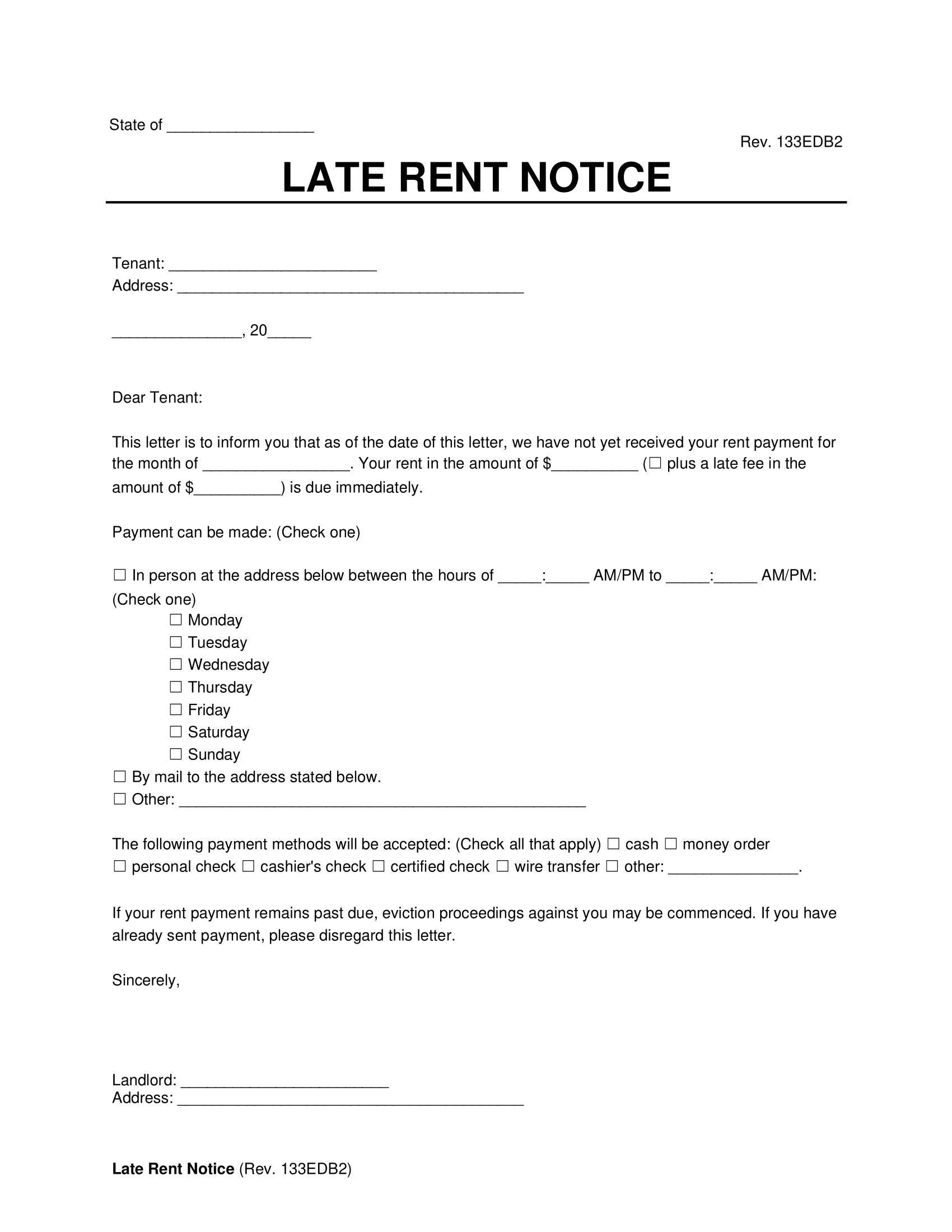
Use professional, direct language, such as “This letter is to inform you that, as of the date of this letter, we have not yet received your rent payment.” State the amount and the month for which rent is in arrears. Break down the amount due by listing the current month’s rent and any past unpaid rent, then show the total amount the tenant must pay.
Make it clear that the notice relates to nonpayment of rent for a specific period, to avoid any confusion about what the tenant must fix. If you need to communicate a breach of the lease, use our notice to comply or vacate instead.
Use Legal Templates’s late rent notice form to get the wording right and convey the purpose of your message.
Step 3 – Note Any Late Fees
If a tenant is late in paying rent, you may be able to charge a late fee. In order for you to charge late fees in your delinquent rent notice, state law must allow them, and your lease agreement must list them. If you meet these conditions, you’re permitted to charge a late fee. Communicate the late fee to your tenant by listing it in your overdue rent notice, and clarify that the fee is due in addition to the overdue rent amount.
Not sure if your state allows late fees for overdue rent? Explore the state laws below:
| State Name | Maximum Late Rent Fee | When Can I Charge a Late Rent Fee? | Statute |
|---|---|---|---|
| Alabama | No limit on late fees | As soon as the rent is late | n/a |
| Alaska | No limit on late fees | As soon as the rent is late | n/a |
| Arizona | Must be reasonable | As soon as the rent is late | AZ Rev Stat § 33-1368 |
| Arkansas | No limit on late fees | As soon as the rent is late | n/a |
| California | Must be reasonable | As soon as the rent is late | CA Civ Code § 1671 |
Even if state law doesn’t explicitly cap late-fee amounts, they must still be reasonable. Otherwise, courts will likely not uphold them.
Step 4 – Specify How Payment Can Be Made
List acceptable payment methods so the tenant can easily send their overdue payment to you. Give a deadline by which you’re willing to accept the overdue payment.
You may specify that the tenant may pay in person or by mail to your address. Plus, Legal Templates’s guided form lets you customize your late rent notice with the following payment options:
- Cash
- Personal check
- Money order
- Cashier’s check
- Certified check
- Wire transfer
Step 5 – Clarify That You May Initiate Eviction Proceedings
Reinforce that this reminder is not a notice to pay or quit by informing the tenant that if they don’t pay the overdue rent, you may initiate eviction proceedings. Giving this consequence may alert the tenant and encourage them to pay so they can avoid the legal process of eviction.
Conclude your notice of past-due rent by signing it as the landlord.
Step 6 – Send the Past-Due Rent Notice
Once you finish writing the late rent payment notice, you can ensure proper delivery to the tenant. Because this notice is not an official eviction notice for nonpayment of rent, there are no legally required methods to follow. However, you should consider handing it to the tenant personally or sending it via certified mail. You may also post it on their property.
Whichever method you use, you should be confident that it will serve them the notice in a timely manner. This ensures they get the notice, have time to review it, and are aware of the overdue rent.
Sometimes, a past-due rent notice is enough of a reminder. It may motivate the tenant to pay without you needing to pursue the formal eviction process.
Sample Late Rent Notice
View an example of our late rent notice template to see how to request an overdue payment from a tenant informally. Once you’re ready, you can fill out your own using our guided form. Then download it in PDF or Word format to prepare to distribute it to your tenant.
What to Do If a Tenant Ignores a Late Rent Notice?
After sending a late rent notice, follow up to confirm the tenant received it. If they respond but can’t pay or ignore the notice altogether, discuss possible solutions:
- Let them catch up. Write a payment plan so they can pay over time.
- Offer temporary relief. Use a rent forgiveness amendment to absolve the tenant of an overdue payment.
- Pay them to leave. Write a cash-for-keys agreement to encourage them to leave voluntarily, but make sure that you do not violate any housing laws in the process.
- Transition to a new lease. Switching from a fixed-period lease to a month-to-month lease provides flexibility for both parties.
Initiating Formal Eviction After a Late Rent Notice
If the tenant refuses to cooperate with a late rent notice and the above methods, review your state’s laws to determine the next step. Most states require you to send a notice to pay or quit to initiate the formal eviction process. This notice officially starts the clock on eviction proceedings. It gives tenants the state-mandated notice period to pay or move out.
Select your state to find the eviction notice for nonpayment of rent that’s applicable to your situation:
- Alabama
- Alaska
- Arizona
- Arkansas
- California
- Colorado
- Connecticut
- Delaware
- District of Columbia
- Florida
- Georgia
- Hawaii
- Idaho
- Illinois
- Indiana
- Iowa
- Kansas
- Kentucky
- Louisiana
- Maine
- Maryland
- Massachusetts
- Michigan
- Minnesota
- Mississippi
- Missouri
- Montana
- Nebraska
- Nevada
- New Hampshire
- New Jersey
- New Mexico
- New York
- North Carolina
- North Dakota
- Ohio
- Oklahoma
- Oregon
- Pennsylvania
- Rhode Island
- South Carolina
- South Dakota
- Tennessee
- Texas
- Utah
- Vermont
- Virginia
- Washington
- West Virginia
- Wisconsin
- Wyoming
Things to Remember When Sending a Notice to Pay or Quit
-
Use your state’s official notice to pay or quit template.
-
Wait for any grace period to pass before sending the notice.
-
Follow state laws for properly delivering the notice.
-
Give the tenant the amount of time stated in the notice to pay rent or move out.
-
File a lawsuit if the tenant does not comply with the notice to pay rent or quit.