What Is a Cross-Purchase Buy-Sell Agreement?
A cross-purchase buy-sell agreement is a legal agreement that explains how business owners buy a partner’s share when they leave the business. It requires the remaining owners to buy that share, while the departing owner (or their estate) agrees to sell.
It applies when an owner dies, becomes disabled, retires, or exits. Instead of the business buying the shares, the remaining owners buy them directly. That keeps ownership in the same hands and avoids bringing in outsiders.
The agreement also sets clear rules for how the buyout works. It covers how the price is set, when the purchase happens, and how the process moves forward. With everything mapped out ahead of time, ownership changes stay simple and predictable.
After the buyout, ownership shifts to the remaining owners based on their shares.
When Should You Use a Cross-Purchase Agreement?
A cross-purchase agreement works well when:
- You have two to five owners. Each person can take on a buyout without overextending
- You have a funding plan in place. Cash, financing, or insurance supports the purchase
- You want to keep ownership within the group. Shares stay between current owners
- You’re preparing for life changes. Death, disability, retirement, or exit
- You want to prevent ownership surprises. No unintended transfer to family members
- You want everything mapped out in advance. Price, timing, and transfer steps are agreed in advance
As the number of owners grows, this structure becomes harder to manage. Larger companies often shift to a company buyback approach.
If a cross-purchase agreement isn’t the right fit, consider a redemption buy-sell agreement, where the business buys the shares, or use a general buy-sell agreement for a more flexible structure.
What to Include in a Cross-Purchase Buy-Sell Agreement
To avoid gaps, your agreement should address each part of the buyout process:
- Add the details: Company details, ownership breakdown, and purpose
- Set transfer rules: When ownership can change and what’s allowed
- Give owners first rights: Remaining owners get the first chance to buy
- Plan for leftover shares: What happens if not all shares are purchased
- Cover major events: Death, disability, retirement, or exit
- Define the buyout: How price is set and how value is calculated
- Set payment terms: Cash, installments, or a promissory note
- Plan funding: Insurance, savings, or a structured payment plan
- Set expectations for new owners: They must agree to the same terms
- Include legal terms: Disputes, governing law, and when the agreement ends
When these terms are built into the agreement, each owner knows exactly how a buyout will unfold. That makes it easier to handle real events like retirement or death without delays, disputes, or uncertainty around ownership.
Decide how the business will be valued upfront. Use a fixed price, formula, or appraiser, and update the value regularly.
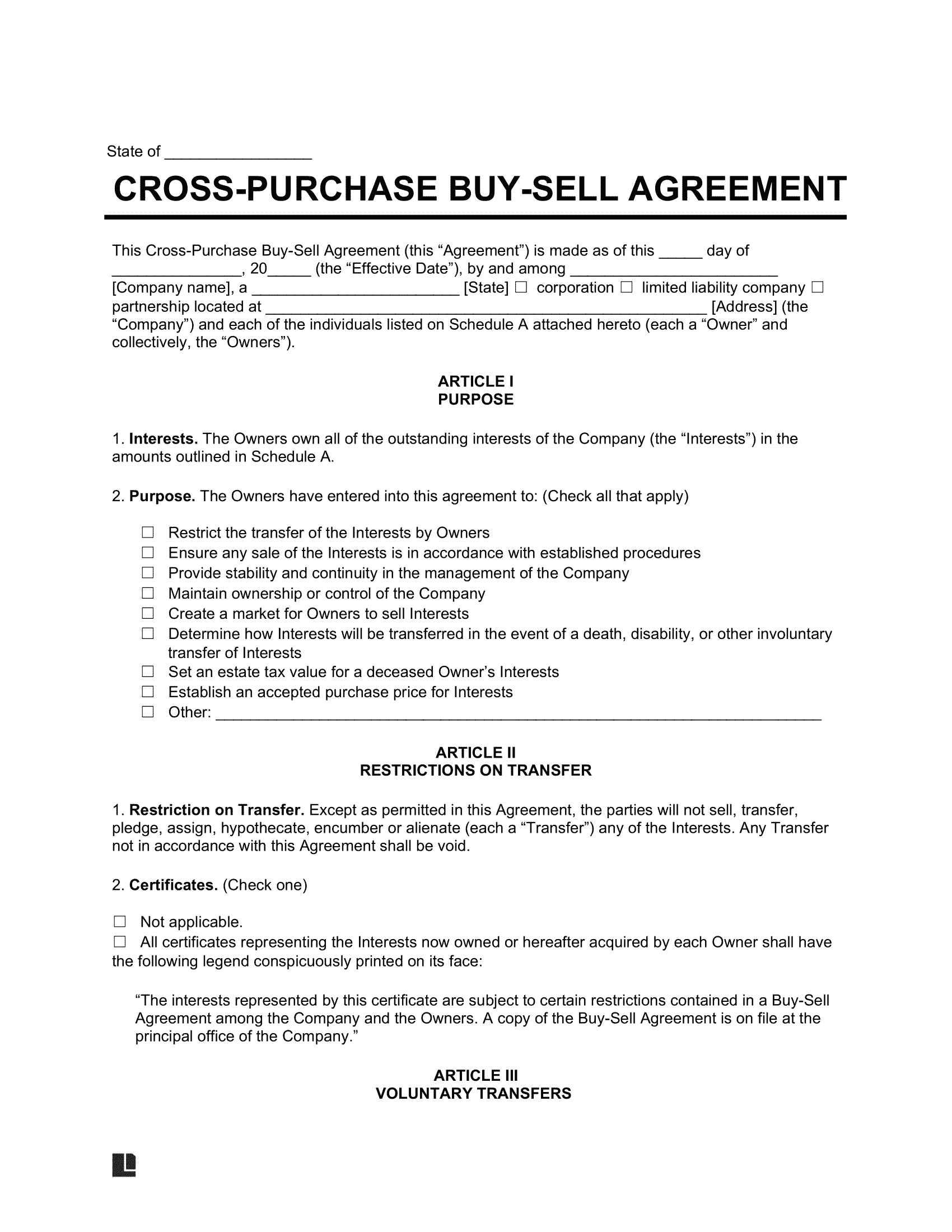
Sample Cross Purchase Buy-Sell Agreement
Review a sample cross-purchase buy-sell agreement. Use it as a guide, then customize and download the template in Word or PDF.