What Is a Maternity Leave Letter of Intent?
A maternity leave letter of intent is a document submitted by an expectant mother to their employer, requesting a leave of absence for childbirth and newborn care. It communicates their role within the company and the anticipated dates of their maternity leave.
The employee typically sends it well in advance, usually around 15 weeks before the child’s due date. However, they should refer to their employment contract, as it may list specific notice period requirements for maternity leave.
Writing a letter of intent for maternity leave is a smart professional step. It shows that the employee respects the employer, giving them time to plan for the employee’s absence.
It also benefits the employee by helping them comply with the Family and Medical Leave Act (FMLA). The FMLA does not mandate paid leave for expectant mothers, but it protects their job position during maternity leave. If the mother is an eligible employee who works at a covered workplace, they qualify for 12 weeks of unpaid leave. A letter of intent helps convey their plans and request leave under the FMLA.
The FMLA does not apply to all employers. It only covers employers who employ 50 or more employees in 20 or more workweeks.
How to Write a Maternity Leave Letter of Intent
A maternity leave letter of intent helps you tell your employer about your pregnancy and the time off you’ll need. Plus, it helps you align with notice requirements under FMLA, protecting your job while you’re on leave. Review the steps for writing your pregnancy notification letter to your employer below.
- Date the letter. Include the date you’re writing your letter of intent to return to work after maternity leave. This shows your employer that you provided ample notice, whether the 30-day notice required under FMLA or a longer period required by your employment contract.
- Address it properly. Include a sender and recipient line at the top of your letter if you plan to send it by mail. If you plan to email it, a simple salutation and closing will work.
- Introduce yourself. Identify yourself as the writer of the letter. Provide your name, the name of your company, your job title, and your department.
- List your expected due date. State when your child’s expected birth date is.
- Describe the duration of your leave. Give the expected start and end dates for your maternity leave. Clarify the number of weeks you expect to be gone from work.
- Delegate tasks. Outline who will take over your responsibilities so business operations can proceed as normal.
- State your availability. Use your maternity leave notice letter to explain whether you’ll be available to assist the company and answer questions during your time away from work.
Attach Supporting Documents
As specified by the Department of Commerce, you may need to attach additional documents to support your request:
- The newborn’s birth certificate
- A consular report for children born outside the country
- Relevant healthcare documents
- The hospital admission paperwork related to the birth
- (For adoptions) The official adoption placement agreement
- (For foster care situations) The formal foster care placement documentation
You can also submit a pregnancy verification letter to prove a health care professional’s diagnosis.
Maternity Leave Letter Example
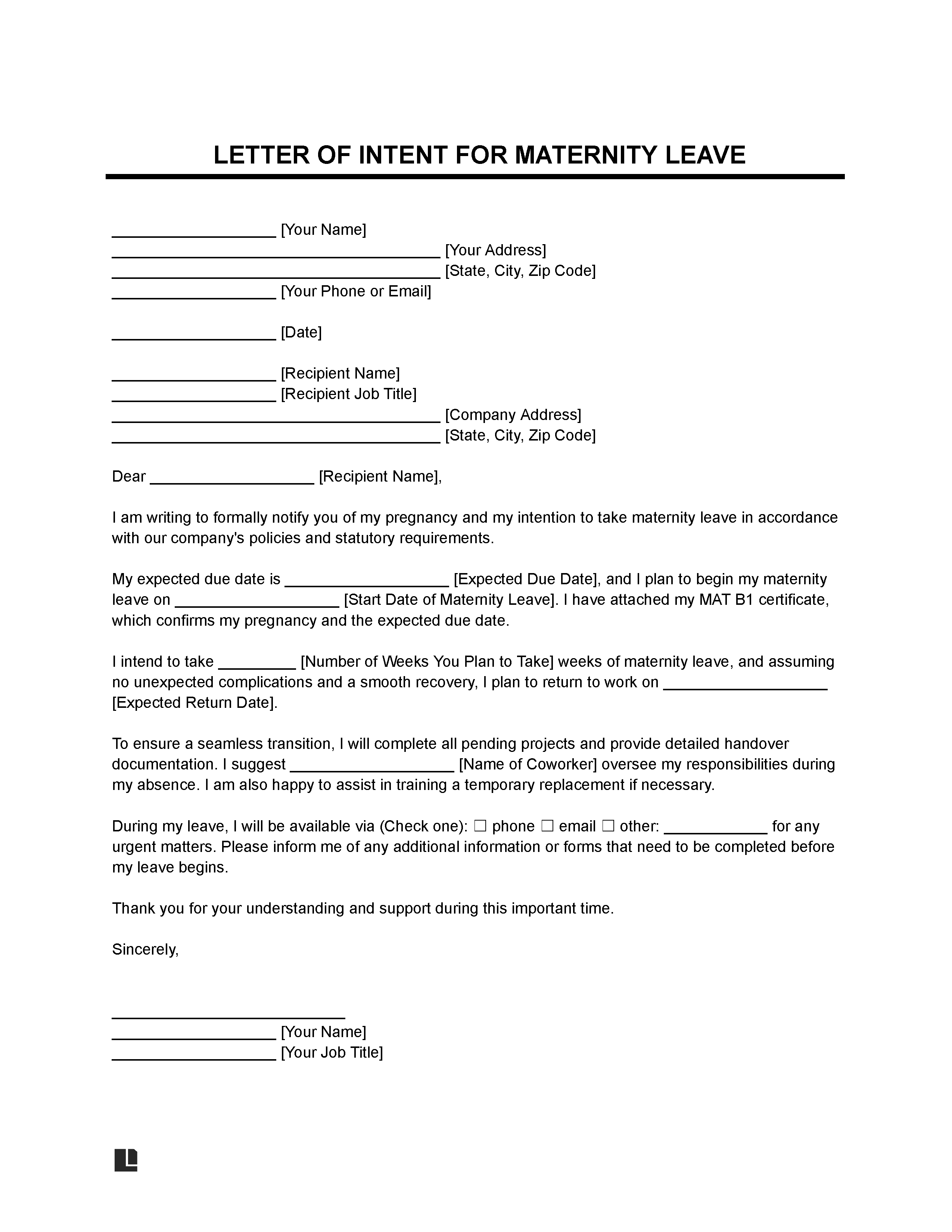
Here’s an example of a maternity leave letter of intent:
Charlotte J. Miller
123 Bayside Drive, St. Petersburg, FL 33701
727-555-0198
[email protected]
April 3, 2026
Robert Henderson
Director of Operations
Clearwater Logistics Group
4500 Business Parkway, Suite 200, Tampa, FL 33602
Dear Robert Henderson,
I am writing to formally notify you of my pregnancy and my intention to take maternity leave in accordance with our company’s policies and statutory requirements.
My expected due date is August 14, 2026, and I plan to begin my maternity leave on August 3, 2026. I have attached my pregnancy verification letter, which confirms my pregnancy and the expected due date.
I intend to take 12 weeks of maternity leave, and assuming no unexpected complications and a smooth recovery, I plan to return to work on October 26, 2026.
To ensure a seamless transition, I will complete all pending projects and provide detailed handover documentation. I suggest James Chen oversee my responsibilities during my absence. I am also happy to assist in training a temporary replacement if necessary.
During my leave, I will be available via email for any urgent matters. Please inform me of any additional information or forms that need to be completed before my leave begins.
Thank you for your understanding and support during this important time.
Sincerely,
Charlotte J. Miller
Senior Project Coordinator
Maternity Leave Letter Sample
View our simple maternity leave letter to an employer to see how you can clearly communicate your leave request for childbirth and newborn care. When you’re ready, customize your leave dates and availability using our guided form. Then, download copies in PDF or Word format to share with your employer.
Legal Considerations for a Maternity Leave Letter of Intent
Because FMLA only provides unpaid leave for expectant mothers, you may wonder if paid leave is available. 13 states and the District of Columbia offer paid maternity leave with different terms. You can use your maternity leave letter of intent to request paid maternity leave, but you should reference applicable state laws to justify your request. Explore the states that allow paid maternity leave below:
| State | Notes | Eligibility Requirements |
|---|---|---|
| California (Paid Family Leave) | Provides up to eight weeks of partial pay (between 60 and 90% of income). | • Be employed or actively looking for work when your family leave starts. • Earned at least $300 and paid into State Disability Insurance (SDI) in the last 18 months. |
| Colorado (Family and Medical Leave Insurance Program) | Provides 12 weeks, with an additional 4 weeks available for pregnancy or childbirth complications. Can cover up to 90% of wages, depending on income level. | • Earned at least $2,500 in wages during your base period. • Worked at your job for at least 180 days. |
| Connecticut (Paid Family and Medical Leave Act) | Provides up to 12 weeks of income-replaced leave for bonding with a new child, with an additional 2 weeks for complications. Can cover up to 95% of income. | • Worked for a covered employer for at least three months. • Earned at least $2,325 in a base period. • Be currently employed or have been employed within the last 12 weeks. |
| Delaware (Healthy Delaware Families Act) | Provides up to 12 weeks of paid, job-protected leave. Can cover up to 80% of income. | • Worked for your employer for at least 12 months. • Worked 1,250 hours in the previous 12 months. |
| District of Columbia (Paid Family Leave) | Provides up to 12 weeks for bonding with a new child and up to 2 weeks for prenatal care. Can cover up to 90% of income. | • Work for a covered employer. • Report your wages to the District of Columbia. |
| Maine (Paid Family and Medical Leave) | Doesn't start until May 1, 2026; will provide up to 12 weeks of paid leave, covering up to 90% of wages. | • Worked for at least 120 days for the same employer. |
| Maryland (Paid Family and Medical Leave) | Doesn't start until July 1, 2026; will provide up to 12 weeks of paid leave, with weekly payments going up to $1,000 (depending on income). | • Worked at least 680 hours in Maryland over the 12 months before the leave starts. |
| Massachusetts (Paid Family and Medical Leave) | Provides six to eight weeks for pregnancy-related disability and up to 12 weeks of paid leave for bonding. Can cover up to 80% of wages. Offered by most Massachusetts employers. | • Have taxes taken out of your paycheck. • Worked at least 16 weeks in Massachusetts. • Earned at least $6,300 in the 12 months before you apply for leave |
| Minnesota (Paid Leave) | Provides up to 12 weeks for pregnancy-related medical leave and 12 weeks for bonding. Can cover up to 90% of wages. | • Earned at least $3,900 in the last year. • Worked at least 50% of the time in Minnesota. |
| New York (Paid Family Leave) | Provides up to 12 weeks of paid bonding leave. Can cover up to 67% of your average weekly wage. Also mandates 20 hours of paid prenatal leave per year. | • Maintain a regular work schedule of at least 20 hours per week for 26 consecutive weeks of employment. |
| New Jersey (Temporary Disability Insurance (TDI) and Family Leave Insurance (FLI)) | TDI covers the pregnancy and recovery period (four weeks before the due date and six to eight weeks after birth). FLI provides up to 12 weeks of paid bonding leave for new parents. | • Work in New Jersey. • Worked for at least 20 weeks in the base year. |
| Oregon (Paid Leave Oregon) | Provides up to 12 weeks of paid bonding leave (and two additional weeks for complications). Can cover up to 100% of wages. | • Earned at least $1,000 in the previous year. |
| Rhode Island (Parental Leave) | Provides up to six weeks for bonding with the new child. Can cover up to 60% of wages. | • Work for a covered employer or for the state. • Worked for 12 consecutive months (or 1,250 hours in the last 12 months). |
| Washington (Family and Medical Leave Insurance Program) | Provides up to 12 weeks of paid leave (or up to 16-18 weeks if the pregnancy results in serious health issues). Can cover up to 90% of wages. | • Worked at least 820 hours in Washington during the qualifying period. |
New Hampshire offers a voluntary paid maternity leave program that employers can choose to opt into.
What About Paid Paternity Leave for State Employees?
Most states offer paid paternity leave for state employees. Check your state’s laws, as some states only cover executive branch workers, while others cover all state employees.