What Is a Hawaii Notary Acknowledgment?
A Hawaii notary acknowledgment form confirms that a person appeared before the notary and willingly signed the document. The notary public then:
- Checks signer’s identity
- Ensures they sign voluntarily
Notary acknowledgments are commonly used to help prevent fraud. They also add credibility to important documents. In Hawaii, notarial acts are governed by the Revised Uniform Law on Notarial Acts (RULONA) under HI Rev Stat Chapter 456.
A notary acknowledgment does not prove that everything in the document is true. It simply confirms that the signer showed proof of identity and signed the document willingly.
Documents that Typically Require Notarization in the State of Hawaii
Certain documents may require notarization in Hawaii before they can be recorded or accepted. Typically, the following documents in Hawaii require notarization:
Other documents may also require notarization in the state of Hawaii, depending on the situation, the type of document, and the organization requesting it, such as:
Note that even if Hawaii law does not require notarization, banks, courts, or other organizations may still ask for a notarized document before accepting it.
Legal Requirements for Notarizations in Hawaii
In Hawaii, there are certain rules you must follow to complete a valid notarization. Following these requirements not only helps confirm a signer’s identity but also ensures the notarization is completed properly and accepted without delay.
-
Required Information: As per HI Rev Stat § 456-21, for a Hawaii notary acknowledgment form to be considered valid, it must include the following information:
- The date of the notarization.
- The notary public’s signature.
- The notary public’s printed name.
- The notary’s commission expiration date (if applicable).
- The official notary seal or stamp.
- The state and county where the notarization took place.
- Personal Appearance: In most cases, the signer must appear in person before the notary at the time of notarization (HI Rev Stat § 456-1.6).
- Identity Verification: A notary public must verify the signer’s identity before completing the certificate (HI Rev Stat § 456-20). They may rely on satisfactory evidence, such as a government-issued ID or a passport.
- Notary Seal and Journal: Notaries are required to keep a journal of the notarial acts they perform for at least 10 years after the performance of the last notarial act (HI Rev Stat § 456-15). They must also use an official seal or stamp when completing notarizations.
Notarization for Individuals Unable to Sign
The state of Hawaii allows a notary public to sign on behalf of an individual who is physically unable to sign or make a part. The person must give voluntary consent. A doctor’s written certificate must also be attached to the document (HI Rev Stat § 456-19).
Is Remote Online Notarization Legal in Hawaii?
Yes, Hawaii allows remote online notarization (RON). This means the signer can appear before a remote online notary public via communication technology rather than being in the same room.
Under HI Rev Stat § 456-23, the technology must allow the notary and the signer to see and speak with each other in real time. The notary must also:
- Create an audio-visual recording
- State in the certificate the communication technology used
Sample Hawaii Notary Acknowledgment
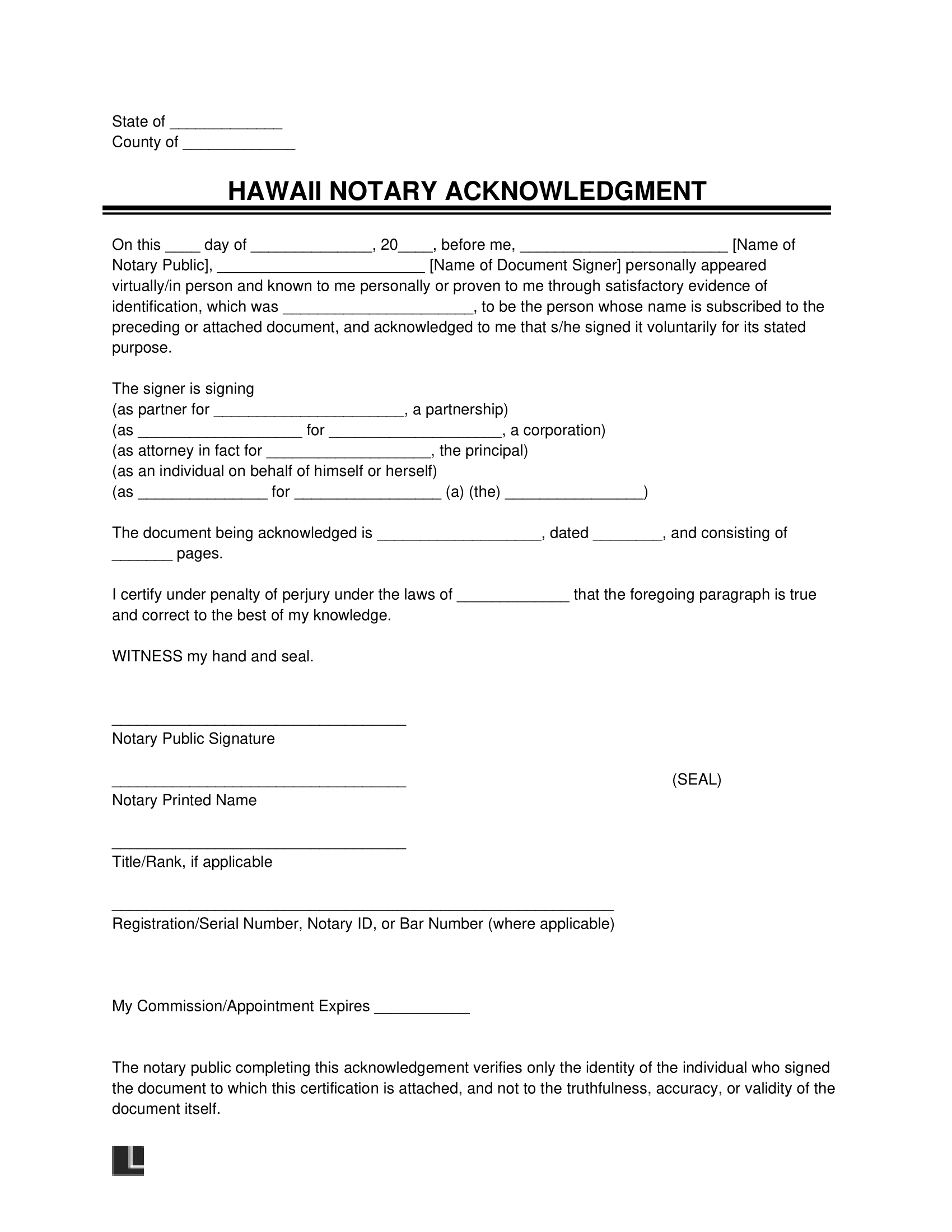
View a sample Hawaii notary acknowledgment form below to see understand the form is typically formatted. Use Legal Templates’s step-by-step questionnaire to quickly create and download yours in PDF or Word format.