What Is an Indiana Notary Acknowledgment?
An Indiana notary acknowledgment verifies a signer’s identity for legal or financial documents. A signer signs their legal document, such as a property deed, either prior to or in the notary public’s presence. Once in the notary public’s presence, the signer proves their identity via satisfactory evidence, which may include showing ID or knowing the notary public personally. Then, the signer attests that the signature is theirs and that they signed it willingly for the document’s stated purpose.
When completed properly, an Indiana notary acknowledgment form prevents fraud and improves the legal validity of certain documents. State law also upholds the integrity of the process, as a notary cannot notarize their own signature, their spouse’s, or any document where they have a financial interest (IN Code § 33-42-13-3).
Documents That May Require Notarization in Indiana
Sensitive legal documents often require notarized signatures to be considered enforceable. The following forms must have an Indiana notary acknowledgment to prove legal validity:
- Deed of reconveyance (IN Code § 32-21-2-3)
- Mortgage deed (IN Code § 32-21-2-3)
- Power of attorney (IN Code § 30-5-4-1)
Other documents may benefit from having a notarized signature. Consider a notary acknowledgment for the following forms for increased verification in Indiana:
Is Online Notarization Legal in Indiana?
Yes, as of July 1, 2019, online notarization is legal in Indiana under the Remote Notarization Act (33-42-17). This allows a notary to verify signatures online, provided all parties communicate via approved audio and video technology. Records of remote notarizations must be kept for at least 10 years (IN Code § 33-42-17-8).
Legal Considerations for Notarization in Indiana
Obtaining an acknowledgment in Indiana requires notaries to meet legal requirements. Consider the following elements to ensure a proper acknowledgment and valid notary processes.
- Notary term: Under IN Code § 33-42-12-1, Indiana institutes an eight-year term for notary publics. Renew notary status by reapplying, purchasing a notary bond, passing a course, and undergoing a criminal background check.
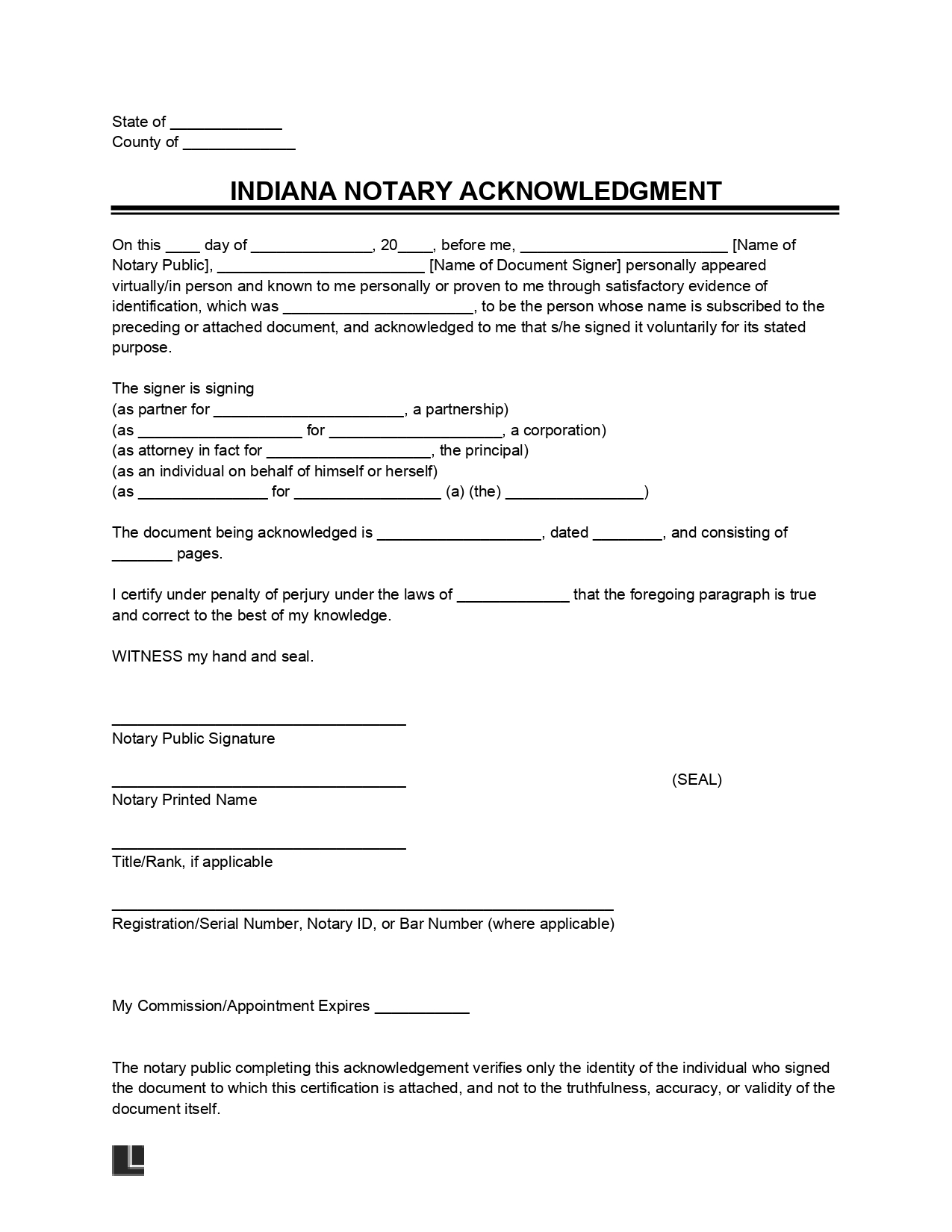
- Forms of acknowledgment: Per IN Code § 33-42-9-12, an acknowledgment must include a statement of voluntary signature, the signer’s name, and the acknowledgment date. It must also include the notary’s name, title, commission expiration date, signature, and seal.
- Notary handbook: The Indiana Notary Public Handbook governs the requirements for notaries in the state.
- Notary fees: Remote notarization may incur a $25 fee, and a notary may charge $10 per notarial act, plus the federal mileage rate for travel.
Sample Indiana Notary Acknowledgment Form
View a sample notary public acknowledgment in Indiana to better understand how the form is filled out. When you use Legal Templates’s guided form, you can customize your acknowledgment with the document being acknowledged, the date of the act, and who the signer is signing for. Then download the form in PDF or Word format so the notary public can correctly execute the rest of the document.