What Is a Maine Notary Acknowledgment?
A Maine notary acknowledgment form helps verify that an individual willingly signed a document. The notary completes the notarial certificate after confirming the signer’s identity. Under 4 ME Rev Stat § 1902, the signer must acknowledge that they signed the document for the purpose stated in the document.
A notary acknowledgment does not prove that the information in the document is correct. It only confirms two things:
- The signer personally appeared before the notary.
- The signer acknowledged that the signature is theirs.
Documents That Typically Require Notarization in Maine
In Maine, notary acknowledgments are commonly attached to important legal or financial documents, especially those that require proof of identity. Here are some common documents that typically require notarization:
Other documents may not strictly require notarization to be enforceable. However, a notary public’s signature can enhance the authenticity of your legal document. It can also help prevent questions about its legitimacy. Here are some common documents that may benefit from notarization:
Notary requirements may vary depending on the type of document and the receiving agency. Be sure to confirm the requirements before signing or submitting a document.
Legal Requirements for a Maine Notary Acknowledgment Form
Both the signer and the notary public need to follow certain guidelines when completing a Maine notary acknowledgment form. Here are some legal rules you should be aware of:
Certificate Language
Maine law provides approved language for an acknowledgment certificate. Your certificate of the notarial act should comply with the wording authorized by the state. As per 4 ME Rev Stat § 1916, the certificate should indicate:
- The state and county where the acknowledgment occurred.
- The person who is signing and who appeared before the notary.
- The date of acknowledgment.
- The notary’s signature and official title.
Legal Templates’s free Maine notary acknowledgment includes information required by Maine law. Our guided questionnaire helps you fill in your details quickly, and you can download your form as a PDF or Word file when you’re ready.
Personal Appearance
The signer must personally appear before the notary when completing the acknowledgment in Maine (4 ME Rev Stat § 1906). The notary public cannot issue the certificate without the signer’s appearance, as they must first verify the signer’s identity.
Identity Verification
The notary public should verify the individual’s identity before completing the certificate. Under 4 ME Rev Stat § 1907, they may confirm the identity of the signer through:
- Personal knowledge of the individual
- Government-issued identification, such as a passport or a driver’s license
- A credible witness who appears before the notary and can verify the signer’s identity
Individuals Unable to Sign
People with disabilities can direct another person to sign on their behalf. The notary public must note in the certificate that the signature was made at the signer’s direction. They can either state “signature affixed by (name of other individual) at the direction of (name of individual)” or use wording of a similar nature (4 ME Rev Stat § 1909).
Notary Signature and Seal
Once the acknowledgment is complete, the notary public must sign the certificate and affix their official stamp (4 ME Rev Stat § 1918). Maine law also requires the notary to include information about their office and authority.
Is Remote Online Notarization Legal in Maine?
Yes, Maine law allows notaries to perform notarizations remotely (4 ME Rev Stat § 1915). The signer can satisfy the personal appearance requirement by appearing before the notary through audio-visual communication. Remote notarization can be useful when the signer and notary are not in the same location. The notary public should still follow the requirements set by Maine law.
Maine law also recognizes notarizations involving electronic records. Before performing notarial acts on electronic records, a notary must notify the Secretary of State and use approved technology (4 ME Rev Stat § 1921).
Certain Remote Notarial Acts That a Maine Notary Public May Not Perform
While RON is legal in Maine for the most part, a notary public is not allowed to perform the following notarial acts remotely (4 ME Rev Stat § 1915):
- Witnessing the marking and sealing of an absentee ballot
- Administering an oath or affirmation to a candidate for office
- Administering an oath or affirmation to the circulator of a candidate petition
- Witnessing the signing of an application for a people’s veto referendum or the direct initiative of legislation
- Administering an oath or affirmation to the circulator of a people’s veto referendum or the direct initiative of legislation
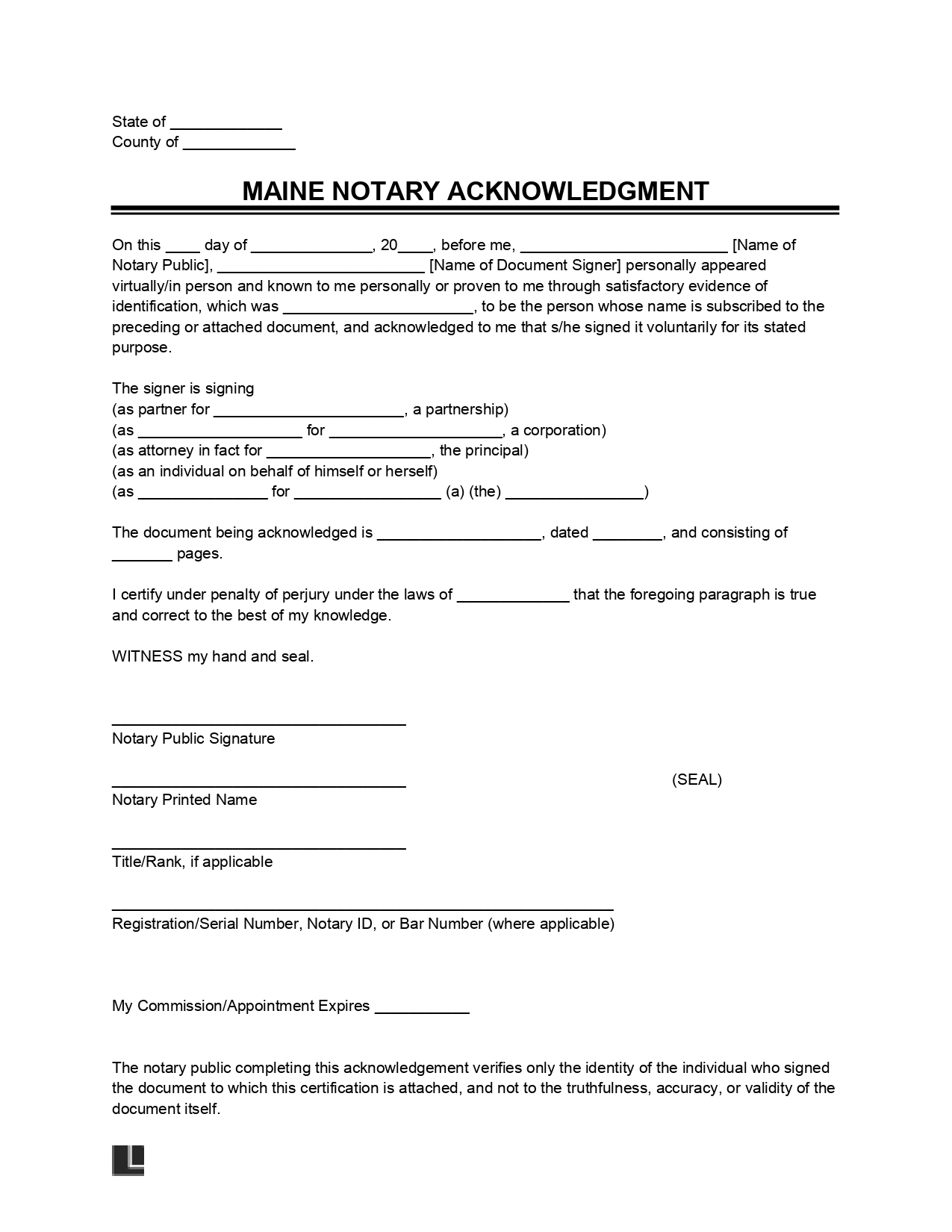
Sample Maine Notary Acknowledgment
See a sample Maine notary acknowledgment form below to see the information typically required to complete the certificate. Once you’re ready, use our step-by-step questionnaire to create yours, then download it as a PDF or Word file.