What Is a Maryland Notary Acknowledgment?
A Maryland notary acknowledgment is a certificate that confirms that a person signed the document willingly in the presence of a notary public. It is commonly attached to legal documents to verify the signer’s identity.
A notary public does not verify whether the document is true or legally valid. Their job is to simply confirm that:
- The signer personally appeared before them.
- The signer was properly identified.
- The signer acknowledged that the signature is theirs.
In Maryland, notary acknowledgments are recognized under the Maryland Revised Uniform Law on Notarial Acts (RULONA).
Documents That Typically Require Notarization in Maryland
Many legal and financial documents in Maryland require notarization before they can be filed or recorded. Common documents that require notarization in Maryland include:
Other documents that may require notarization in Maryland include:
- Bill of sale
- Promissory note
- Mortgage deed
- Deed of trust
- Prenuptial agreement
- Postnuptial agreement
- Warranty deed
- Minor travel consent form
If your document does not include a notary section, you will usually need to add one using a Maryland notary acknowledgment form. In some cases, the notary can just witness your signature, but most documents still require the correct form to be attached.
Legal Requirements for Maryland Notary Acknowledgment
Here are the legal requirements your notary acknowledgment must meet to be valid. Maryland updated its notary laws in 2020 to require specific wording on notary acknowledgment forms. You can use Legal Templates’s free template that meets these state requirements.
-
Required Elements of the Certificate: A Maryland notary acknowledgment form must include important information under MD State Government Code § 18-215, such as:
- The county where the notarization took place.
- The date of acknowledgment.
- The name of the person signing the document.
- A statement confirming the signer acknowledged the signature voluntarily.
- The notary public’s signature and seal.
- Personal Appearance Requirement: In Maryland, the signer must appear before the notary to acknowledge their signature (MD State Government Code § 18-208).
- Identity Verification: The notary must verify the signer’s identity using personal knowledge, a government-issued ID, or a credible witness (MD State Government Code § 18-206).
Is Online Notarization Legal in Maryland?
Yes. Maryland allows online notarizations, and notaries can perform remote notarizations using audio-visual communication technology under MD State Government Code § 18-214. This means the signer and notary can complete the notarization process remotely, rather than meeting in person. In order for online notarization to be valid in Maryland, the notary must:
- Verify the signer’s identity
- Use approved communication technology
- Keep a recording of the remote notarization session for at least 10 years
- Follow Maryland requirements for identity proofing, credential analysis, security, and record retention as per MD State Government Code § 18-220 – 223.
Note that Maryland does not allow remote notarization for wills and trust instruments.
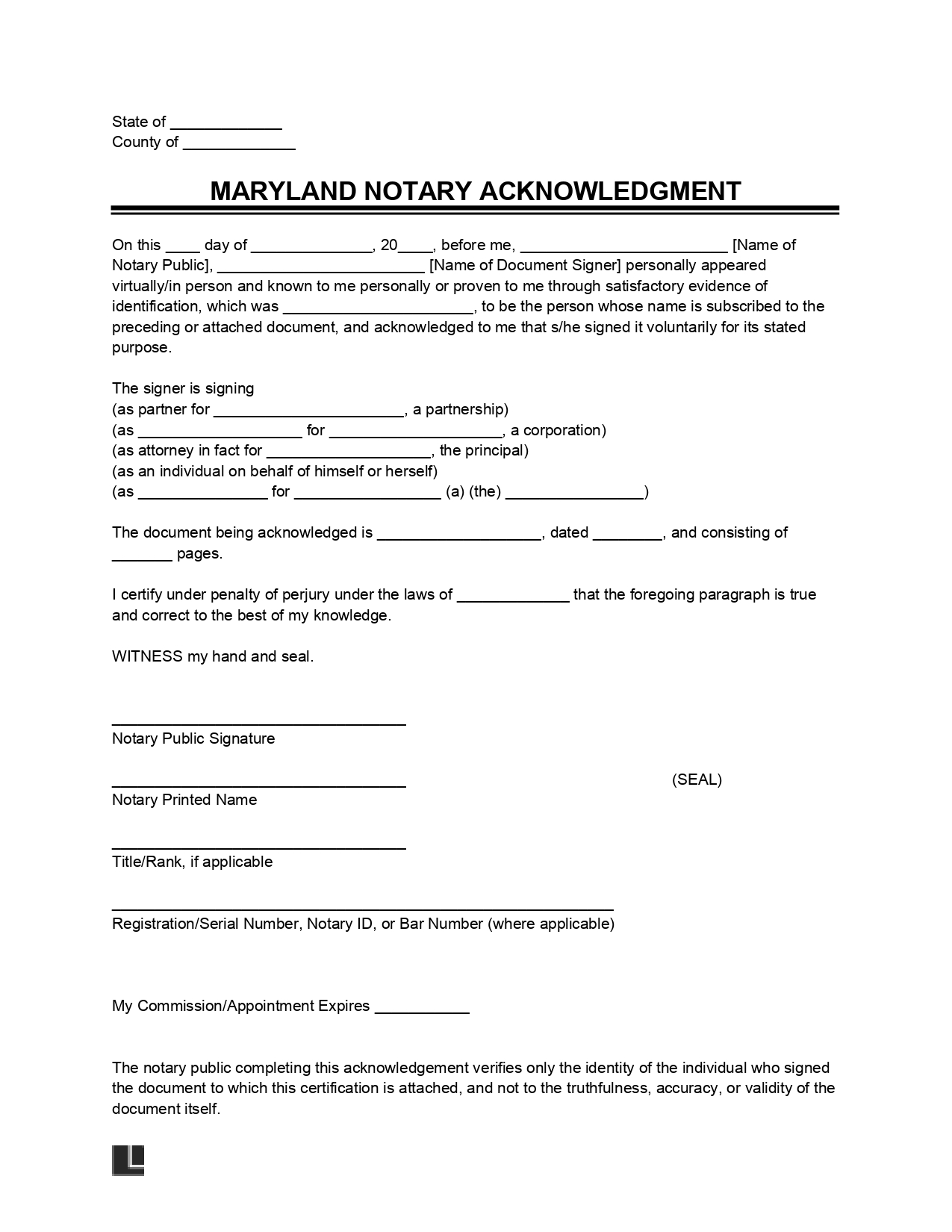
Sample Maryland Notary Acknowledgment
Take a look at a sample Maryland notary acknowledgment form below that shows what information is typically required for a valid acknowledgment. Once you’re ready, use our step-by-step questionnaire to complete and download yours in PDF and Word.