What Is a North Dakota Notary Acknowledgment?
A North Dakota notary acknowledgment is a certificate proving that a signer confirmed they signed a record for the purposes stated in it (ND Cent. Code § 44-06.1-01(1)).
That confirmation can apply to more than personal signatures. If someone signs for a business, trust, estate, or another person, the acknowledgment can also show they had authority to sign in that role (ND Cent. Code § 44-06.1-01(1), (4)).
Because the certificate proves the acknowledgment, it must stay with the right record. North Dakota law says the certificate must be part of, securely attached to, or logically associated with the record it acknowledges (ND Cent. Code § 44-06.1-14(6)).
What to Include in a North Dakota Notary Acknowledgment
A North Dakota notary acknowledgment needs enough detail to prove who appeared, what record they acknowledged, and which notary completed the act. Include:
- The notary location should include the state and county where the acknowledgment takes place (ND Cent. Code § 44-06.1-14(1)(c); § 44-06.1-19(1)).
- The signer’s full name should appear in the acknowledgment (ND Cent. Code § 44-06.1-19(1)).
- The ID method should show how the notary confirmed the signer’s identity, such as with a driver’s license, passport, government-issued nondriver ID, or another acceptable government ID (ND Cent. Code § 44-06.1-06(2)).
- The document details can include the document type, document date, and number of pages.
- The appearance method should state whether the signer appeared in person or by communication technology (ND Cent. Code § 44-06.1-05; § 44-06.1-13.1(2)).
- The acknowledgment date should show when the acknowledgment took place (ND Cent. Code § 44-06.1-14(1)(b); § 44-06.1-19(1)).
- The acknowledgment statement should say that the signer acknowledged the record before the notarial officer (ND Cent. Code § 44-06.1-19(1)).
- The notary’s name and signature should appear on the acknowledgment (ND Cent. Code § 44-06.1-14(1)(b)).
- The notary’s commission expiration date should be included (ND Cent. Code § 44-06.1-14(1)(e); § 44-06.1-19(1)).
- The notary stamp should be added when required (ND Cent. Code § 44-06.1-14(2)).
Missing details can weaken an acknowledgment or make it harder to rely on later. Legal Templates provides a North Dakota notary acknowledgment form with clear sections for the signer, document, location, and notary details.
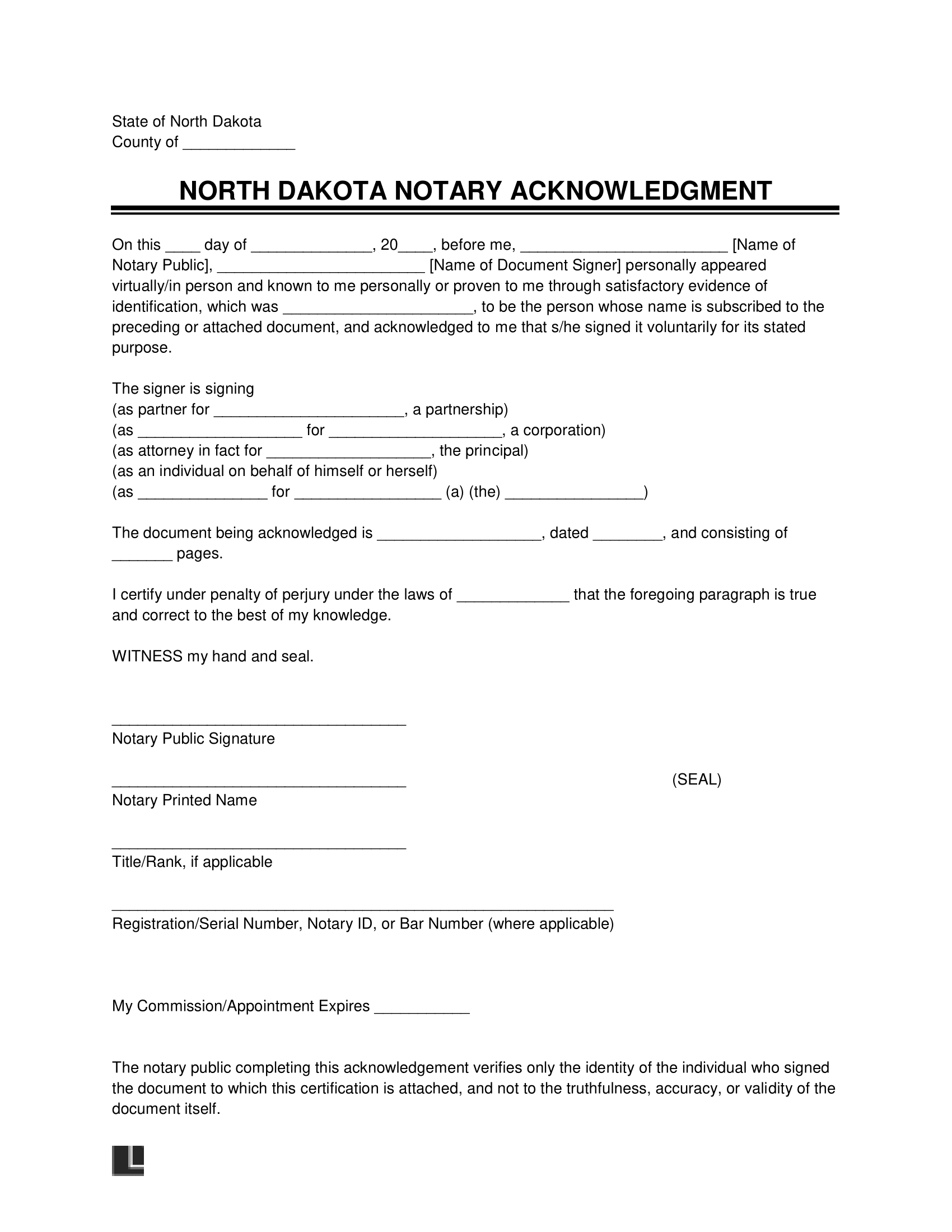
North Dakota Notary Acknowledgment Sample
Use the sample below to see what a completed North Dakota notary acknowledgment form looks like. It shows where the signer, document, location, date, and notary details appear. View the sample, customize the template, and download your form in Word or PDF.
Is Remote Online Notarization Legal in North Dakota?
Yes. North Dakota allows remote notarization. A signer can appear before a North Dakota notary public remotely instead of meeting in person (ND Cent. Code § 44-06.1-13.1(2)-(3)). North Dakota allows two remote options:
- Remote Online Notarization (RON): The signer appears remotely. The document is signed and notarized electronically.
- Remote Ink Notarization (RIN): The signer appears remotely. But the document is signed on paper with ink.
Both options have similar rules. The notary must verify the signer’s identity, confirm the document shown during the session is the one being signed, and use real-time audiovisual technology so both people can see and hear each other.
The notary also has to keep the required journal and audiovisual recording for 10 years. A signer’s identity can be confirmed through personal knowledge, a credible witness’s oath or affirmation, or at least two types of identity proofing.
If the acknowledgment is completed remotely, the certificate must say the notarial act was performed using communication technology (ND Cent. Code § 44-06.1-13.1(9)). Remote notarization isn’t the same as In-Person Electronic Notarization (IPEN). With IPEN, the signer appears in person and signs electronically. With RON and RIN, the signer appears remotely.
Documents That Typically Require Notarization in North Dakota
Some North Dakota documents need notarization before they can be accepted, recorded, or put into effect. This is especially common for documents that give someone legal authority, transfer real estate, or affect important personal or financial rights. Documents that commonly require notarization include:
- Durable power of attorney
- Non-durable power of attorney
- Limited power of attorney
- Real estate power of attorney
- Minor power of attorney
- Power of attorney revocation
- Warranty deed
- Quitclaim deed
- Living trust
Some documents can be valid without notarization, but a notary acknowledgment can make them feel more complete and formal. For important agreements, that extra step can be worth taking. Notarization is often recommended for: