What Is a Rhode Island Notary Acknowledgment?
A Rhode Island notary acknowledgment is a legal form attached to another document that confirms a signer’s signature. A notary public takes the signer’s acknowledgment to confirm that they willingly signed the document. A properly completed RI notary acknowledgment prevents fraud and ensures receiving organizations can confidently accept the executed document.
Before a signer goes before a notary public, it’s their job to recognize the need for notarization. A notary public may not recommend it to them.
Once the signer knows they need notarization, they should schedule an appointment and bring their legal document to the notary public. This fulfills the “personal appearance” requirement under state law.
They may sign the document in advance or at their meeting with the notary. If they don’t sign it in front of the notary, they must acknowledge their signature as their own. A notary public must verify a signer’s identity through personal knowledge or satisfactory evidence (RI Gen L § 42-30.1-6).
An RI notary acknowledgment form will be attached as a loose certificate to ensure the accepting organization knows that the notarization goes with the appropriate legal document.
What to Include in a Rhode Island Notary Acknowledgment?
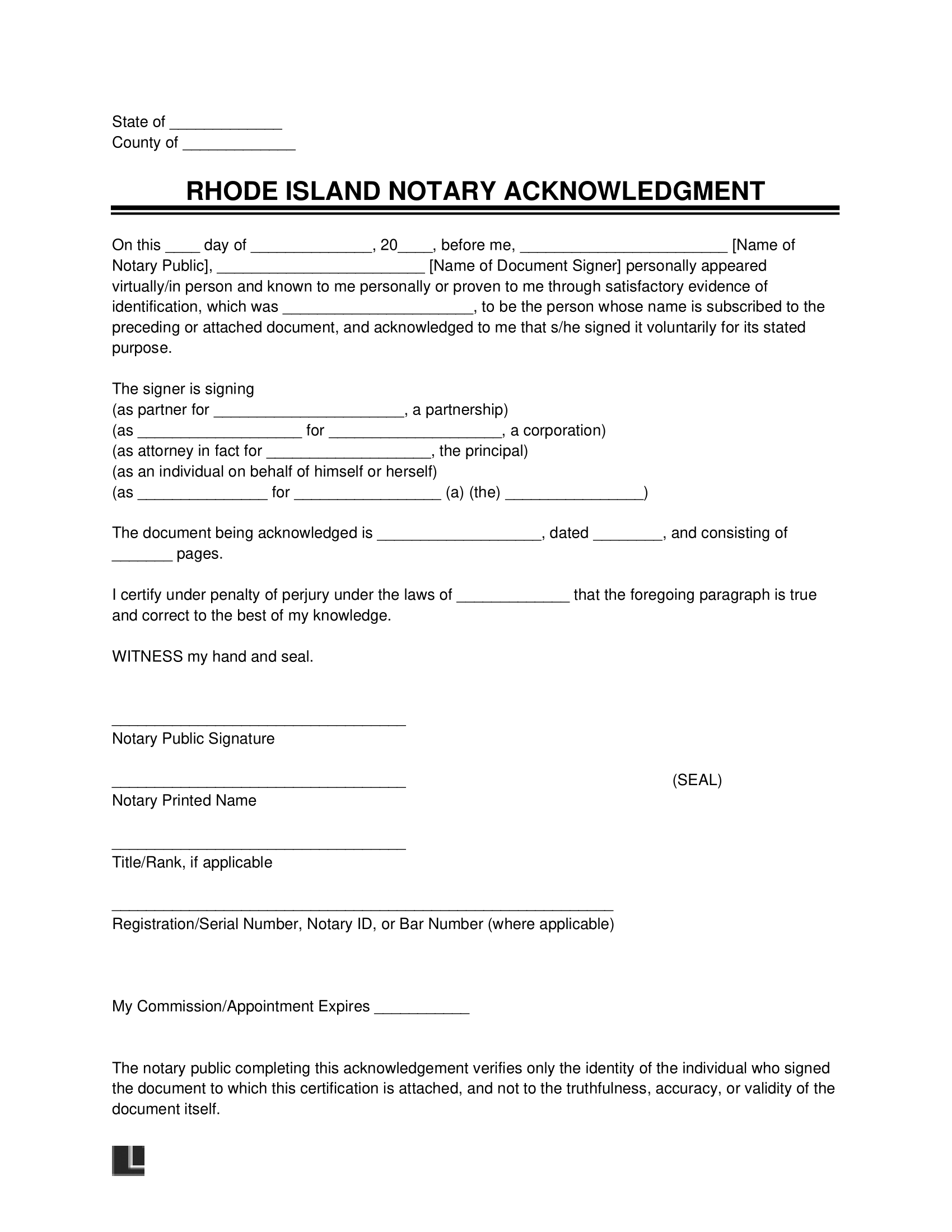
According to RI Gen L § 34-12-1, a Rhode Island notary acknowledgment does not need to be in any set form. It must only recognize that the notary knew all parties and understood they signed the document of their own free will. While there is no set form, you can review the typical elements in a Rhode Island notary acknowledgment form:
- The state and county where the acknowledgment occurred
- The date the acknowledgment was taken
- The notary’s official seal, which includes the words “Rhode Island,” “Notary Public,” and their name as it appears on their commission
- The notary’s commission expiration date
- The notary’s signature
- Authority verification (if the signer is signing on behalf of another person or entity)
What If the Signer Can't Physically Sign the Document?
If the signer can’t physically sign the document they want notarized, they can direct someone other than the notary to sign the document on their behalf (RI Gen L § 42-30.1-8).
Sample Rhode Island Notary Acknowledgment
View an example of our Rhode Island notary acknowledgment template to see how the notary takes the signer’s acknowledgment. It clarifies that the signer signed their own name and for the document’s intended purposes, not that the document’s contents are true or accurate.
Draft your own RI notary acknowledgment form using Legal Templates’s guided form. Then download it as a PDF or Word document and present it to a notary, who will take the acknowledgment.
Is Remote Online Notarization Legal in Rhode Island?
Yes. Two bills passed on June 30, 2022, Senate Bill 2705 and House Bill 7363, allow remote online notarization. The notary must be physically in Rhode Island when acknowledging the signatures, but the signer can be in a different state or country. If the signer is located outside the US, the legal document being notarized must pertain to a US affair (RI Gen L § 42-30.1-12.1).
The signer and the notary public must use state-approved RON technology. In general, it should include live audio-video communication, tamper-evident technology, and automatic digital journaling.
Because notaries can’t physically examine a driver’s license to verify identity, they must use a multi-layered process. This includes credential analysis and knowledge-based authentication.
The notary public must keep a record of the remote notarial act for at least 10 years. Also, they can charge no more than $25 for their services. The notary is required to notify the state commission prior to performing their first remote notarial act and must identify the type of technology they are using for remote notarization.
Does Rhode Island Allow Remote Ink Notarization?
Yes. Rhode Island allows Remote Ink Notarization (RIN) for paper documents. The signer must physically sign a paper document live on camera and mail the signed paper to the notary within 30 days. Furthermore, the notary must complete the physical notarial certificate and apply their traditional ink stamp.
Documents That Typically Require Notarization in Rhode Island
Legal documents related to property or legal authority may only be seen as legally complete and enforceable if they are notarized. Here are some examples of documents that typically need to be notarized in Rhode Island:
- Durable power of attorney
- Non-durable power of attorney
- Limited power of attorney
- Real estate power of attorney
- Minor power of attorney
- Power of attorney revocation
- Warranty deed
- Quitclaim deed
- Living trust
Even if state statutes don’t explicitly require notarization for certain documents, getting them notarized can still help prevent fraud and reassure a requesting organization that your signature is authentic. Consider getting a Rhode Island notary acknowledgment for the following documents: