What Is a Vermont Notary Acknowledgment?
A Vermont notary acknowledgment form is completed by a notary public to verify a signer’s identity and signature. It helps show that an individual:
- Appeared before a notary
- Signed the document willingly
- Confirmed the signature as their own
This document is often attached to important legal or financial documents. It can help add an extra level of verification, often required by government agencies, courts, or financial institutions.
In Vermont, a signer must appear before a notary public and acknowledge their signature under 26 VT Stats § 5367. It is important to understand that a notary acknowledgment only applies to the signatures. It does not verify the information in the document nor confirm its accuracy.
Documents That Typically Require Notarization in Vermont
Notarization requirements can vary based on the type of document and the organization requesting it. It’s always a good idea to check with the receiving party to confirm the notarization requirements. Doing so can help you avoid delays with recording or filing your documents.
In Vermont, deeds, mortgages, and other real estate documents typically require notarization before they can be recorded. Below is a list of common documents that typically require notarization in Vermont:
There are several other documents that may benefit from notarization in Vermont, as some receiving agencies may ask for a notarized signature before they accept a document. Common documents include:
Legal Requirements for a Vermont Notary Acknowledgment Form
A Vermont notary acknowledgment must meet certain state rules. To save time, you can use Legal Templates’s guided questionnaire to complete yours. Our form helps you comply with state laws and create a valid acknowledgment.
Certificate Wording
A Vermont notary acknowledgment should include a notarial certificate that a notary should complete. This certificate serves as an official record of the notarization. According to 26 VT Stats § 5367, the form should include the following information:
- The date of notarization
- The state and county where the notarization occurs
- The name of the signer
- A statement that the signer appeared before the notary public
- The notary’s signature
- The notary’s title and commission information
- The notary’s stamp or seal
Personal Appearance
The signer must appear before a notary public in Vermont to complete the acknowledgment. It helps the notary confirm the signer’s identity and ensure the signature belongs to the person named in the document (26 VT Stats § 5364).
Identity Verification
A notary public in Vermont must verify the signer’s identity before completing the certificate. Under 26 VT Stats § 5365, they may verify the signer’s identity through the following methods:
- Personal knowledge: This is where the notary knows the signer well enough already to be certain of their identity.
- Government-issued identification: A notary can verify the signer’s identity through official documentation, such as a driver’s license or a passport.
- A credible witness: A witness whose identity can be proven may confirm the signer’s identity under oath.
The notary public can always ask for additional identification if they believe that they need it to verify the identity of the signer.
Notary Signature and Stamp
The notary public must sign and affix their official stamp to the form after completing the certificate (26 VT Stats § 5367(b)). If an official stamp is used, it should be clear and easy to read so that it can be copied easily. The stamp should include the notary public’s name, jurisdiction, and commission number (26 VT Stats § 5369).
Signer Unable to Physically Sign
If a signer cannot physically sign the document, another person can sign on their behalf under 26 VT Stats § 5366. The signer must ask the person to sign on their behalf. Note that this person cannot be the notary public.
The notary is required to add specific wording indicating who signed in place of the signer and that the signer gave their consent. This can help show that the signer still approved the signature, even though someone else physically signed.
Is Remote Online Notarization Legal in Vermont?
Yes, Vermont allows remote online notarization. A signer who is not present in the same place as the notary can still complete the notarization using approved audio and video technology (26 VT Stats § 5379). The notary public should be able to see and hear the signer in real time (26 VT Stats § 5380). Vermont law also requires notaries to keep audio and video recordings of remote notarizations for at least 10 years.
While remote online notarizations may be allowed in Vermont, it is recommended that you check with the organization receiving the document, as they may have their own rules and regulations regarding notarizations.
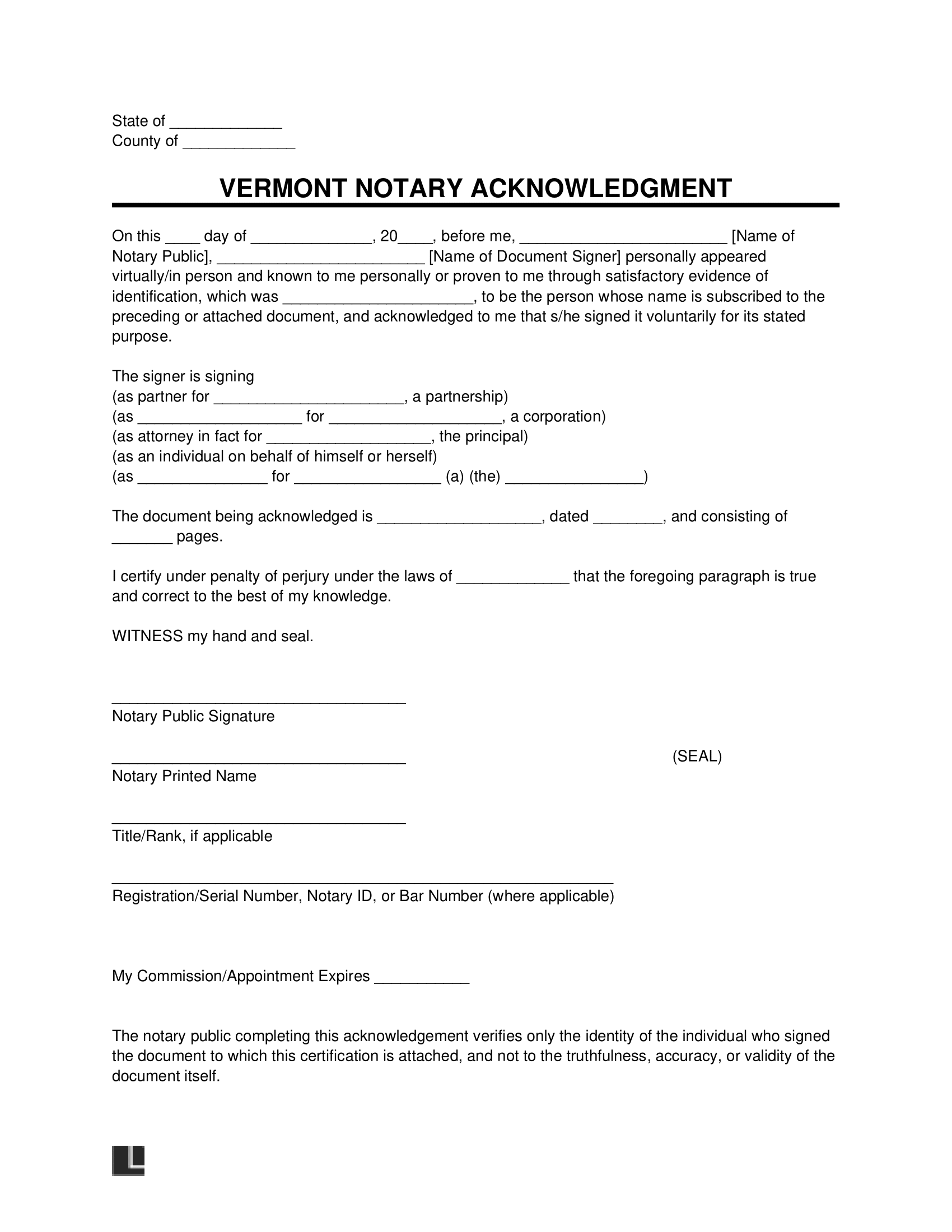
Sample Vermont Notary Acknowledgment
Review a sample Vermont notary acknowledgment form below. It shows you how the certificate is usually formatted and where the notary adds key details. When you’re ready, use our guided questionnaire to customize and create your own. You can download your completed form in PDF or Word format.