What Is a Pet Custody Agreement?
A pet custody agreement is a written agreement between people who share a pet and need to address care after a relationship change. Most often, that means separating or divorcing couples, but roommates or friends can also use one.
It explains who keeps the pet and who is responsible for care, so day-to-day life for the animal is clear. This usually includes where the pet lives, whether time is shared, how ongoing costs like food and vet visits are handled, and who makes medical decisions.
With these details agreed upfront, routine care is easier to manage. For example, the agreement can cover where the pet returns at the end of the day, who pays the vet bill, and who decides on treatment if something happens after hours.
Pet Custody Agreement vs. Pet Agreement
A pet custody agreement is typically used after a breakup or during separation, when clear rules are needed around who keeps the pet and who makes decisions.
A pet agreement or pet care agreement fits situations where people are still together and on the same page. Custody plans for disagreement, while pet agreements rely on trust and shared care.
When to Use a Pet Custody Agreement
A pet custody agreement makes sense when more than one person has a real claim to a pet’s care. It’s most useful once a shared living or caregiving arrangement ends and decisions about the pet need to be clearly defined. You may want to use a pet custody agreement if:
- A couple is breaking up, and both consider the pet to be theirs
- Friends or roommates are separating after sharing ownership, caregiving duties, or expenses
- A divorce or legal separation is underway, and both parties want to resolve pet arrangements privately
- Ownership is unclear because both people paid for care or acted as primary caregivers
- Both sides want to agree on shared custody or visitation, even though courts rarely order it
In these situations, a pet custody agreement helps set clear roles around care, costs, and decision-making while keeping the pet’s routine as stable as possible. Legal Templates makes it easy to create a clear, custom pet custody agreement you can use right away.
Pet custody agreements are becoming more common
- 97% of US pet owners consider pets part of the family
- 3 in 5 Americans would consider legal action to keep a pet after a breakup
- Nearly half of pet parents expect some form of shared custody, even though courts rarely order it
Who Gets Custody of a Pet After a Breakup? How Pet Custody Laws Work
In most cases, the pet goes to one person, not both. Courts usually decide this based on legal ownership and who paid for the pet’s care. In most states, pets are treated as personal property, even when owners see them as family. Emotional attachment alone rarely decides the outcome.
Judges focus on clear, practical evidence. This often includes adoption or purchase records, licensing, and who paid for food and vet care. Shared custody or visitation is rarely ordered.
A small number of states now allow courts to consider a pet’s well-being, starting with Alaska in 2017. Similar laws exist in California, Delaware, Illinois, Maine, New Hampshire, New York, Rhode Island, and Washington, DC Even in those states, judges are not required to order shared custody, and results can differ.
Courts also avoid managing visitation schedules or pet handoffs. In some cases, judges may look at where children live if they have a close bond with the pet, but ownership evidence still carries more weight.
Because these rules can feel rigid and uneven, many couples choose a written pet custody agreement. This keeps decisions about care, costs, and responsibility in the hands of the people involved, rather than a judge.
Verbal pet custody agreements often break down during or after a separation. They can also be difficult to prove or enforce if conflict increases. Without written terms, courts typically fall back on basic ownership rules. If you’re relying on a verbal agreement, it helps to understand when spoken agreements hold up legally.
What to Include in a Pet Custody Agreement
A pet custody agreement should focus on the everyday realities of caring for a pet once two people go their separate ways. Things like feeding schedules, vet visits, and who the pet goes home with at night matter more than broad promises. In practice, that usually means covering:
- Where the pet lives and who the pet stays with most of the time, including any shared time
- Daily care and costs, like food, grooming, training, and medications
- Vet and health decisions, including who chooses the vet and who approves treatment in emergencies
- Insurance and major bills, such as pet insurance and uninsured or emergency vet expenses
- Moves and travel, including whether one person can relocate with the pet
- Backup care, naming who looks after the pet if neither person can
- How disagreements are handled, including mediation, and which state’s law applies
Putting these details in one place helps keep the pet’s routine steady when everything else is changing. A clear pet custody agreement gives both parties defined roles while keeping the focus on the pet’s day-to-day care.
If someone else will step in to care for the pet, a pet sitting contract helps keep short-term care clear.
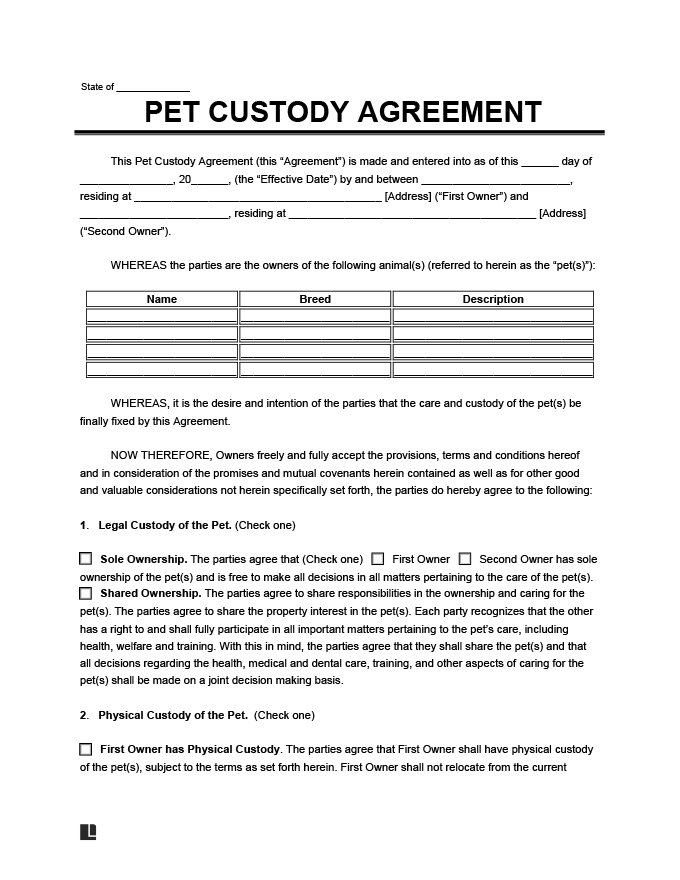
Pet Custody Agreement Sample
Start by reviewing a sample pet custody agreement. Then customise the template and download it in Word or PDF.