What Is a Vermont Minor (Child) Power of Attorney?
A Vermont minor (child) power of attorney is a legal document that allows a parent or legal guardian to name a trusted adult to help care for their child for a short period of time. This caregiver can help with tasks like medical appointments, school communication, and daily care.
Parents in Vermont use this form when they are unavailable due to:
- Military service
- Illness
- Travel
- Some other temporary issue
A (minor) child power of attorney document ensures that a responsible adult, whom the parents trust, is able to step in and take care of the child when needed. In Vermont, power of attorney documents are governed under the general Vermont Uniform Power of Attorney Act. The parent or legal guardian should clearly state what powers the caregiver has and when the authority begins and ends.
A temporary guardianship agreement may be a better fit if the caregiver needs more formal authority to care for the child. In Vermont, a parent or another person concerned about the child’s welfare can ask the Probate Division to appoint a guardian under 14 VT Stats § 2623.
Legal Requirements for a Minor (Child) Power of Attorney in Vermont
A minor’s power of attorney in Vermont must meet certain requirements to be valid. To save time, you can use Legal Templates’s free form to get started. It complies with state laws and can be customized in minutes. Here are the key requirements you should know before creating the document.
Who Can Create the Form?
A child power of attorney in Vermont can only be created by a parent or a legal guardian of the child. The person creating the form should have legal authority to make decisions on behalf of the child. The document should also clearly list the powers they want to hand over to the caregiver for the time period that they are away.
Who Can Be Named as a Caregiver?
The caregiver can be any trusted adult who can care for the child during the temporary arrangement. Parents often choose a grandparent, close relative, or family friend. The caregiver should be responsible, available, and comfortable handling the child’s daily needs.
Should a Vermont POA be Signed and Notarized?
Yes, the parent or legal guardian should sign the form for it to be valid. If both parents share custody, both must sign. A Vermont minor power of attorney should also be notarized. Under 14 VT Stats § 4055, a signature is presumed genuine if it is acknowledged before a notary public or another authorized officer.
Notarization can also help schools, doctors, and other third parties confirm that the parent or legal guardian indeed authorized the temporary authority. You can use a free Vermont notary acknowledgment to complete this process.
How Long Does a Vermont Minor POA Form Last?
Vermont law does not set a specific time limit for a minor (child) power of attorney form. The parents or a legal guardian should include a clear start and end date to specify when the powers begin and end. This clarification can also help third parties relying on the form understand exactly when the caregiver’s authority begins and expires.
Revoking a Vermont Minor (Child) Power of Attorney
Only a parent or a person with legal authority over the child can revoke a Vermont minor power of attorney. The revocation should be in writing so that third parties know the authority has ended and there is a clear record.
Vermont’s general power of attorney law also recognizes revocation as one way a power of attorney can end under 14 VT Stats § 4010. If a parent or legal guardian ends the minor POA this way, they should keep a copy for their records and give copies to all parties relying on the original form.
You can use a free revocation form to cancel a minor power of attorney in Vermont.
Sample Vermont Minor (Child) Power of Attorney
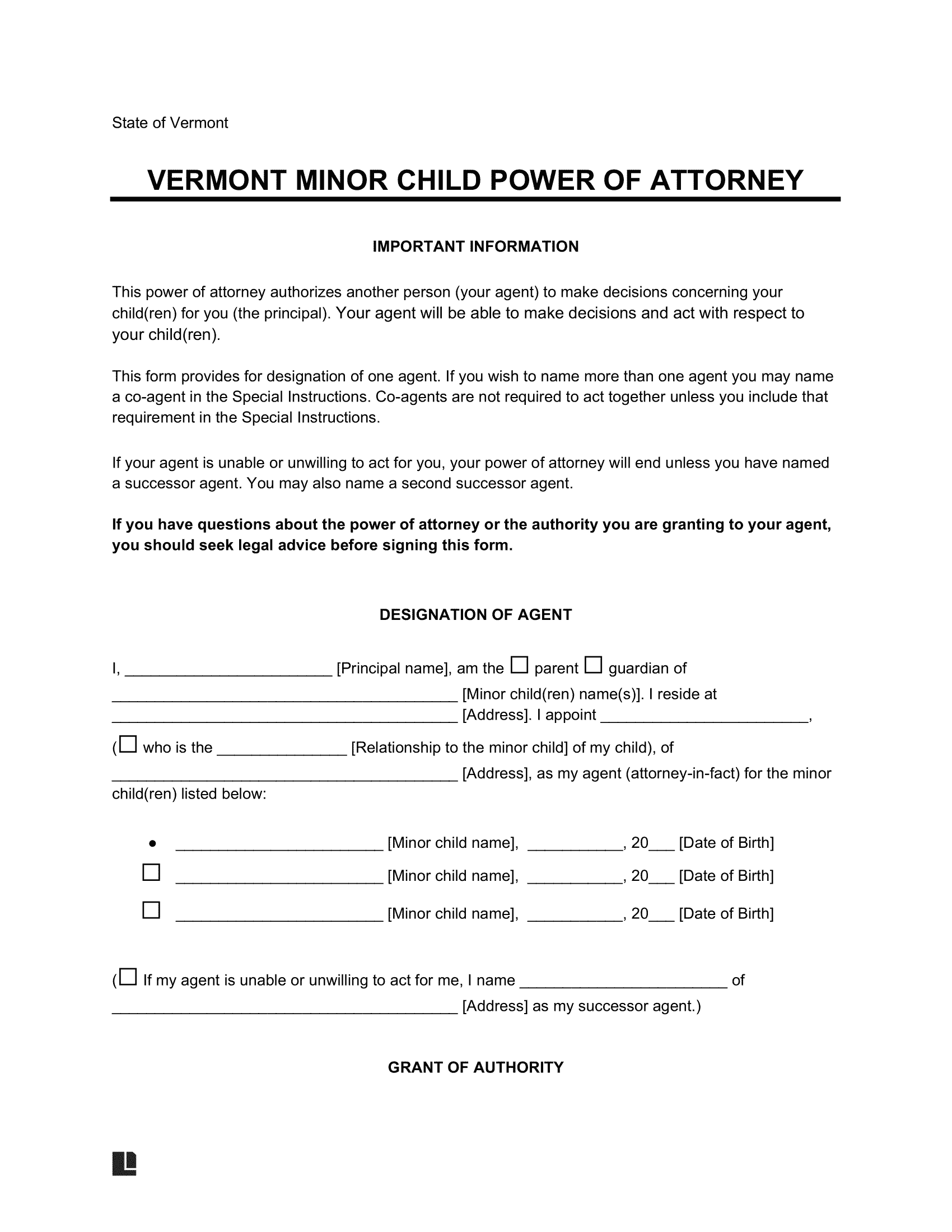
Take a look at the sample Vermont minor (child) power of attorney below to understand how you can name a trusted caregiver and hand over temporary authority. When you’re ready, use our step-by-step questionnaire to create and download your form in PDF or Word format.