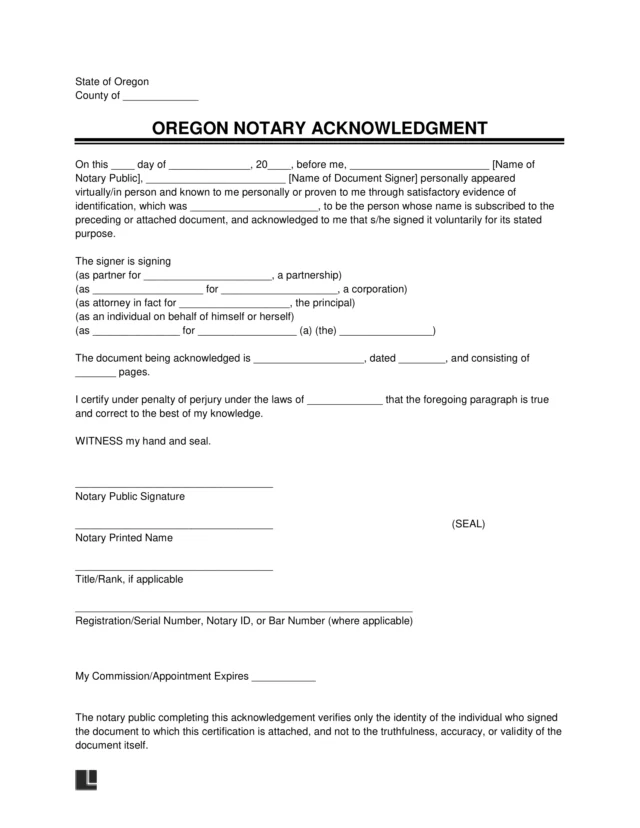
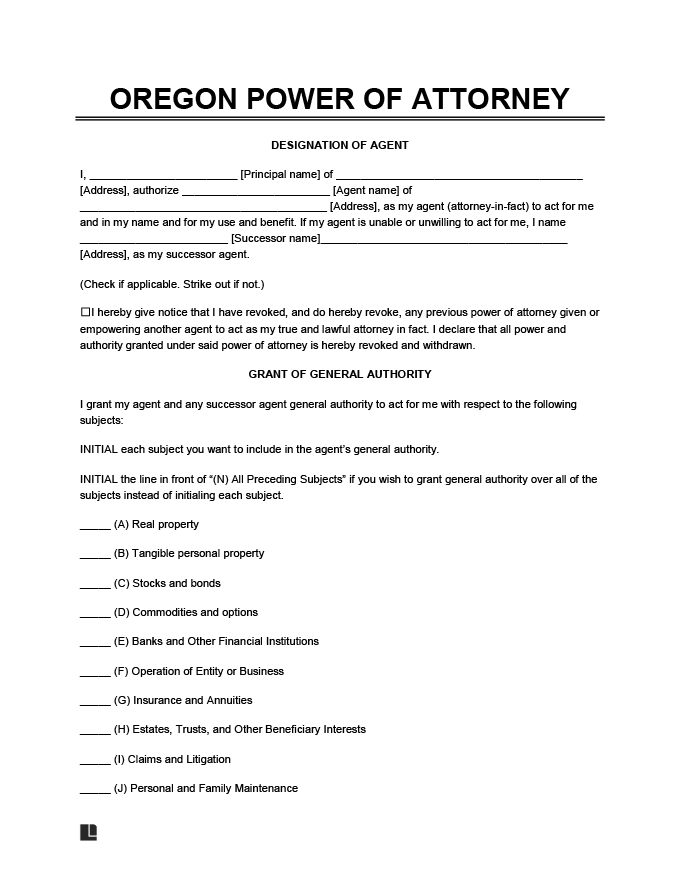
What Is an Oregon Power of Attorney?
An Oregon power of attorney is a legal document that grants someone else the authority to act on behalf of another person. This document allows the person granting the authority to choose another individual to make important decisions for them, including matters related to medical treatment, finances, or the care of a child. The principal outlines the terms for the agent who represents them. The principal must be at least 18 and competent when making this document.
With Legal Templates’s free Oregon power of attorney forms, you can add the terms that work for you. Use our form to outline your agent’s authorities and protect your interests.
Types of Powers of Attorney in Oregon
An Oregon power of attorney agreement can take many forms. By tailoring the durability and purpose of your document, you can create a document that meets your specific needs. Understand the following types of power of attorney in Oregon to define your agent’s authorities.
Durable vs. Non-Durable
Any POA can be made either durable or non-durable. A durable power of attorney allows the agent to exercise authority even after the principal’s incapacitation. In a non-durable arrangement, the principal’s incapacity triggers the end of the agent’s abilities.
Per OR Rev Stat § 127.005(1)(c), all POAs are considered durable unless stated otherwise. If you don’t want the agent to act during your incapacity, include specific terms stating your contract as non-durable.
Financial
A financial power of attorney gives your agent authority to represent your financial interests and handle your monetary assets. Select any or all of the following financial powers for your agent:
- Accessing bank accounts
- Handling personal property
- Managing real property
- Filing tax documents
Medical
A medical POA, more often called a form appointing a health care representative, gives the agent authority over the agent’s treatment decisions. Typically, the principal uses this agreement to ensure the agent honors their wishes if they become incapacitated. You can authorize your agent for the following health care powers:
- Refusing/consenting to treatments
- Hiring/firing caretakers
- Accessing medical records
- Deciding on pain treatments
This document can serve as an advance directive in Oregon to detail the principal’s end-of-life care preferences. It can also be combined with other instructional healthcare forms, such as a living will or DNR.
Durable (Financial)
Use if you want your POA to remain in force even after you've become incapacitated.
Signing Requirements: Principal only (ORS 127.005(1)(a)).
Medical
Give legal authority to your caregivers to follow specific care guidelines should you become incapacitated.
Signing Requirements: Two witnesses or a notary public. (§ 127.515(2)(b)).
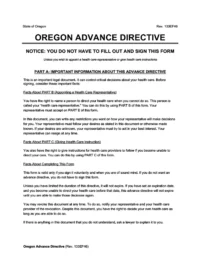
Advance Directive
Use when you want to appoint another to make health care decisions on your behalf if you cannot make them for yourself.
Signing Requirements: Two witnesses or a notary public. (§ 127.515(2)(b)).
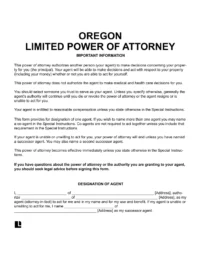
Limited (Special)
If you don't want your agent or proxy to have sweeping powers to manage your affairs, you can restrict them to a set of tasks.
Signing Requirements: Not specifically mentioned but notary or witness is recommended (ORS 127.005).
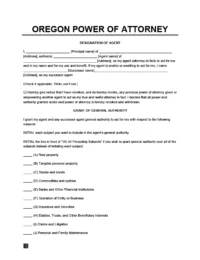
Non-Durable (General)
Provides sweeping powers to the agent to manage your affairs.
Signing Requirements: Principal only (ORS 127.005(1)(a)).
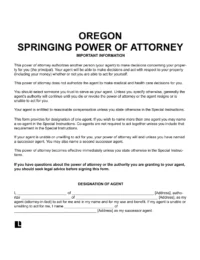
Springing
Comes in effect at a time in the future, and only when a specific event occurs (such if the principal becomes incapacitated).
Signing Requirements: Not specifically mentioned but notary or witness is recommended (ORS 127.005).
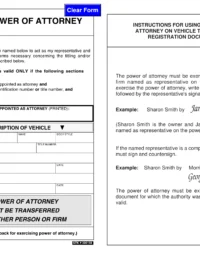
Vehicle (Form 735-500)
Gives an agent the capacity to manage your affairs only where they relate to motor vehicles.
Signing Requirements: Principal only.
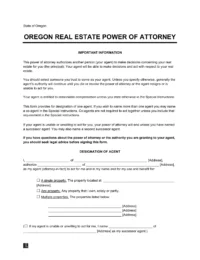
Real Estate
Assigns an agent the role of overseeing the principal's property transactions.
Signing Requirements: Notary public.
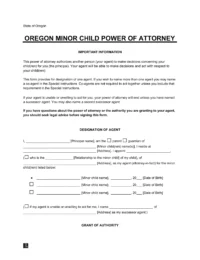
Minor (Child)
Endows provisional care responsibility for a child's health and education.
Signing Requirements: Notary public.

How to Write a Power of Attorney for Oregon
In Oregon, writing your power of attorney helps you outline your agent’s duties. Create an effective POA with the following steps:
- Name the parties involved: Add the principal’s and agent’s full legal name and address. Also include any successor agents when applicable.
- Grant general authority: Select the general authorities for your agent. General powers include accessing bank accounts, hiring caretakers, and handling personal property.
- Select specific powers: Note any agent authorities requiring particular statements. For example, the agent may need to give a special permission statement for power over gifts, trusts, and insurance beneficiaries.
- Set the effective date: Per OR Rev Stat § 127.005, a POA is effective at the time of signing, unless stated otherwise. You can also provide a specific date or event to trigger the agent’s powers.
- Finalize and sign: Review the terms and powers in the POA. Once satisfied, the principal should sign and date the document and fulfill the necessary notarization or witness requirements.
Oregon Power of Attorney Requirements & Legal Considerations
When enacting a power of attorney in Oregon, it’s crucial to meet the legal requirements. Understand the following aspects of Oregon’s POA laws and the factors for validity.
Notarization
Per OR Rev Stat § 127.005, a general POA does not require formal notarization; however, it is highly recommended that your form be acknowledged. Notarization increases the enforceability of your agreement and makes it easier for the affected institutions to validate your agent’s ability.
Other types may have additional notarization or witness requirements. For example, a medical POA requires notarization or two witnesses under OR Rev Stat § 127.515(2)(b). In addition, a real estate POA must be notarized, per OR Rev Stat. §93.670
Filing
Oregon POAs don’t need to be officially filed according to state laws. If the agent wishes to exercise authority for real estate transactions, it must be filed with the county recorder’s office where the property is located. In addition, the affected banking or medical institutions will ask for a copy of the agreement to verify the agent’s abilities.
Revocation
When the terms of the POA no longer work or apply, the agent’s powers of attorney may be terminated. Per OR Rev Stat § 127.015, the following scenarios revoke the agent’s abilities:
- Principal death or incapacity: Depending on the durability of your agreement, the agent’s powers end at either the incapacity or death of the principal.
- Principal or court revocation: If the principal no longer wants the POA to apply, they can create and deliver a written revocation to the agent. The courts may also revoke the arrangement if they feel the agent is no longer fit to serve. When the agent receives this notice, they no longer have the authority provided in the POA.
- Agent death or incapacity: If the appointed agent passes away or becomes incapacitated, their power of attorney ends. If there are named successor agents, they may take over the agent’s duties.
- POA terms for revocation: The original terms may include a specific purpose for the arrangement. Once the agent has fulfilled this purpose, the POA provides that their powers end.
- Divorce or annulment: If the principal’s spouse works as their agent, any action filed for the dissolution or annulment of the marriage will end their powers, unless the terms of the agreement provide otherwise.